Most of us know that Franklin D. Roosevelt was a serious stamp collector. Few of us know just how active he was in selecting stamp subjects and approving final designs. I will relate a few true FDR stories over the next few days/weeks.
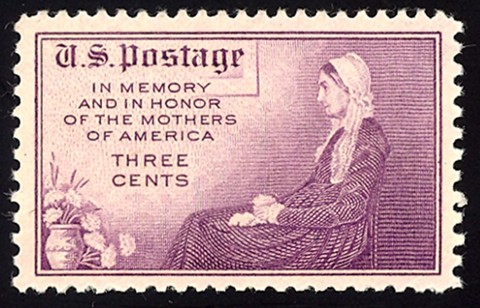
In 1933 it was suggested to FDR that a stamp be issued to celebrate the 100th anniversary of artist James Whistler's birth. He agreed wholeheartedly and wrote the Postmaster General James A. Farley and asked him about the feasibility of producing a stamp representing the famous painting "Whistler's Mother." He even went so far as to prepare a possible design which he presented to Farley during a meeting. It was decided that FDR's sketch would be used both as a tribute to Whistler and to the "Mothers of America," but when it came time to produce the stamp the Bureau of Engraving and Printing decided that FDR's design would leave too much empty space on the left side of the stamp.
A controversial decision was made to cut the feet off of the mother in the portrait, and to add a vase of flowers in the lower left corner. Many thought the vase looked like a cuspidor and/or that alteration of the painting was tantamount to mutilating the artist's original painting.
The furor raised over the design of the stamp, though negative in nature, actually resulted in a much larger initial sale of the issue than was normal. It was at this point that Farley realized that publicity, even negative publicity, was good for business – a point taken by future postal administrators. As Farley realized just how well this issue was selling, he ordered a second printing of 15 million stamps to supplement the original printing of 190 million. The second printing was by the flat-plate process instead of the rotary-plate process, and as a result, there were two separate Scott numbers assigned. It is easy to tell the difference as the original printing was perforated at 11 x 10.5 and the second printing at 11 x 11.
The first sheet of the Mother's Day stamp, printed on April 13, 1934 was presented by Farley to Eleanor Roosevelt. The official first day of issue was May 2, 1934, but despite severe warnings to Post Masters across the U.S., first use covers are known from April 23rd and April 26th.





 Posted 02/16/2009 7:38 pm


 yes Phil that's another way to look at it,so now I'll just sit back and absorb as much as I canregards Harry


