Stamp Community Family of Web Sites
Thousands of stamps, consistently graded, competitively priced and hundreds of in-depth blog posts to read


Stamp Community Forum
 
Username:
Password:
Save Password
Forgot your Password?

This page may contain links that result in small commissions to keep this free site up and running.

Welcome Guest! Registering and/or logging in will remove the anchor (bottom) ads. It's Free!

Opinions For This 2 Cent Washington

Next Page    
 
To participate in the forum you must log in or register.
Author Previous TopicReplies: 16 / Views: 7,611Next Topic
Page: of 2
Valued Member
United States
240 Posts
Posted 10/16/2014   9:13 pm  Show Profile Bookmark this topic Add Gar to your friends list Get a Link to this Message
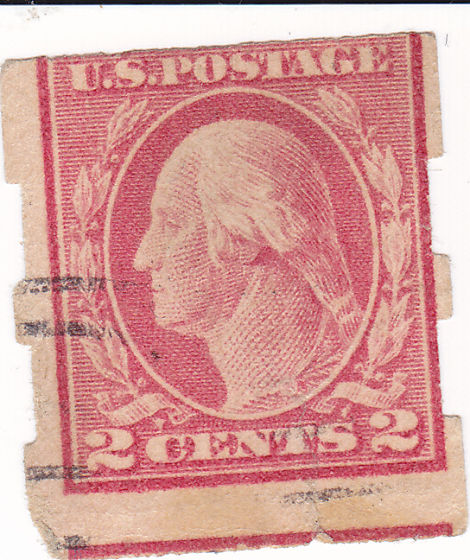
Hi all, How can I really determine if this is a type 1 or 1A. It has no watermark.Some of the characteristics are like the type 1 and some like the type 1A. I would appreciate any help please. Respectfully, Gary

Send note to Staff

Pillar Of The Community
United States
937 Posts
Posted 10/16/2014   9:43 pm  Show Profile Bookmark this reply Add Historical DNA Collector to your friends list  Get a Link to this Reply
Looks like a type I to me.

From this site:

http://1847usa.com/washfrank/2cT1_3...1_03main.htm

Only areas 3 and 4 differentiate the two. I know that there are other methods, but I don't have them memorized.
Send note to Staff  Go to Top of Page
Valued Member
United States
240 Posts
Posted 10/16/2014   9:51 pm  Show Profile Bookmark this reply Add Gar to your friends list  Get a Link to this Reply
Thanks DNA Collector.
Send note to Staff  Go to Top of Page
Pillar Of The Community
United States
937 Posts
Posted 10/16/2014   10:13 pm  Show Profile Bookmark this reply Add Historical DNA Collector to your friends list  Get a Link to this Reply
You're very welcome Gar. I've confused myself before by looking at the other characteristics that don't specifically pertain to these two versions.

Hopefully someone else will chime in to confirm and/or detail the other methods.

-EDIT: missed an "in"
Send note to Staff  Go to Top of Page
Edited by Historical DNA Collector - 10/17/2014 12:05 am
Pillar Of The Community
United States
1756 Posts
Posted 10/16/2014   11:18 pm  Show Profile Bookmark this reply Add disi123 to your friends list  Get a Link to this Reply
Brother Gary... here's the secondary
link from the main link kindly provided
by DNA... if you save this one, you'll
always have the quickest reference to
differentiate...

http://1847usa.com/washfrank/2cT1_3/2cA04.htm

Randall
Send note to Staff  Go to Top of Page
Pillar Of The Community
United States
1414 Posts
Posted 10/16/2014   11:26 pm  Show Profile Bookmark this reply Add cfrphoto to your friends list  Get a Link to this Reply
The toga button on a type Ia is prominent enough to be visible with the naked eye. The rest of the design is generally stronger also helping the stamp to have a stronger appearance. The most common shade is a deep rose, but other shades exist. Because some type I stamps exist on the otherwise type Ia plate 10208, the shade or color cannot be used as a definitive test. Some may confuse the strong toga button seen on most offset varieties (types IV - VII), but the toga button will have a unprinted area inside the button outline and will generally have more unprinted areas than the a type Ia. Plating marks consisting of a partial second line in the right or left ribbon is also generally visible on a type Ia stamp. Nicely printed single line watermark stamps like 406 or 409 show no trace of a second line whatsoever. A common mistake is to confuse a 409 with Schermack perforations with the exceedingly rare type Ia 482A.

I examined a 482A for the APEX Expertizing Committee when a couple of expertizers questioned whether the stamp was really a type Ia. It was clear to me that it was. Once you learn to recognize a type Ia, it should be easy to spot other examples. I have found more than 80 perforated examples in Washington/Franklin mixes over the last few years.

Clark
Send note to Staff  Go to Top of Page
Edited by cfrphoto - 10/16/2014 11:28 pm
Valued Member
United States
240 Posts
Posted 10/17/2014   01:52 am  Show Profile Bookmark this reply Add Gar to your friends list  Get a Link to this Reply
Randall and Clark, I appreciate all that info.Thank you. Basically I put all my Washington/Franklin's away because I became very frustrated with the identification of all the different types. Someone told me I would have more patience as I grew older, what a lie. Anyway, I have always received great info out here. Hopefully I will be able to help others like I've been helped. Respectfully, Gary
Send note to Staff  Go to Top of Page
Pillar Of The Community
United States
6661 Posts
Posted 10/17/2014   07:33 am  Show Profile Bookmark this reply Add stallzer to your friends list  Get a Link to this Reply
I love the 1847USA site, the description for the type 1A and type II are exactly the same so how is one supposed to tell the difference between the two ?
Send note to Staff  Go to Top of Page
Valued Member
United States
240 Posts
Posted 10/17/2014   08:11 am  Show Profile Bookmark this reply Add Gar to your friends list  Get a Link to this Reply
Howdy Stallzer, OK that's it back in the box.
Send note to Staff  Go to Top of Page
Pillar Of The Community
United States
1414 Posts
Posted 10/17/2014   09:34 am  Show Profile Bookmark this reply Add cfrphoto to your friends list  Get a Link to this Reply

Quote:
I love the 1847USA site, the description for the type 1A and type II are exactly the same so how is one supposed to tell the difference between the two ?


Aside from some significant differences like the lock of hair above George Washington's ear, type Ia stamps are from flat plate printings and type II are rotary press coils or coil waste (rare). Visually, rotary press printings look quite different than flat plate. Lines are thinner and more sharply defined. Rotary press stamps are taller or wider than flat plate examples. While nominally, gauging at 10, coil perforations were applied with a bar perforator and must be aligned side to side on a horizontal coil or top to bottom on a vertical coil. Perforations are 10-80 compared to the flat plate 10-79.

An effective way to understand Washington/Franklins is to study the business problem facing the Bureau of Engraving and Printing. Business demand for stamps was increasing at a rapid rate. Quality control was a major problem. Private vending coil producers were starting to compete and required coils suitable for high speed affixing machines. The Bureau started selling imperforate sheets to allow vending machine companies to prepare their own coils with private perforations.

The Bureau experimented with higher rag content paper in an attempt to reduce shrinkage creating the "bluish paper" varieties. Next the Bureau changed from double line to single line watermark paper in the hope that it would be less fragile. In response to private vending machine companies, the Bureau started producing coils hand assembled from strips of 20 perforated in one direction and cut in the other by a specially equipped perforating machine. The process was very labor intensive.

A project to produce coil stamps more efficiently ultimately resulted in the Stickney rotary press. initially, only the coiling equipment was available. Production of single line watermark flat plate coils was switched to the new coilers. Sheets perforated in one direction were cut in half and pasted up in rolls ten stamps wide. The new coilers proved to be more efficient, but perf 8 1/2 replace perf 12 when the rolls were found to be too fragile. Quality of sheet stamps continued to be an issue.

Design changes in 1912 were intended to reduce confusion between look-alike stamps and to comply with UPU requirements for numeric denominations. Plate layout changes were made to attempt to reduce waste. Uneven vertical plate spacing (3 mm and 2 mm) was replaced with slightly wider uniform spacing. Perforations of sheet stamps were changed from 12-66 to 10-79 to improve durability and flat plate coils were changed from 8 1/2 to 10-79 at the same time.

Finally, when rotary presses were ready, coil stamp production was switched over. Some issues with printing quality of 2 and 3 cent coils resulted some strengthening of design elements and new type II and finally type III for 2 cent dies were produced. Meanwhile, the Bureau continued to experiment with sheet stamp perforations. A perforator was equipped with perf 11-72 wheels and a short run of 2 cent stamps was produced while single line watermark paper was still in use. While deemed successful, perf 10 stamps continued to be produced until the pins wore out. Meanwhile, use of watermarked paper was abandoned, resulting in some perf 10 unwatermarked stamps before perf 11 became the norm.

The World War I period was a time of desperation. Supplies of ink were disrupted causing significant plate wear and other quality problems. The type II die was applied to 3 cent flat plate stamps in 1918. The type Ia 2 cent experiment was related to an attempt to use a five or ten subject transfer roll. As an interim step to increase stamp production, 3 cent, 1 cent and later 2 cent stamps were printed using offset presses. In order to have a satisfactory product, design elements were strengthened resulting in types III and IV for the 3 cent and types IV, V, Va, VI and VII for the 2 cent.

After the end of the wartime disruption, stamp production at the Bureau returned more or less to normal, but producing enough stamps remained a problem. A larger Stickney rotary press for sheet stamps was placed into production resulting in the perf 10 x 11 Scott 542 and later the perf 10 x 10 Scott 543. While plates were made for 2 cent rotary sheet stamps, they were not placed in use. While the rotary presses were more efficient, they created a lot of waste that could not be effectively stripped into coils. A decision was made to cut up coil waste into perforated sheets. Sheets perforated in one direction by the bar perforator were perforated in the other direction using flat plate perforators. Imperforate sheets were perforated in both directions. This process continued through the transition from the Third Bureau Washington/Franklin designs into the beginning of the Fourth Bureau issue period.

Some imperforate waste from printing sheet stamps were also processed through flat plate perforators resulting in the rare Scott 544, 596 and 613. For many years, Scott misattributed these stamps as vertical coil waste, clearly impossible for the 2 cent Harding. Another odd variety was the perf 10 on one side resulting from replacing a section of pins on a perf 11 wheel with some nominally perf 10 pins.

An eye trained by experience can spot the differences between flat plate and rotary stamps without using a magnifier.

Clark
Send note to Staff  Go to Top of Page
Pillar Of The Community
United States
937 Posts
Posted 10/17/2014   09:44 am  Show Profile Bookmark this reply Add Historical DNA Collector to your friends list  Get a Link to this Reply
stallzer, areas 6,7, and 9 do differentiate between Ia, and II. Area 9 seems the most definitive and easiest to pick out.
Send note to Staff  Go to Top of Page
Pillar Of The Community
United States
937 Posts
Posted 10/17/2014   09:48 am  Show Profile Bookmark this reply Add Historical DNA Collector to your friends list  Get a Link to this Reply
Clark, I hadn't noticed that the type II only exist on rotary prints. That makes it pretty easy.

Thank you for typing out that wall of text. It's a great wealth of information that I'll commit to memory.
Send note to Staff  Go to Top of Page
Edited by Historical DNA Collector - 10/17/2014 09:49 am
Valued Member
United States
240 Posts
Posted 10/17/2014   11:06 am  Show Profile Bookmark this reply Add Gar to your friends list  Get a Link to this Reply
Now that my Wash/Frank are back in the box, I'm gonna start checking my Canadian stamps. Please tell me you mean computer memory?
Send note to Staff  Go to Top of Page
Pillar Of The Community
United States
937 Posts
Posted 10/17/2014   11:17 am  Show Profile Bookmark this reply Add Historical DNA Collector to your friends list  Get a Link to this Reply
"commit to memory" was not the best choice of words. Perhaps, read multiple times and memorize key points?
Send note to Staff  Go to Top of Page
Valued Member
United States
240 Posts
Posted 10/17/2014   11:31 am  Show Profile Bookmark this reply Add Gar to your friends list  Get a Link to this Reply
Send note to Staff  Go to Top of Page
Pillar Of The Community
United States
6661 Posts
Posted 10/26/2014   8:56 pm  Show Profile Bookmark this reply Add stallzer to your friends list  Get a Link to this Reply

Quote:
stallzer, areas 6,7, and 9 do differentiate between Ia, and II. Area 9 seems the most definitive and easiest to pick out.


?? I have no clue what you are referring to. I clicked on the link that Disi123 posted, http://1847usa.com/washfrank/2cT1_3/2cA04.htm

The descriptions given for the types I listed above are identical. I realize it is just describing the Toga button but it just amuses me a bit.

Type 1a;

The lines in the toga button are well defined and sharp. In particular, the top outline of the toga button is complete. This is a defining feature of the Type Ia stamp.

Type II;

The lines in the toga button are well defined and sharp. In particular, the top outline of the toga button is complete. This is a defining feature of the Type II stamp.
Send note to Staff  Go to Top of Page
Page: of 2 Previous TopicReplies: 16 / Views: 7,611Next Topic  
Next Page
 
To participate in the forum you must log in or register.

Go to Top of Page

Disclaimer: While a tremendous amount of effort goes into ensuring the accuracy of the information contained in this site, Stamp Community assumes no liability for errors. Copyright 2005 - 2026 Stamp Community Family - All rights reserved worldwide. Use of any images or content on this website without prior written permission of Stamp Community or the original lender is strictly prohibited.
Privacy Policy / Terms of Use    Advertise Here
Stamp Community Forum © 2007 - 2026 Stamp Community Forums
It took 0.34 seconds to lick this stamp. Powered By: Snitz Forums 2000 Version 3.4.05