| Author |
 Replies: 9 / Views: 2,762 Replies: 9 / Views: 2,762 |
|
|
Valued Member
48 Posts |
|
|
the stamp pictured to the left is 2cent type one , rotary press?. its perf 11 on all sides witch is throwing me off . cant find it in catalouge except for the one that says offset. I dont think its offset it measures 19x22.5. I put it next to an offset example. 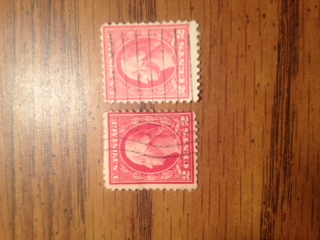 |
|
Send note to Staff
|
|
|
|
|
Pillar Of The Community
United States
937 Posts |
|
|
Hello Fireman451, good username! There are a few Type I perf 11 stamps in that series. In the picture that you posted, the bottom one that has a more deep red color looks like a flat plate stamp. It's impossible for me or others to know for certain with such a small picture. The Scott catalog isn't the easiest thing to use to look for varieties. Try this site: http://1847usa.com/1908WashingtonIdentifier.htm |
Send note to Staff 
|
Ryan = HDNAC = DNA = HDC = Hysterical DNA Collector = Historical DNA Collector = me who just loves stamps :) |
| Edited by Historical DNA Collector - 12/09/2014 8:47 pm |
|
|
Valued Member
48 Posts |
|
|
Thank you . I'm pretty sure it's a type 1 or 1a . It measures 22.5 in height x 19 width . Perf 11. One next to it is the offset print . |
|
Send note to Staff
|
|
|
Pillar Of The Community
United States
578 Posts |
|
|
Regardless of your measurements, it doesn't have the "rotary press" look. Most likely a common Scott 499 IMO. |
|
Send note to Staff
|
|
|
Pillar Of The Community
United States
937 Posts |
|
|
Measuring a stamp may or may not help in identifying it. Stamps can shrink or expand due to many things.
However, I just measured a bunch of "2 cent" offset printed Washington's and found them all to be significantly smaller than flat plate printings.
What are you using to measure your suspect stamp? Are you using a very accurate device AND using it correctly? It's not always easy to do. Do you have a known rotary print stamp that is "tall" that you can compare it to?
By looking at the link that I sent you earlier, there are no stamps that are perf 11 that are 22.5 mm tall that are recognized by the Scott catalogue. An unrecognized variation is always a possibility, but the likelihood is very, very, very low. So, double, triple, and quadruple check your suspect stamp to see if it is a simple error in measurement.
If you post a scan of it next to a known flat plate or rotary printed stamp, then we can help you identify it. 600 dpi at a minimum, 1200 dpi preferred. |
|
Send note to Staff
|
Ryan = HDNAC = DNA = HDC = Hysterical DNA Collector = Historical DNA Collector = me who just loves stamps :) |
|
|
Valued Member
48 Posts |
|
|
Thank you. I will post more about this tommorow. It might be offset . I don't know . These Washington franklins drives me crazy lol |
|
Send note to Staff
|
|
|
Pillar Of The Community
United States
578 Posts |
|
|
The stamp in question appears to be perf 11, appears to be engraved, appears to be flat plate, the toga rope doesn't appear to be strong enough to be type Ia (and it doesn't appear to be a shade known on type Ia's.) I think there's a very good likelihood (99%) that it's Scott 499. A better scan/picture would be helpful though. |
|
Send note to Staff
|
|
|
Pillar Of The Community
United States
937 Posts |
|
|
srailkb, I agree. By posting a scan or at least a much better quality image, then we can know with even more certainty. Fireman451 has expressed that he has difficulty with the W/F series, so it could also help us to help him to learn the differences. |
|
Send note to Staff
|
Ryan = HDNAC = DNA = HDC = Hysterical DNA Collector = Historical DNA Collector = me who just loves stamps :) |
|
|
Valued Member
48 Posts |
|
|
Valued Member
48 Posts |
|
| |
Replies: 9 / Views: 2,762 |
|



 Posted 12/09/2014 7:42 pm


