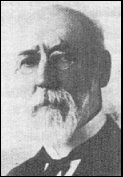
John Walter Scott
(November 2, 1845 – January 4, 1919) New York City
Scott was called "The Father of American Philately" in his lifetime. His first interest in stamp dealing began around 1860 in his native London. It continued in 1863 when he came to New York City. In 1865 he went to California seeking gold but had no success. He returned to New York City in 1867 and resumed his stamp business.
During the next two decades he became America's leading stamp dealer. In 1868, he began publishing the American Journal of Philately, the first important stamp journal in the U.S. That same year he helped support the first U.S. stamp club, the New York Philatelic Society (the second in the world).
From June 1867 to August 1868, Scott issued fifteen monthly one-page price lists. In September 1868, he issued his first catalog: A Descriptive Catalogue of America and Foreign Postage Stamps, Issued from 1840 to Date. This was the first "Scott Catalog", although Scott counted his first fifteen one-page lists and called the September 1868 issue as his "Sixteenth Edition". Scott's Catalog soon became the most important catalog in the United States.
On May 28, 1870, in New York City, Scott organized the first stamp auction ever held. Two years later he opened a branch in London and organized his fifth auction there. The sale, held March 18, 1872, was the first stamp auction held in Europe. In 1882, for his 42nd sale, he sold (for ten cents) a photographic plate of some of the most valuable stamps in the sale. It was the first time an auction catalog contained photographic illustrations.
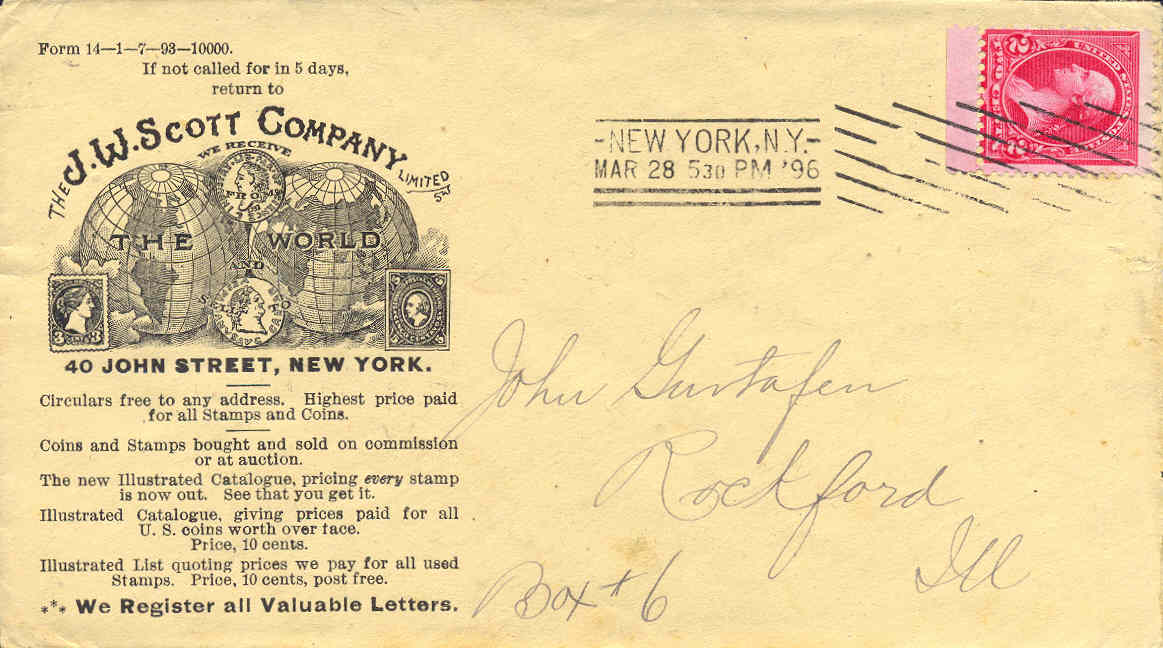
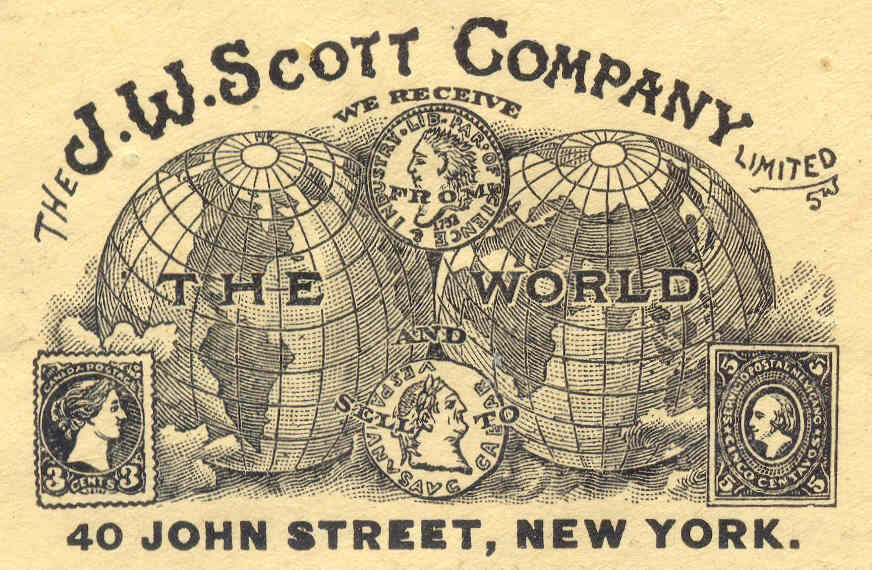
In December 1885 Scott sold his name, his catalog and his stock to the Calman brothers, who renamed it the Scott Stamp and Coin Company. Scott remained a minority partner in the business, and continued to edit the catalogs and new journal, The American Journal of Philately (Second Series) until 1889. At that time he sold his interest to the brothers and re-entered the stamp business as J.W. Scott and Co., Ltd.
The Calman brothers sued Scott for using the name "Scott," and after a celebrated legal battle, the New York Superior Court ruled that he had a legal right to use his own name in his business. Scott quickly rebuilt his reputation as a leading stamp dealer and auctioneer. He published and edited the important journal, The Metropolitan Philatelist, from 1890 to 1915.
On September 25, 1895, Scott issued his first J.W. Scott & Co., Ltd. Weekly News Letter, a folio-sized single-sheet described as "a private and confidential communication to the 100 leading amateurs of America." This first philatelic "insider newsletter" continued until May 1, 1897.
Scott also issued during 1897 a more widely distributed weekly, John W. Scott's Junior Weekly Letter, later called John W. Scott's Weekly Bulletin.
Scott was an organizer of the first important philatelic exhibition in the U.S. This took place in 1889 at the Eden Musée in New York City; Scott wrote the catalog and was the major exhibitor. He was an active supporter of stamp clubs in Brooklyn, Manhattan and Staten Island. Scott permanently retired as a stamp dealer in 1917, after seeing his business become the most successful in the U.S. He held 120 stamp auctions, including the first one held anywhere, the first auction catalog with illustrations, and the first auction to sell a stamp at above $1000.
He was a founding member of the Collectors Club of New York (1896), serving in many positions, including president in 1910. He catalogued its philatelic library (Catalogue of the Philatelic Library of the Collectors Club (1917)). He was also a member of the American Philatelic Association (now the APS), holding many positions, including Trustee. He was the APS President (1917-1919) when he died.
In an 1890 poll by The Philatelist (NY) (Vol. 2, No. 4, June 16, 1890), Scott was named "The most prominent philatelist," winning over John K. Tiffany in a "glorious victory for the 'Great and only Scott'."
from the
APS Hall of Fame biographies.





 Posted 02/28/2009 12:03 am




 yes,with the great deal.


