| Author |
 Replies: 20 / Views: 5,914 Replies: 20 / Views: 5,914 |
|
Pillar Of The Community
United States
2948 Posts |
|
|
Still struggling with the W/F type ID's. With the stamp below, I'm seeing what I think are a combination of types. I'm using the 1847USA site. Left ribbon not sure Right ribbon looks Ia Toga rope type I Toga button not sure Right ribbon middle type Ia Line under the ear type I curve of the mouth not sure Locks of hair shading type I or Ia Laurel berry type I, Ia or II Not sure if the pictures below will be good enough to see what I think I'm seeing. But obviously I'm not seeing thing correctly. Any thoughts on the stamp below? 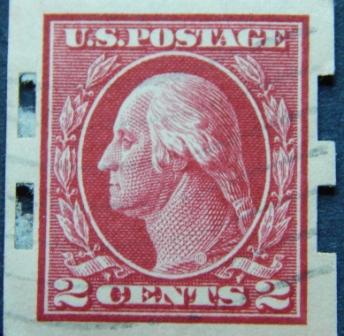 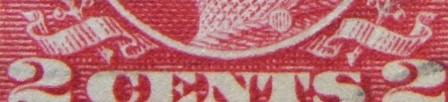 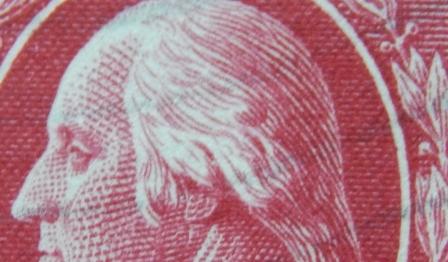 |
|
Send note to Staff
|
| Edited by stampcrow - 01/12/2015 7:20 pm |
|
|
|
|
Pillar Of The Community
United States
937 Posts |
|
|
Knowing where to start when identifying W/F isn't always apparent. It gets easier and quicker with practice. For this stamp, we can see that it has private perforations (non-tooth like). We can also see from your close up image that the line detail (look at the horizontal straight lines) is thick which means that it is a flat plate printing.
Then take a look at the "Private Perforations" section located at the right side of 1847.com's index page. Your stamp's perforations match up with Schermack Type III perforations. That section details flat plate printings with those perforations as existing on #409, 482, and 482A. The #409 and 482 are type I printings.
The #482A is Type Ia printing and is cataloged at a value of somewhere around $60,000. It's unlikely, but you'll never find one if you don't look for it. Looking at your stamp I see that the lines of the toga button are at least somewhat well defined, but the top line of the toga rope is not well defined at all. Also the lines of the toga rope itself are not consistent from top to bottom. To further kill the possibility of it being Type Ia is that the Ia is deep rose in color while your stamp appears to be carmine, though what I'm seeing on my end may not represent what you have in front of you. Also, the Type Ia was printed at a very high pressure which gives the #482A a distinctive "bold" appearance. This can be seen by reviewing the results of a power search at Siegel for catalog #482A.
So that leads me to believe that you have either a #409 or 482. The main difference between the two is the presence or not of a single line watermark. Going by color, yours is most likely a #409, but I haven't stared at enough of these two types to say anything more definitive. |
Send note to Staff 
|
Ryan = HDNAC = DNA = HDC = Hysterical DNA Collector = Historical DNA Collector = me who just loves stamps :) |
| Edited by Historical DNA Collector - 01/12/2015 7:50 pm |
|
|
Pillar Of The Community

United States
1273 Posts |
|
|
Have you checked for a watermark? Its not a Ia--design elements are too weak, I think. Probably a #409 but could be #482. #482 is usually, but not always, a "weaker" less defined impression and having a color a bit more toward a rosier carmine color, but again, not always. #409 is watermarked and #482 is not, as you probably already know. The illustrations your looking at for the types are good to help make determinations--if only all the printed stamps of each type would strictly adhere to the illustrations....but they don't always (at least to my thinking), which does make it harder sometimes to determine just what you have. I still struggle with it sometimes. Hope this helps.  Ryan beat me to an answer. |
|
Send note to Staff
|
| Edited by Al E. Gator - 01/12/2015 7:58 pm |
|
|
Pillar Of The Community
United States
937 Posts |
|
|
Dave, I'm glad that you chimed in. You make an important point by highlighting that each printing type doesn't strictly adhere to any explanations nor depictions. You also seem to know the color variations of the Washington Franklins much better than I. In the end, the more heads involved, the better. I image that experts such as Clark and/or Bill Weiss could present even further information, though identification of the stamp here now relies on a "simple" watermark test. Single line watermarks can be quite frustrating to identify. |
|
Send note to Staff
|
Ryan = HDNAC = DNA = HDC = Hysterical DNA Collector = Historical DNA Collector = me who just loves stamps :) |
|
|
Pillar Of The Community
United States
2948 Posts |
|
|
Thanks guys. I'm soaking the stamp now and will check for a watermark.
The color in person, does not look like, what I think, the rose would look like. But, I have never seen it. I choose this stamp because I thought it was a nice flat plate image to work with. But I started seeing what I thought were Ia characteristics.
What I'm hearing is, first from DNA, the Ia would be "bold". That sounds like, there would be little doubt. And second from Al, the types like a I, II or III do not adhere exactly 100% to what I might see as examples given. So...it's a matter of fitting as many pieces together as possible. ie watermark.
|
|
Send note to Staff
|
| Edited by stampcrow - 01/12/2015 8:25 pm |
|
|
Pillar Of The Community
United States
937 Posts |
|
|
Quote:
So...it's a matter of fitting as many pieces together as possible. Yep, that's how many of the type determinations of the W/F go. It takes time to learn which characteristics should be looked for, then making a determination based on observations pointing stronger towards one type versus another. It gets easier with practice, then you find a stamp where the cancel is in the way.  |
|
Send note to Staff
|
Ryan = HDNAC = DNA = HDC = Hysterical DNA Collector = Historical DNA Collector = me who just loves stamps :) |
|
|
Pillar Of The Community
United States
2948 Posts |
|
|
I believe I can see the watermark on this stamp.
I just recently picked up my first bottle of Ronsonol lighter fluid. Thanks to suggestions from members here. It works!
It helps that the wavy line cancel is very lite. The hook of the S is much sharper.
So it would seem I have a very nice example of a 409 Schermack perforation III.
Thanks for taking the time on this.
|
|
Send note to Staff
|
|
|
Pillar Of The Community
United States
1273 Posts |
|
|
Ryan, use the search link and search "In a quandary on this Washington 2c"--it will be the first one that is listed. Go down into the comment and find the comment by "Tipzi". Then use the search link again and search "546 listed as 500". Again, find "Tipzi"s comments. I know him and he's quite knowledgeable--lives not far from me. If I knew how to just post the links in this post I would have done that to keep you from searching, Sorry. If you can access it, some good articles on the type Ia: 1.)"What Color are Type IA 2-Cent George Washington Stamps?" 1995 Vol.66 No.8-- 2.) "The 2c Washington Type Ia Identifier---Its "Partial Line" by S. Richard Prothero, M.D. 1998 Vol.69 No.2 ---and 3.) "Scott #482A: Type Ia Washington-Franklin by Steven Belasco 1992 Vol.63 No.10. All these are in the United States Specialist journals that can be accessed on the USSS web site, www.usstamps.org. If you can not access them, e-mail me. |
|
Send note to Staff
|
| Edited by Al E. Gator - 01/12/2015 9:03 pm |
|
|
Pillar Of The Community
United States
1414 Posts |
|
|
The stamp is probably a 409 as indicated by the relatively clean impression and brighter color. Some collectors may confuse a clean 409 impression with 482A despite differences that will be immediately apparent using a perforated type 1a Scott 500 as a reference. Watermarking will settle the 409 or 482 issue. The stamp cannot be a 482A because it lacks traces of a second line in the right or left ribbon. The partial lines are sometimes called plating marks because they can be used to help identify the position on the multi-subject type Ia transfer rolls. Normal type I stamps were laid down on plates using a normal single subject transfer roll.
It should be possible to find the article by Dr. Richard Prothero in the USSS online archives of the "United States Specialist." Non-members may have more difficulty accessing the article. Joining the United States Stamp Society is relatively inexpensive and has many benefits outweighing the modest cost.
Clark |
|
Send note to Staff
|
| Edited by cfrphoto - 01/13/2015 09:54 am |
|
|
Pillar Of The Community
United States
937 Posts |
|
|
Clark, thank you for the further information. Quote:
The stamp cannot be a 482A because it lacks traces of a second line in the right or left ribbon. The partial lines are sometimes called plating marks because they can be used to help identify the position on the multi-subject type Ia transfer rolls. Is the converse true that if a stamp exhibits some "plating marks" in the left or right hand ribbon, then it ccoule be a 482A? From what you stated earlier, this seems to be true that the "plating marks" are helpful but are not definitive. In my example below, I see a very minor remnant of a second line in the right hand ribbon. It is barely representative of some of the 482A examples on Siegel. This stamp's attributes are somewhat ambiguous to me: 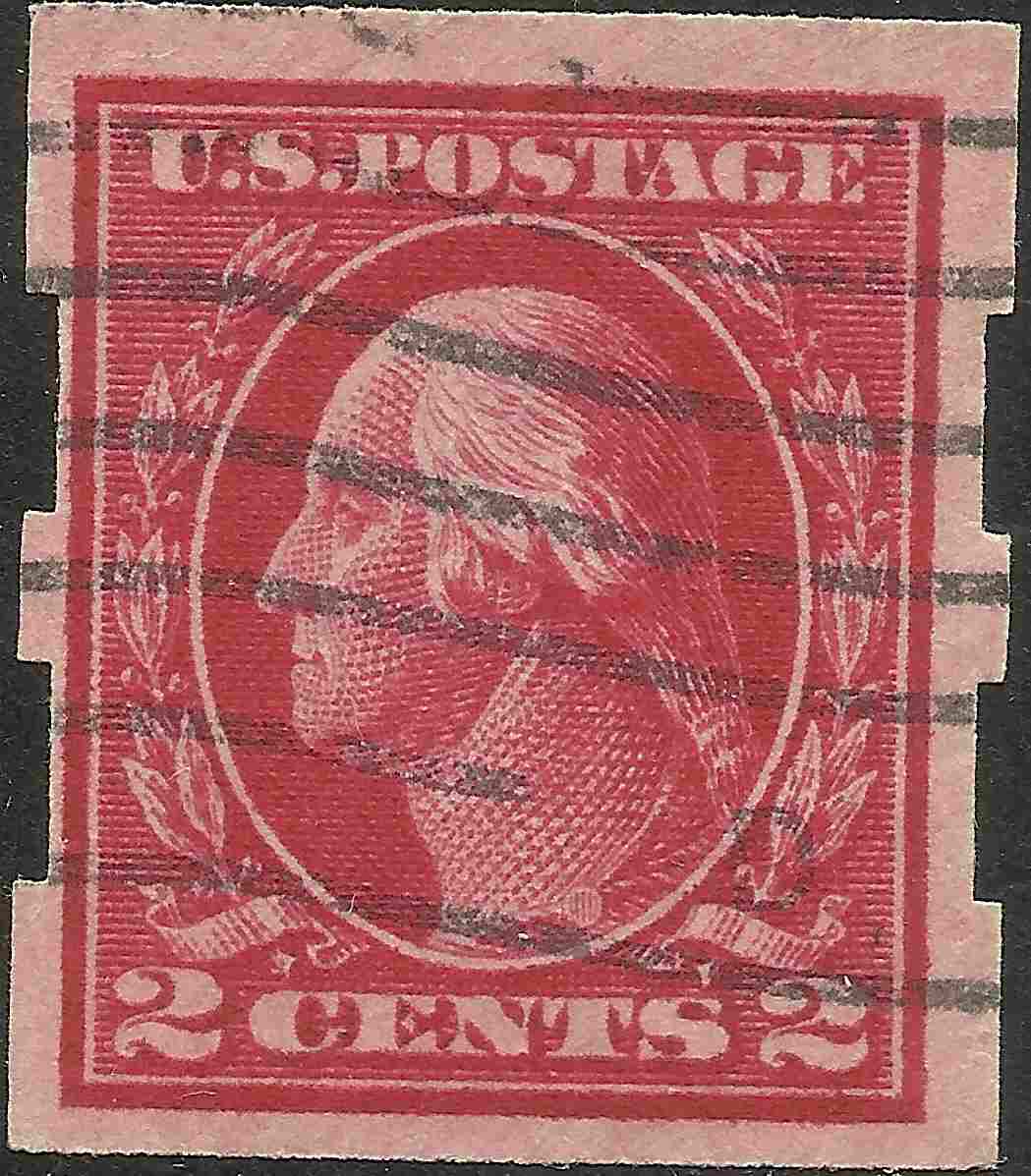 Some Siegel examples of the 482A have nearly as faint of a top toga rope line as mine has. The toga rope line "blobs" of my stamp seem to be indicative of Type I. Regardless, the overall impression is very similar to Type Ia examples. The perforations are very close to what are depicted on the Sonic Imagery Labs US Specialty Precision Multi-Gauge. My stamp has some discrepancies in terms of overall shape of Type III Schermack perforations, but I do not know enough to credit nor discredit genuine examples. In essence, I believe that my stamp is Type I, but could be Type Ia. Having an expert definitively call it one way or the other would be very helpful for others who have stamps like mine that have characteristics that are between the two types. |
|
Send note to Staff
|
Ryan = HDNAC = DNA = HDC = Hysterical DNA Collector = Historical DNA Collector = me who just loves stamps :) |
| Edited by Historical DNA Collector - 01/14/2015 01:17 am |
|
|
Pillar Of The Community
United States
1414 Posts |
|
|
Quote:
Regardless, the overall impression is very similar to Type Ia examples. I am not sure I agree. The scan looks like a 409 with a strong impression. The left and right ribbons are clean except for a tick at the bottom of the right ribbon where the start of the second line would be found. I have seen this much on other type I stamps from time to time. However compared to a type Ia 482A, the outline of the toga button is almost nonexistent especially on the right side and bottom. I am attaching an image of a 482A. It has plating marks at the top of the right and left ribbon in addition to the heavy toga button outline and strong line at the top of the toga rope. Also note that the digs at the bottom of the toga rope are comparatively heavier on the type I example. Clark 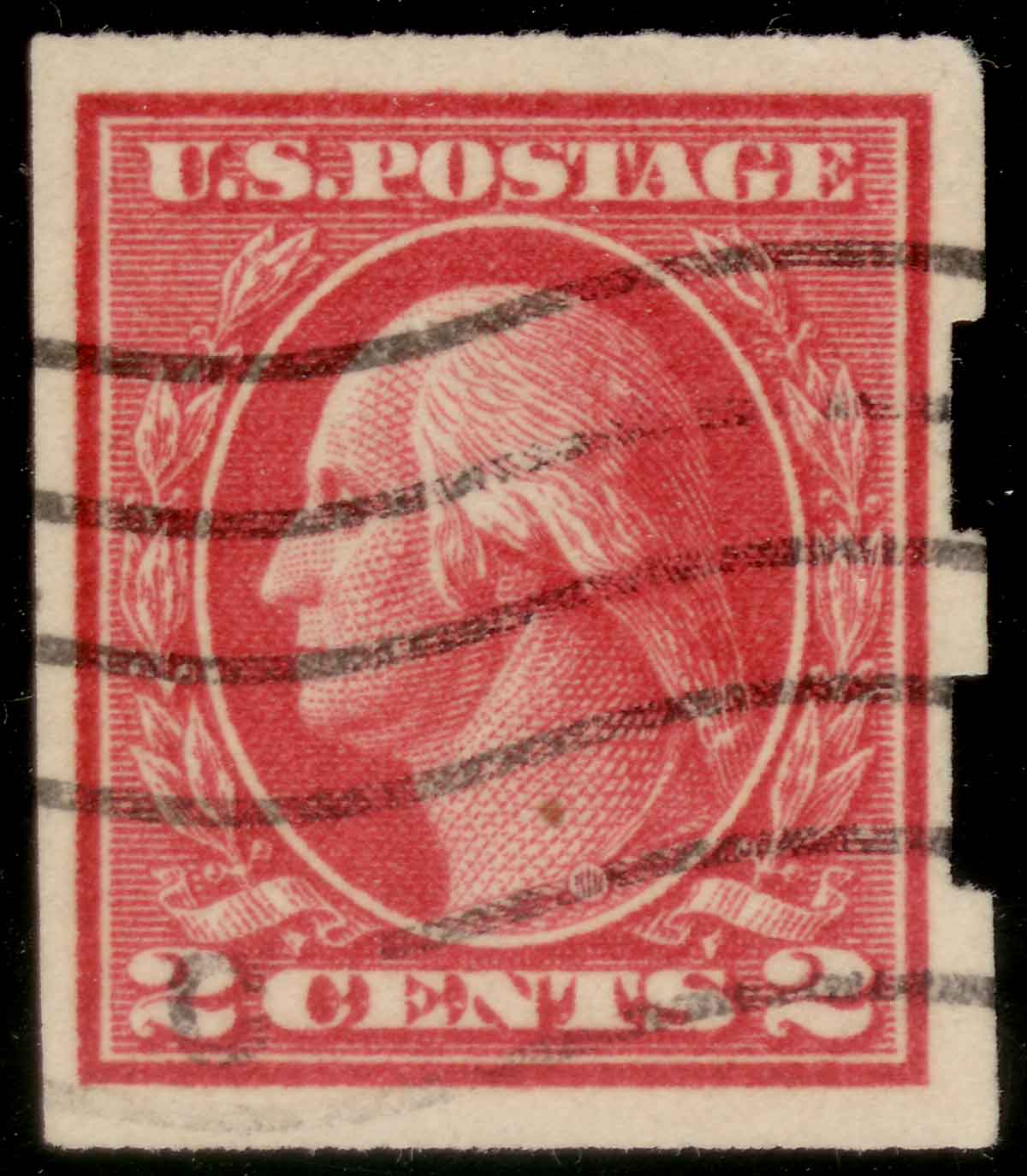 |
|
Send note to Staff
|
| Edited by cfrphoto - 01/14/2015 1:49 pm |
|
|
Pillar Of The Community
United States
2948 Posts |
|
|
Pillar Of The Community
United States
670 Posts |
|
|
When I get stuck on one of these WFs I start to call them  s. EDIT: Oops, I got censored. I just put a T between the W and F. As in "what the frank type is this???" Hope that helps. |
|
Send note to Staff
|
| Edited by raymodj - 01/14/2015 2:53 pm |
|
|
Pillar Of The Community
United States
2948 Posts |
|
|
Quote:
"what the frank type is this???"
Hope that helps. LOL, yea that helps |
|
Send note to Staff
|
|
|
Pillar Of The Community
United States
937 Posts |
|
|
Clark, I thank you for your reply. In my sleepiness I didn't state my questions clearly. Regardless, you answered them succinctly.
From your reply it seems that "plating marks" are also found on Type I stamps, but are necessary for a stamp to be considered a Type Ia. The lack of strong presence of the outline of the toga button at right side and bottom was not apparent to me until you mentioned them.
"digs" that's an interesting name. I cannot think of anything better. Regardless, you and I are both in agreement that they are defining features of the Type I stamps.
You have yet again proved your abilities as an expert. I very much appreciate your contributions to this forum. I very much appreciate your response to my questions. Your position as an expert will always be needed to definitively make opinions on stamp identification amongst other things. Experts can never be replaced by anything other than the next generation of those who dedicate themselves to acquiring vast amounts of knowledge. Certification and the costs of it are absolutely necessary in this hobby.
In summary, I thank you for responding and enlightening all of us as to what to observe to make distinctions when stamps show characteristics that are between Type I and Type Ia.
raymodj, did you mean the abbreviation for Washingtons Then Franklins ? |
|
Send note to Staff
|
Ryan = HDNAC = DNA = HDC = Hysterical DNA Collector = Historical DNA Collector = me who just loves stamps :) |
|
|
Pillar Of The Community
United States
1414 Posts |
|
|
Historical,
Thank you for the kind words.
To clarify a couple of points. The article documenting plating or tick marks in the ribbons was not universally accepted. A few maintained that some 500 examples could exist without any plating marks. Also, Dr Prothreo asked to see type I examples with plating marks. My experience is that the exist on virtually all type Ia examples. I saw one type number 500 stamp with minimal tick marks on the right side because it had what I believe was a weak impression in the right half of the stamp. While it is possible that the plate was unevenly inked, it is also quite likely that one or more stamps on plate 208 may be poorly impressed on the plate. Recall that positions on the plate were reentered with the type I relief. It is possible that some other positions were relatively weak, but not so bad as to justify the time and cost of re-entry.
At one time I owned about 80 type Ia number 500 stamps all found in mix. Also, I one type I example with some extra ink in one of the ribbons, but it does not appear to follow the pattern associated with the documented type Ia plating marks.
Clark |
|
Send note to Staff
|
| Edited by cfrphoto - 01/16/2015 10:46 pm |
|
|
Replies: 20 / Views: 5,914 |
|




 Posted 01/12/2015 7:14 pm


