| Author |
 Replies: 10 / Views: 2,363 Replies: 10 / Views: 2,363 |
|
|
Pillar Of The Community
United States
937 Posts |
|
|
Does this appear to be transitioning to perf 10 on the bottom? 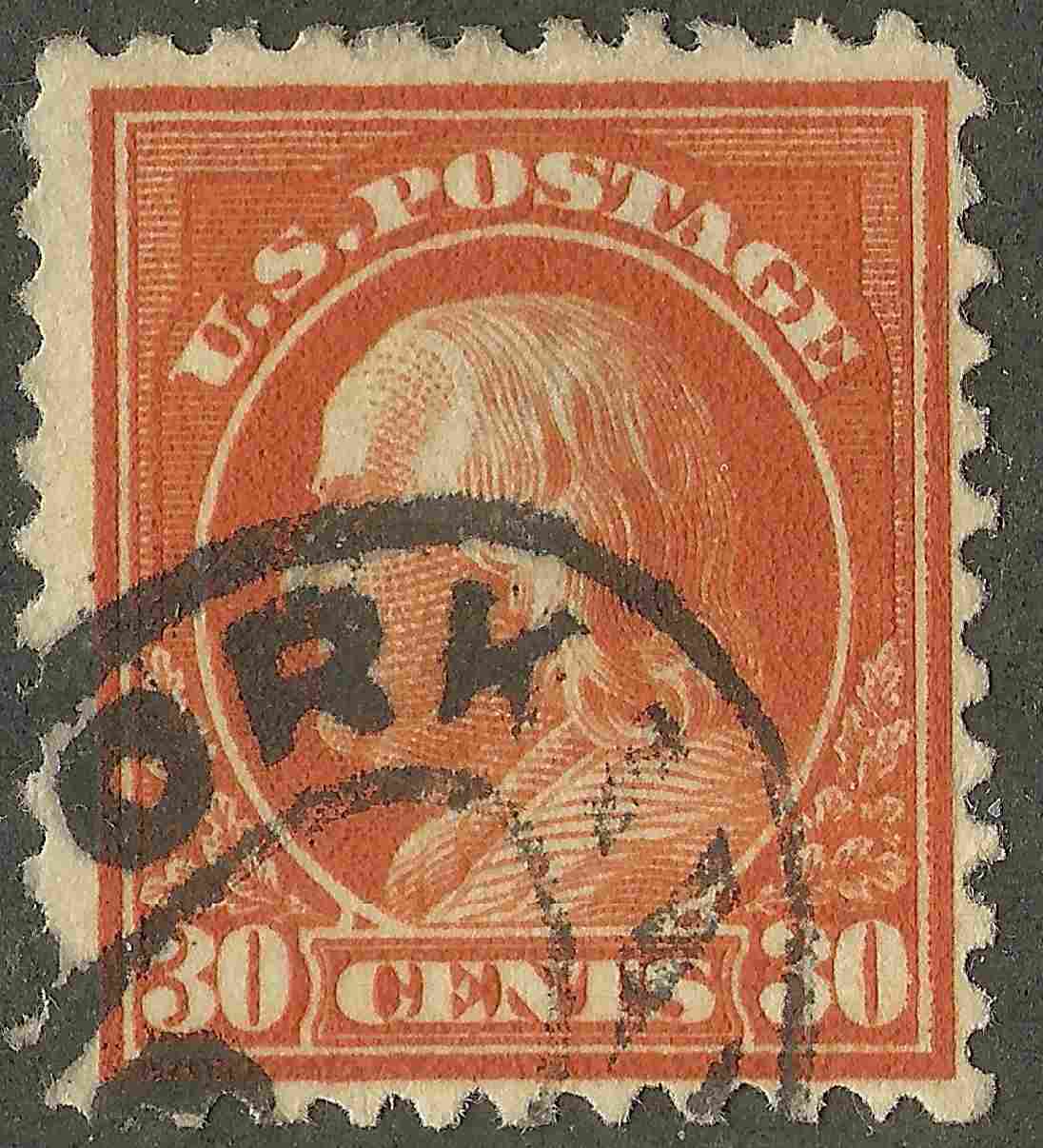 Here is a copy of the top placed at the bottom: 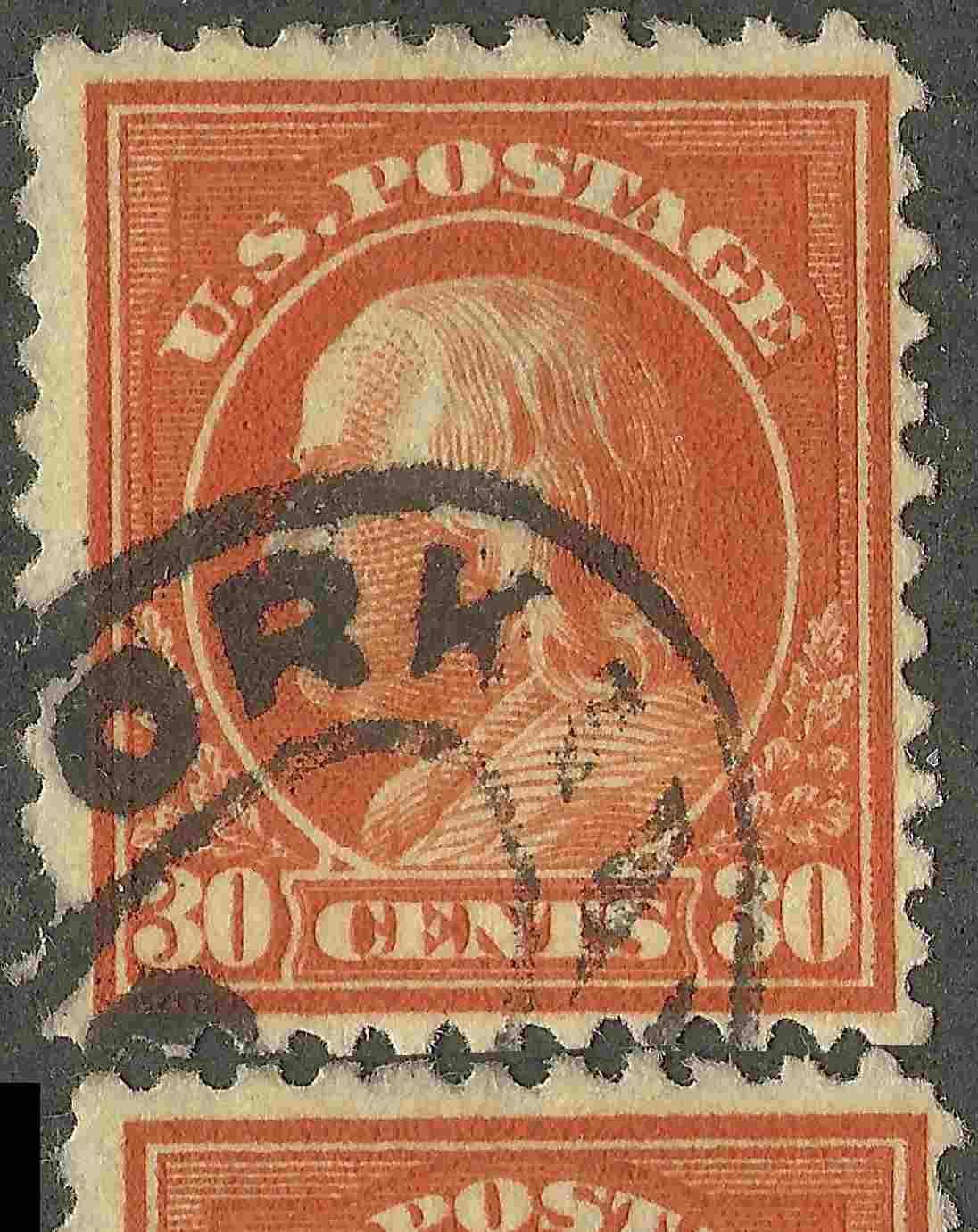 The green dots are a 11-72 perf overlay: 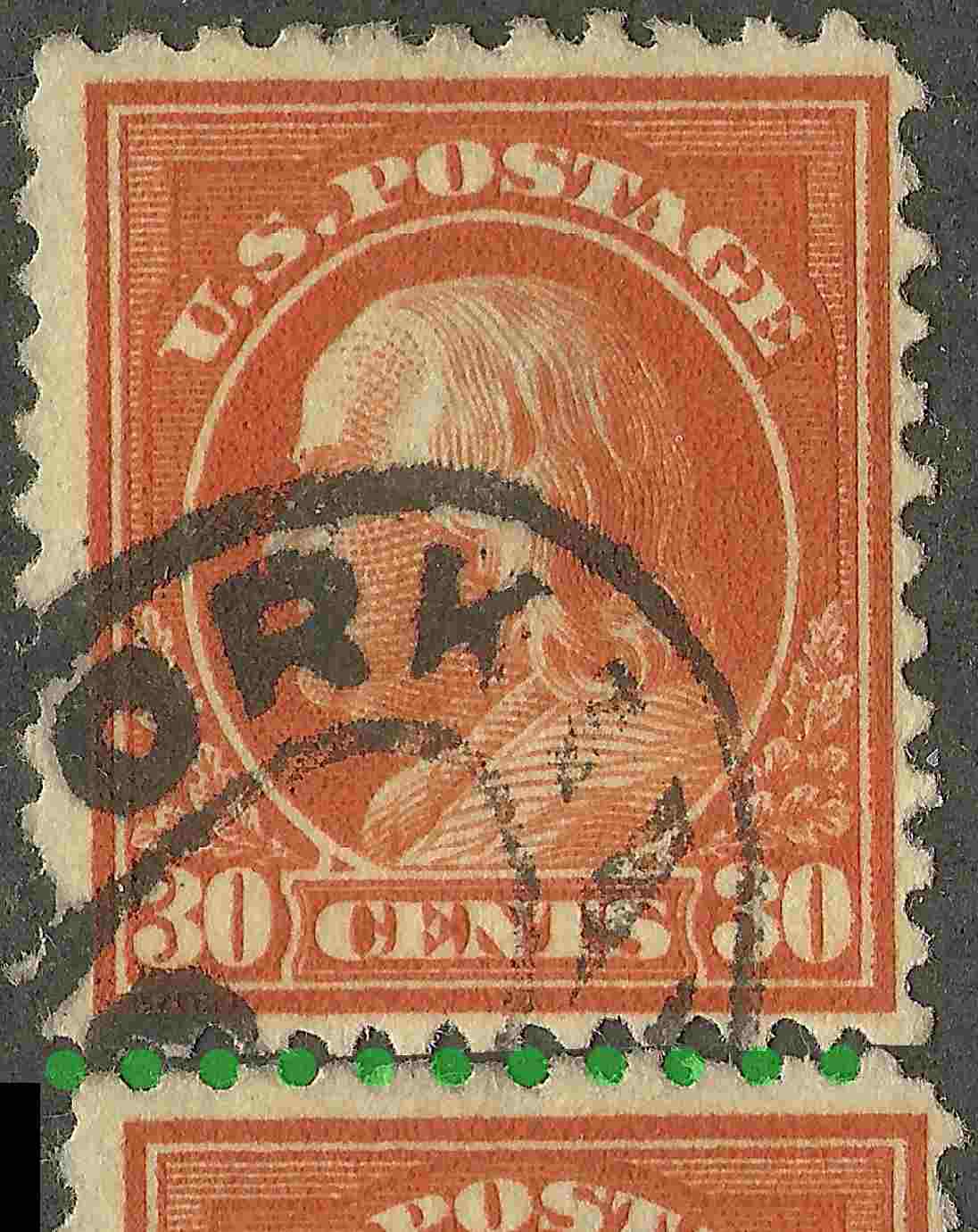 |
|
Send note to Staff
|
Ryan = HDNAC = DNA = HDC = Hysterical DNA Collector = Historical DNA Collector = me who just loves stamps :) |
|
|
|
|
Pillar Of The Community
United States
8956 Posts |
|
|
Pillar Of The Community

United States
1273 Posts |
|
|
Does look more like a bad reperfing attempt-notice the clean looking straight cut on the far right corner (with enough room for at least a partial perf.) which kinda looks like a straight edge remnant? Perf. holes seem to be running up hill west to east on the bottom only, which I think would be inconsistent with the bureau perforation process wouldn't it? Not sure just what it is, but probably not a transitional.  |
Send note to Staff 
|
|
|
Pillar Of The Community
United States
937 Posts |
|
|
Good points. Clark made mention of how to further examine this type in a post only a few days ago: https://goscf.com/t/41723&whichpage=3#356266I can't find the article that he references. Anyone have access/link to it? The blue dots are a 10-81 overlay that matches 3 of the 5 holes. 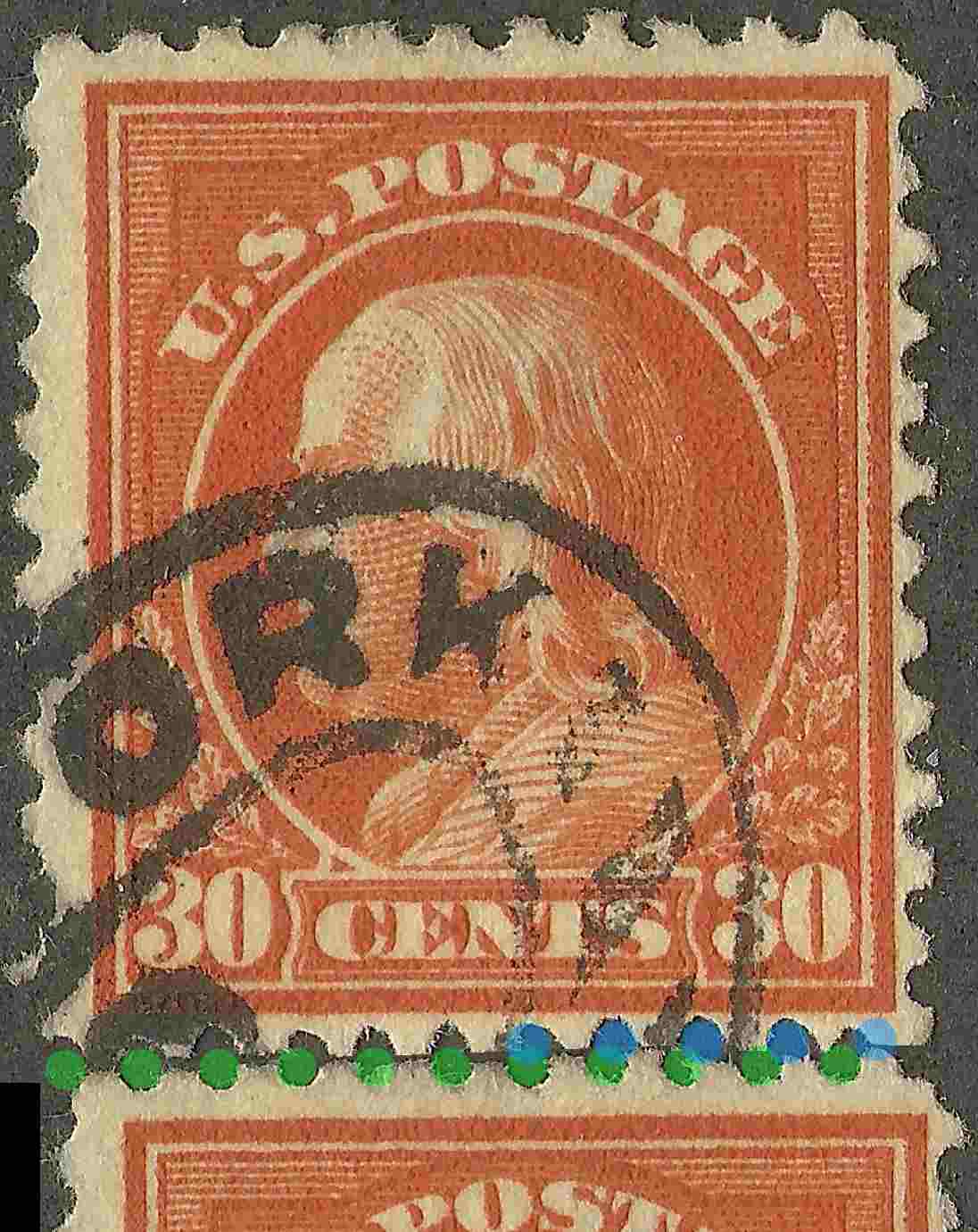 That long straight section at far right does seem to indicate reperforation. However, the cancel on mine is very similar to the only used example at Siegel and the stamp came from an older beginner's album. |
|
Send note to Staff
|
Ryan = HDNAC = DNA = HDC = Hysterical DNA Collector = Historical DNA Collector = me who just loves stamps :) |
|
|
Pillar Of The Community
United States
644 Posts |
|
|
It's been crudely reperfed.
The cancel is a New York oval, likely a registry cancel and they're quite common on WFs. |
|
Send note to Staff
|
|
|
Pillar Of The Community
United States
937 Posts |
|
|
Yeah, I'm seeing stars. It was a natural straight edge that someone wanted to look "prettier." I got carried away with it. I'd still like to read that article though. Thanks everyone.
Edit: found the article on perforations available for a few bucks on the United States Stamp Society's website. |
|
Send note to Staff
|
Ryan = HDNAC = DNA = HDC = Hysterical DNA Collector = Historical DNA Collector = me who just loves stamps :) |
| Edited by Historical DNA Collector - 02/06/2015 8:39 pm |
|
|
Pillar Of The Community
United States
1273 Posts |
|
|
Ryan, its a nominal fee to join The United States Stamp Society. You'll get a monthly journal that has useful info., not always in one's particular collecting interest, but still often good reading. Plus, you'll have free access to all their journal digitalized back to 1930. Lot's of useful info. in there. |
|
Send note to Staff
|
|
|
Rest in Peace
United States
763 Posts |
|
|
After we discontinued our public auction business about 7 years ago, we also decided we had to cut back on the number of societies/clubs we belonged to, which was about 20 at one time. So we narrowed it down to those whih we felt were the very most important to us;
1. APS (of course!);
2. U.S. Philatelic Classics Society;
3. United States Stamp Society;
4. United Postal Stationery Society;
5. U.S. Cancellation Club;
6. Association of Philatelic Exhibitors.
The point is, of course, that we regard the USSS as one of the best and desirable to belong to. And looking into the future, we will probably need to stop a few more and as of now, I'm leaning toward #4 and #6 (even though I am a founding member of that one, so it will be tough.....). |
|
Send note to Staff
|
|
|
Pillar Of The Community
3865 Posts |
|
|
Historical DNA Collector: Which article are you referring to? They have a very interesting and informative booklet USSS BIA Reprint # 2 "Perforation Measurements of United States Stamps". |
|
Send note to Staff
|
| Edited by jogil - 02/07/2015 08:54 am |
|
|
Pillar Of The Community
United States
937 Posts |
|
|
I would love to subscribe to several groups and purchase several guides and books, but just can't afford any yet. I did recently find a few stamps that might sell for enough to pay for some of that though.
jogil, I think that article is the one in question. |
|
Send note to Staff
|
Ryan = HDNAC = DNA = HDC = Hysterical DNA Collector = Historical DNA Collector = me who just loves stamps :) |
|
|
Pillar Of The Community
United States
1414 Posts |
|
|
I am not going to be able to be of much help on this one. I will be at the APS AmeriStamp Expo at Riverside Feb 13, 14 and 15 in booth 405. I found one reference article in the USSS:
Volume: 75 Number: 4 Year: 2004 Specialist: 890
Article: Newly Discovered Plate Block of 498g
Author(s): Mike Wenkel, Wallace Cleland
Extract from the article:
"But the question remains as to how a gauge II wheel was created or
modified with a short section of gauge 10. Flat plate perforators had matching
perforation wheels. A brass die wheel had holes and was fixed to the shaft that
drove tbe perforation process. Since the chads had to fall out of these holes,
the brass part where the holes were machined could not have been very thick.
The second wheel had hardened steel pins that fit into the holes of the die
wheel, but this wheel was not locked to the shaft on which it was mounted. It
was allowed to rotate freely to the extent that it had to remain meshed witb the
die wheel, which was driven at a fixed speed. To create this perforation variety,
the tbird die wheel from the right (creating the third row of perforations from
the top of the sheet) had a segment 2 1/8" long that had holes spaced 0.0791"
apart (perf 10-79), while the rest of the wheel had holes spaced 0.0725" (perf 11-
72). Close examination of the plate block shows that the perf I 0 holes lie slightly
below the perf II holes. This is clear on the enlarged portion of the Il¢ variety
shown in Figure 3 (taken from a picture ofa block of30 of the TR pane of plate
13467 illustrated in Vol. 41, p. 116, of The U.S. Specialist.) This is also clear in
Figure I , and in the picture of the Scott 506a block with plate number 12557
described above.
So how did a female die wheel end up with two spacings on the same
wheel? There appear to be two possibilities. First, it may have been manufactured
this way. There must have been a jig to allow accurate drilling of the
holes , and different jigs, or settings of a jig, would be needed for gauge 10 and
gauge II holes. Both gauges were in use during this period at the BEP - gauge
I I wheels for the flat plate perforators and gauge 10 wheels for the vertical
perfs on rotary press sheet stamps (the horizontal 10 gauge perfs for rotary
press sheet stamps and those for coils were added with a perforating bar).
Possibly a workman knocked off for lunch with a wheel partially drilled and
picked up the wrong jig when he (or another workman) returned to finish the
job.
A second possible scenario is that a die wheel was damaged in some way
and was repaired by the drilling of new holes with the wrong spacing, or by
replacement of a segment with one from a spare gauge 10 wheel. But why repair
a wheel when one could simply mount a new one? And how easy would it be to
replace a portion of a wheel with a new segment?
[n any case, the female die wheel ended up with a segment with gauge 10
spacing. The next question is, how did a gauge II pin wheel mesh with such a
die wheel? The gauge 10 pins were 0.042" in diameter according to Southgate,
while gauge II pins were 0.0406". The holes themselves were of course slightly
larger than the pins, since, as the pin and hole came together, they were at an
angle to each other until fully meshed. Unfortunately, Southgate does not tell
184 THE UNITED STATES SPECIALIST
Figure 3. Close up of the Scott #S 1 t a block showing that the perf 10 holes a.-e slightly
lower than the perf II holes, a feature common with the new #498g plate block.
APRIL 2004 IS5
us how large the holes were, but we surmise that it is possible that a gauge II
pin wheel could mesh with a gauge 10 die wheel, as only a few pins at a time
were meshed (the pins only went 0.025" into the holes, which is less than a
millimeter) and the pin wheel was not locked to its shaft. The alternative is that
the machinist noticed what had happened in creating the die wheel with the 10
gauge section and so then created pin wheel to match, but this seems unlikely
since the gauge 10 section is noticeably non-uniform.
We thus conclude that, one way or another, a female die wheel that was
supposed to be gauge II ended up with a 2 I /S" long gauge 10 segment, and
that it was most likely paired on the perforator with a normal gauge II pin
wheel. Just how this happened will probably never be known, but the odd
perforation wheel remained in use for at least several months, and there are
certainly more examples of this perforation variety waiting to be discovered."
I would note that the statement that the perf 10 spacing is 10-79 is not quite accurate and inconsistent with the theory of a mix up with a rotary perf 10 jig which would have been 10-80 not 10-79.
There is an excellent image of a large block of 498g on the Siegel Auction web site. It shows the left transition and most of the row except for the right transition. As I recall a 511a block with the right transition is also available on the site.
As a matter of policy, I will start recommending membership to the United States Stamp Society. It was not difficult to find this and some other articles once a useful search was set up. It was sufficient to search for the Scott number 498g. Not all searches are that easy, but this one seemed to do the trick.
Finally pay attention to the line:
"Close examination of the plate block shows that the perf 10 holes lie slightly
below the perf 11 holes." (with the 506a exception noted).
In my opinion, the perforations will not fit a genuine row. I have seen some lately where the holes are quite ragged, too ragged to be genuine. However, I have found some that fit the row exactly. For that service you would have to send the stamp to the Philatelic Foundation.
Clark
|
|
Send note to Staff
|
|
| |
Replies: 10 / Views: 2,363 |
|




 Posted 02/06/2015 4:36 pm


