Stamp Community Family of Web Sites
Thousands of stamps, consistently graded, competitively priced and hundreds of in-depth blog posts to read


Stamp Community Forum
 
Username:
Password:
Save Password
Forgot your Password?

This page may contain links that result in small commissions to keep this free site up and running.

Welcome Guest! Registering and/or logging in will remove the anchor (bottom) ads. It's Free!

Tools For Linear Measurement

 
To participate in the forum you must log in or register.
Author Previous TopicReplies: 10 / Views: 2,243Next Topic  
Pillar Of The Community
United States
1942 Posts
Posted 02/23/2015   09:13 am  Show Profile Bookmark this topic Add essayk to your friends list Get a Link to this Message
The tools for linear measurement I see mentioned on this site include,
rulers
templates: made from cutting away parts of actual stamps
calipers

The last one is not clear to me, and I would like to see what you are referring to. Could someone post a pic of their caliper device?

For many years I have been using a compass to help measure a gap, and recently acquired an electronic measuring compass with three scales calibrated in metric, to a tenth of a millimeter, and in inches (digital/decimal and fractional). Mine goes by the brand name "Digicompass." Here is a quick and dirty scan to give the general impression:
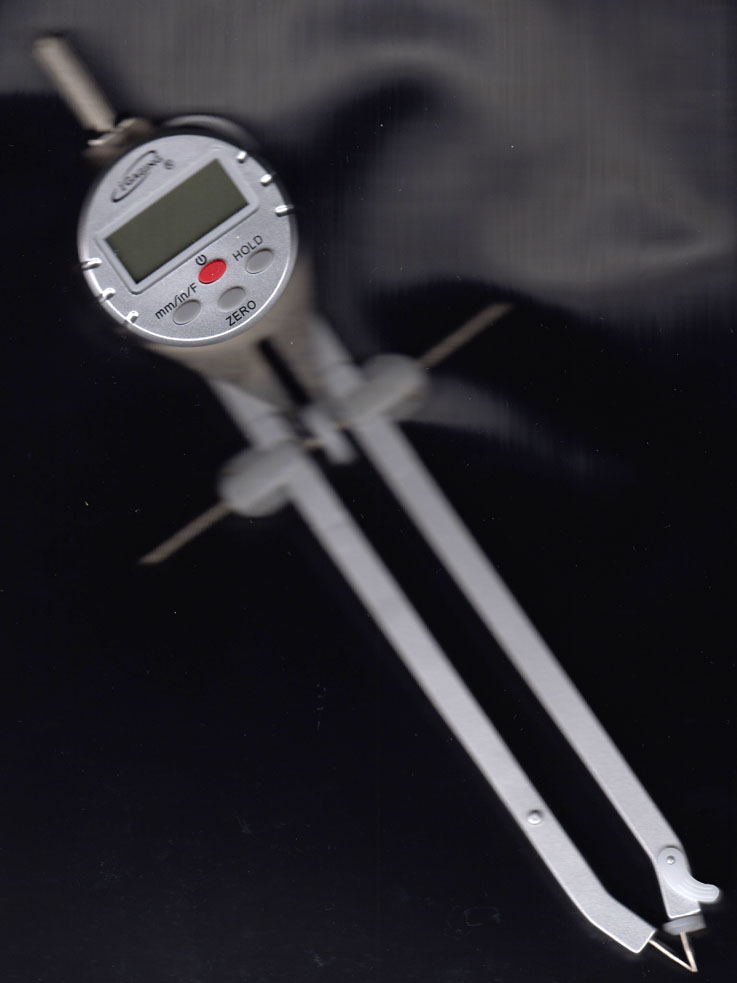


This device is not called a caliper and I wish to distinguish it from whatever people are using that is called by that name. This is a digital measuring compass.

I use it for measuring anything for which a template cannot be made, such as grills, specific short distances within a design (e.g. vignette frame), or the dimensions of a defect or anomaly. The thing that distinguishes it from a caliper, as I have known the latter, is that it uses very sharp needle points at the business end of the tool. It would be easy to inflict damage to a stamp with this tool, so it is not for the faint of heart or unsteady of hand.

However, when used in conjunction with a magnifying glass or other lens I will contend that with this tool you can take measurements that are as precise as what you can do with a template, and get an actual numeric readout. That is very useful for gathering data in research; less so for simply identifying a stamp.

After I see some other tools people are using perhaps we can comment on technique.
Send note to Staff

Rest in Peace
United States
4052 Posts
Posted 02/23/2015   09:38 am  Show Profile Bookmark this reply Add ikeyPikey to your friends list  Get a Link to this Reply
Send note to Staff  Go to Top of Page
Edited by ikeyPikey - 02/23/2015 09:49 am
Pillar Of The Community
United States
8406 Posts
Posted 02/23/2015   09:43 am  Show Profile Bookmark this reply Add floortrader to your friends list  Get a Link to this Reply
Interesting piece of equipment, never saw one . But would be able to distance/size for fake overprints and other things .Thanks for the heads up.
Send note to Staff  Go to Top of Page
Moderator
1589 Posts
Posted 02/23/2015   09:55 am  Show Profile Bookmark this reply Add blcjr to your friends list  Get a Link to this Reply
Good links, IkeyPikey. When I hear or see "caliper," I think of the device in your second link, and that is probably the case for essayk also. But as your first (wiki) link shows, the term can apply to a compass. I did not know that.
Send note to Staff  Go to Top of Page
Pillar Of The Community
United States
937 Posts
Posted 02/23/2015   12:33 pm  Show Profile Bookmark this reply Add Historical DNA Collector to your friends list  Get a Link to this Reply
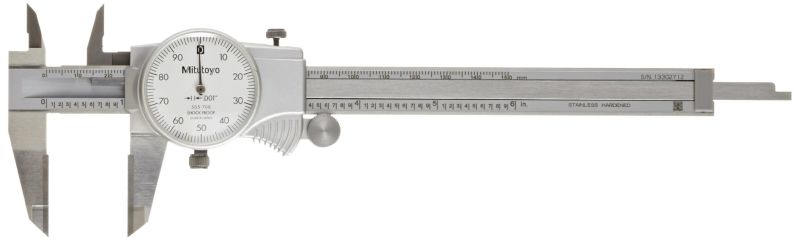
ikey's second link shows a digital caliper, mine is a dial type. Most dial, digital, and Vernier types are accurate to 0.001" (0.0254 mm). I do not know what accuracy metric only ones have. From ikey's link it seems that particular model could be 0.01 mm.

The jaws of this type of caliper are very parallel. This helps to remove error from not having the measuring device aligned to the subject. If I see color against the full edge of both sides, then I know that my subject is the same or larger than the caliper's read out. This method isn't suitable for those with poor vision.

Of the hundreds of rotary stamps that I've used mine on in this manner, I haven't found any smaller than the 19.5, 19.75, 22.25, or 22.5 mm given dimensions for the corresponding side.
Send note to Staff  Go to Top of Page
Ryan = HDNAC = DNA = HDC = Hysterical DNA Collector = Historical DNA Collector = me who just loves stamps :)
Rest in Peace
United States
82 Posts
Posted 02/23/2015   12:53 pm  Show Profile Bookmark this reply Add wbrob to your friends list  Get a Link to this Reply
Ikey -
A quote you included earlier (or perhaps I imagined it)
reminded me of this, one of my favorites:

"Truth is stranger than fiction, but it is because Fiction is obliged to stick to possibilities; Truth isn't."
- Mark Twain

discuss (?)

Bill
Send note to Staff  Go to Top of Page
Valued Member
United States
131 Posts
Posted 02/23/2015   4:33 pm  Show Profile Bookmark this reply Add chaulkdust to your friends list  Get a Link to this Reply
Like DNA I also use the caliper (dial to .001). I like the parallel jaws for measuring designs. Had a digital but I keep forgetting to turn it off and the battery replacement was a pain. So I'm back to old school.
Send note to Staff  Go to Top of Page
Rest in Peace
United States
4052 Posts
Posted 02/23/2015   5:19 pm  Show Profile Bookmark this reply Add ikeyPikey to your friends list  Get a Link to this Reply
I would think that one of the issues in selecting a dial/digital caliper is that, historically, they were hand-held tools, intended & designed to be used with hand-held discrete 3-D parts.

Therefor, the ability of the tool to 1) lay flat with 2) the calipers close the that flat surface is not especially common.

Not their fault: the expectation was that the item to be measured would be placed between the calipers (OD), or around the calipers (ID), but not alongside them.

There is also the issue of physical contact with our precious little delicates, especially with the compass (above).

I suggest folks consult an earlier thread, and consider either an optical reticle (relatively inexpensive, readily portable) or acanalizo's digital microscope (a USB device that but captures & records imagery).

https://goscf.com/t/40589 Instrument to measure in tenths of a millimeter?

Cheers,

/s/ ikeyPikey
Send note to Staff  Go to Top of Page
Pillar Of The Community
United States
1942 Posts
Posted 02/23/2015   5:23 pm  Show Profile Bookmark this reply Add essayk to your friends list  Get a Link to this Reply
Vernier calipers are great for pipe and other hard objects that do not "give" under the pressure of the jaws. They can be tricky at adjusting to use with graphics.

The unit I just recently got (Christmas gift) does not READ finer than .1 mm, .01 inch (estimating to half the smallest gradation based on the rotation of the spreader wheel) but it has the advantage that the placement of the points on the subject is less prone to error than a blade system. When well aligned the blades can cover the edge, and the user might not detect it, whereas the needle points keep the edge in full view at all times, except for the spot covered by each point. Working from the corners of a design, using a magnifying glass, alignment with the edge can be right on with less guessing.

Send note to Staff  Go to Top of Page
Edited by essayk - 02/23/2015 5:29 pm
Pillar Of The Community
United States
937 Posts
Posted 02/23/2015   11:47 pm  Show Profile Bookmark this reply Add Historical DNA Collector to your friends list  Get a Link to this Reply

Quote:
Vernier calipers are great for pipe and other hard objects that do not "give" under the pressure of the jaws. They can be tricky at adjusting to use with graphics.


True, but when used as a go/no go gauge they are very accurate and error free when you are comparing to a minimum measurement.


Quote:
There is also the issue of physical contact with our precious little delicates, especially with the compass (above).


This is a valid area of concern and damage can be prevented by careful use or with a transparent layer between the caliper and the subject. Of the 3 calipers of this type that I have, all of them have the "jaws" in the lowermost plane which allows for placing them directly against a flat surfaces.

I do not typically use mine for measurements. I typically use them to determine if a stamp's dimensions are above a certain threshold.

essayk, I understand the value of having your type of caliper for various measurements, but I would not trust their measurement for something like frame lines which may have a keystone variation or other sources of error. They do seem perfect for things like point to point measurements on things like grills though.
Send note to Staff  Go to Top of Page
Ryan = HDNAC = DNA = HDC = Hysterical DNA Collector = Historical DNA Collector = me who just loves stamps :)
Pillar Of The Community
1545 Posts
Posted 02/24/2015   5:40 pm  Show Profile Bookmark this reply Add I Brake For Stamps to your friends list  Get a Link to this Reply
A set of dial calipers...


-IBFS
Send note to Staff  Go to Top of Page
All science is either Physics or Stamp Collecting. -- Ernest Rutherford
  Previous TopicReplies: 10 / Views: 2,243Next Topic  
 
To participate in the forum you must log in or register.

Go to Top of Page

Disclaimer: While a tremendous amount of effort goes into ensuring the accuracy of the information contained in this site, Stamp Community assumes no liability for errors. Copyright 2005 - 2026 Stamp Community Family - All rights reserved worldwide. Use of any images or content on this website without prior written permission of Stamp Community or the original lender is strictly prohibited.
Privacy Policy / Terms of Use    Advertise Here
Stamp Community Forum © 2007 - 2026 Stamp Community Forums
It took 0.33 seconds to lick this stamp. Powered By: Snitz Forums 2000 Version 3.4.05