| Author |
 Replies: 22 / Views: 12,714 Replies: 22 / Views: 12,714 |
|
Pillar Of The Community

United States
3046 Posts |
|
|
The Scott catalog says that 1041 is 22.7mm high. 1041A is 22.9mm high, and 1042 is a "redrawn" 1041. I don't have anything that will let me measure 22.7 vs 22.9 mm. By the pictures in the Scott catalogue, I THINK I got 1042 right, and I hope 1041 is correct. I did some ebay image searches and was left clueless, since no 2 1041s looked the same. What do you guys think? Any help greatly appreciated.  |
|
Send note to Staff
|
|
| Edited by apastuszak - 03/01/2015 8:03 pm |
|
|
|
|
Valued Member
United States
97 Posts |
|
|
apastuszak - The stamp image on the right is a 1042. Look at the torch flame - on the 1041 and 1041B (note - it's 1041B, not 1041A) the flame from the torch goes between the letters S and P. Not so on the 1042. As far as a 1041 vs 1041B, if you don't have a good micrometer, about the only way you'll be able to tell is if you happen to have samples of both and can compare side by side.
Alan |
Send note to Staff 
|
|
|
Pillar Of The Community
United States
1498 Posts |
|
|
The height difference between 1041 & 1041B is extremely small. One certain way to identify the two is by plate #s. Each plate block has two numbers ... but the pair of plate numbers will identify which stamps are involved. Just for fun, I checked ebay & immediately saw a group of 9 plate blocks offered for sale, all identified as 1041. Based on the plate numbers, five of the blocks are 1041 and four are 1041B. Added: The same seller has other 1041 groups including a group of five plate blocks, four of which are 1041B. According to Durland, the plate numbers for 1041B are all among 24923, 24924, 24927, 24928, 24938, 24940 & 24942. Note that none of these numbers appear on a 1041 plate. |
|
Send note to Staff
|
| Edited by JLLebbert - 02/28/2015 10:35 pm |
|
|
Pillar Of The Community
United States
3046 Posts |
|
|
I would think you would need a digital caliper that can go to at least one decimal place. But even then I would need to ensure the stamp was perfectly flat. 0.2mm is such a minuscule number that I don't see how it would be easy to spot. |
|
Send note to Staff
|
|
|
|
Bedrock Of The Community
United States
12128 Posts |
|
|
Pillar Of The Community
United States
3046 Posts |
|
|
Thanks everyone for your help. I'm going to ask the store owner which one he sold me. I'm thinking it might be better to buy the appropriate plate blocks to ensure I have the right stamps and use what I got for postage. |
|
Send note to Staff
|
|
|
|
Pillar Of The Community
United States
1498 Posts |
|
|
Hope I didn't lead you astray with all the plate block info. The point I was trying to make is that ebay sellers don't really know which of these stamps they are selling. A quick search for 1041B plates on ebay results in a number of items with 1041 plate numbers. If they can't get the plates correct, what's the likelihood that they'll have individual stamps correctly identified? Although 0.2mm is very small, the difference is fairly easy to detect with the human eyeball. Your problem is that you don't have both varieties in hand. Rather than splurge for plate blocks, you might consider a couple of individual stamps from the same seller. Once you have both varieties, the taller one will become fairly obvious. Measuring the stamp is difficult. I tried to carefully measure a 1041B and decided it measured about 22.7mm ... which according to Scott would make it 1041. Then I placed it next to a 1041 and realized quickly that it was the taller of the two stamps. Believe me, the eyeball test will work if you have both stamps in hand. |
|
Send note to Staff
|
|
|
Pillar Of The Community
621 Posts |
|
|
If you have a scanner, you can use measuring functions of photo-editing software to make very accurate measurements. Here is a screen shot of one I use: Photofiltre with the measurement plug-in. 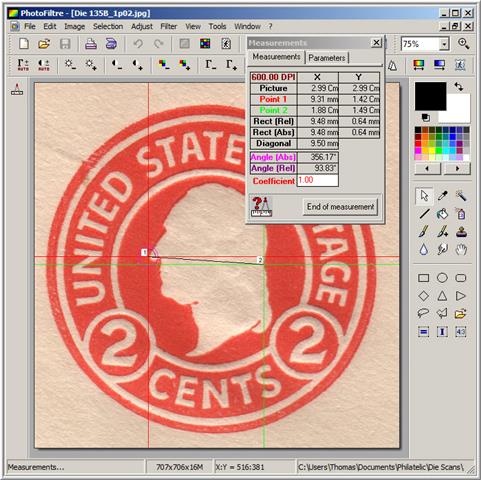 |
|
Send note to Staff
|
|
|
Pillar Of The Community
United States
3046 Posts |
|
|
Quote:
If you have a scanner, you can use measuring functions of photo-editing software to make very accurate measurements. Thank you for that recommendation! I'm off to try that. |
|
Send note to Staff
|
|
| Edited by apastuszak - 03/01/2015 09:39 am |
|
|
Pillar Of The Community
United States
3046 Posts |
|
|
Pillar Of The Community
621 Posts |
|
|
"Ok, because I'm cheap, . . ."
Ok, but for others who might read this thread, Photofiltre is free (better stated "offers a free version"). |
|
Send note to Staff
|
|
|
Pillar Of The Community
6361 Posts |
|
|
But do you trust the accuracy of the measuring device? You got 22.78 versus the catalog measurements of 22.7 an 22.9. Right in the middle. I would not hazard a guess which variety you have. Is your computer portable into the field? That is why the advice to use actual stamps as measuring templates is so good, especially for very small differences. Use other stamps of known dimensions (or even cut up damaged stamps) as templates. This is especially useful for early 20th century issues. I carry my templates to shows, antique shops, flea markets, etc., and can make easy measurements of flat vs rotary, sheet vs booklet, etc. It will pay for itself very quickly.
In this case the two varieties are inexpensive, so as noted before, buying both as plate blocks (or even plate singles) is trivial and certain. My second choice would be measuring stamps against other stamps, and my third (and very distant) choice would be some secondary measuring device like a caliper or scanner.
On an unrelated tangent: And for your example, while the blue has decent centering, the red is printed low and this misalignment in the area of the torch detracts from the overall appearance, IMO. I would seek a copy with better printing alignment. |
|
Send note to Staff
|
| Edited by John Becker - 03/01/2015 2:21 pm |
|
|
Pillar Of The Community
United States
1498 Posts |
|
|
Thought a side-by-side look at the two stamps might be helpful. Note how easy it is to tell the two apart when you have both of them in hand. If you have problems seeing the difference once you have both stamps, just do a scan of the two stamps side-by-side. 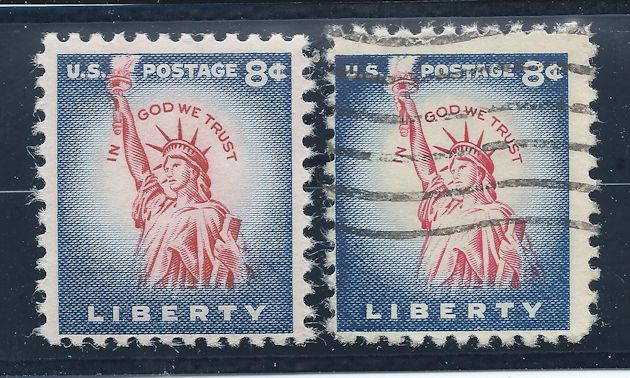 |
|
Send note to Staff
|
|
|
Pillar Of The Community
1545 Posts |
|
|
JL --Your scan interests me. From appearance, that seems quite a difference compared to the height difference as described in the Scott Specialized, which is literally stated as "about the thickness of one line of engraving." I used a ruler, and whether it is accurate or inaccurate really doesn't matter because I used the same ruler on both stamps. What I was looking for was which measurement was shorter than the other, rather than 22.9mm or 22.7mm. Then I measured both stamps very carefully. With the ruler and a glass, I could see that one stamp was shorter than the other, and I mean, by a sliver. The words "about the thickness of one line of engraving." rang true when I saw the shorter stamp on the second measurement.
So the quite noticeable difference in height of you scan does spark a curiosity in me, because, as defined, you shouldn't be able to see the difference from a scan.
-IBFS |
|
Send note to Staff
|
All science is either Physics or Stamp Collecting. -- Ernest Rutherford |
|
|
Pillar Of The Community
United States
3046 Posts |
|
|
The 22.78 measurement I posted earlier was the WIDTH of the stamp. not the height. Scott specifies the height as being 22.7 vs 22.9. When I use the measuring tool in Gimp, it tells me the stamp HEIGHT is 25.3 mm and the WIDTH is 22.7.
I also tend to think that a height or width difference of .2 mm can be achieved easily depending on how your perforation tears. In my opinion, there's shouldn't be a 1041B
|
|
Send note to Staff
|
|
|
|
Pillar Of The Community
United States
3046 Posts |
|
|
Ok, so I'm gathering that it's the height of the design, and not the overall height that is supposed to be 22.7 mm vs 22.9 mm. When I check the measurement of my scan. the height of the design is 22.8 mm. Smack in the middle between the two. That's frustrating as hell. |
|
Send note to Staff
|
|
|
|
Replies: 22 / Views: 12,714 |
|




 Posted 02/28/2015 8:58 pm


