| Author |
 Replies: 30 / Views: 4,773 Replies: 30 / Views: 4,773 |
|
Pillar Of The Community
United States
1946 Posts |
|
|
I just retrieved this 63b from the Post Office 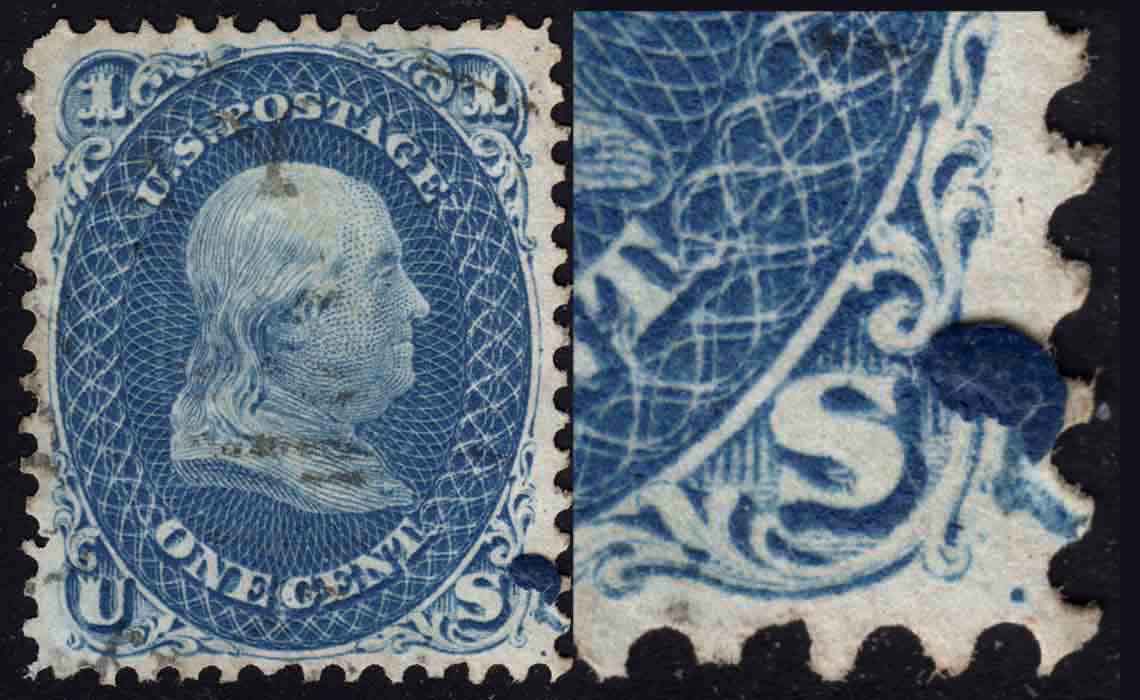 About a week ago I bid on a 63b in an online auction (not ebay) that looked interesting to me. In the catalog pic I noticed a rather sizable speck on it which was not mentioned in the description. It arrived today and I had determined that I would remove it, so I put it under the microscope to have a good look. Much to my surprise the speck appeared to have the same blue color as the deepest printing on the stamp. I also noticed that there is a bit of extraneous printing in the stamp's margin just below the speck, which appears to run beneath it. I am leaning toward the idea that this speck is a dried extraneous bit of the very ink used to print 63b, and that the marginal "printing" is actually a smear from when the blob hit the paper and stuck. What do you think? |
|
Send note to Staff
|
|
|
|
|
Pillar Of The Community
United States
3268 Posts |
|
|
I think that you're correct. I've got two stamps with very similar ink drops, an O57s shown in this thread and an O62, kind of odd that they are both State Department stamps. https://goscf.com/t/40224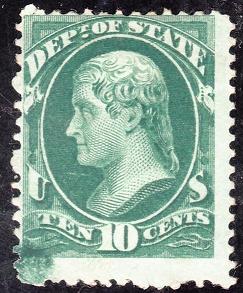 |
Send note to Staff 
|
| Edited by littleriverphil - 03/24/2015 7:45 pm |
|
|
Rest in Peace
7742 Posts |
|
|
Hey essayk...Very nice stamp...I took the liberty of using my software to do an accurate colour match of the spot on your stamp and a sample from the stamp design itself...The darker colour on the left of my sample is taken from the extra ink you are referring to...The colour on the right is taken from the darkest part of the frame as shown by the smaller circle..Not too close in colour though..Don't know it this will help on deciding what is going on with your stamp...The software I use is 99% accurate by the way. To me it looks like a blob of thicker ink that would change the colour density of your stamp. Robert 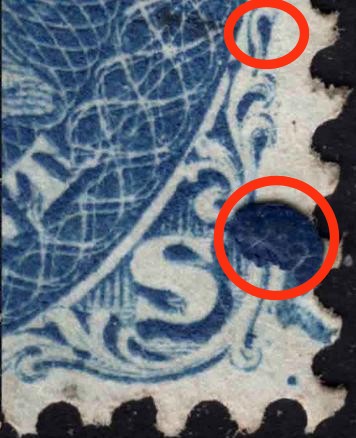  |
|
Send note to Staff
|
| Edited by wert - 03/24/2015 7:51 pm |
|
|
Pillar Of The Community
United States
937 Posts |
|
|
I applied my method of color sampling to your stamp and I found that the colored "blob" is very similar to the ink used to create the intended design. 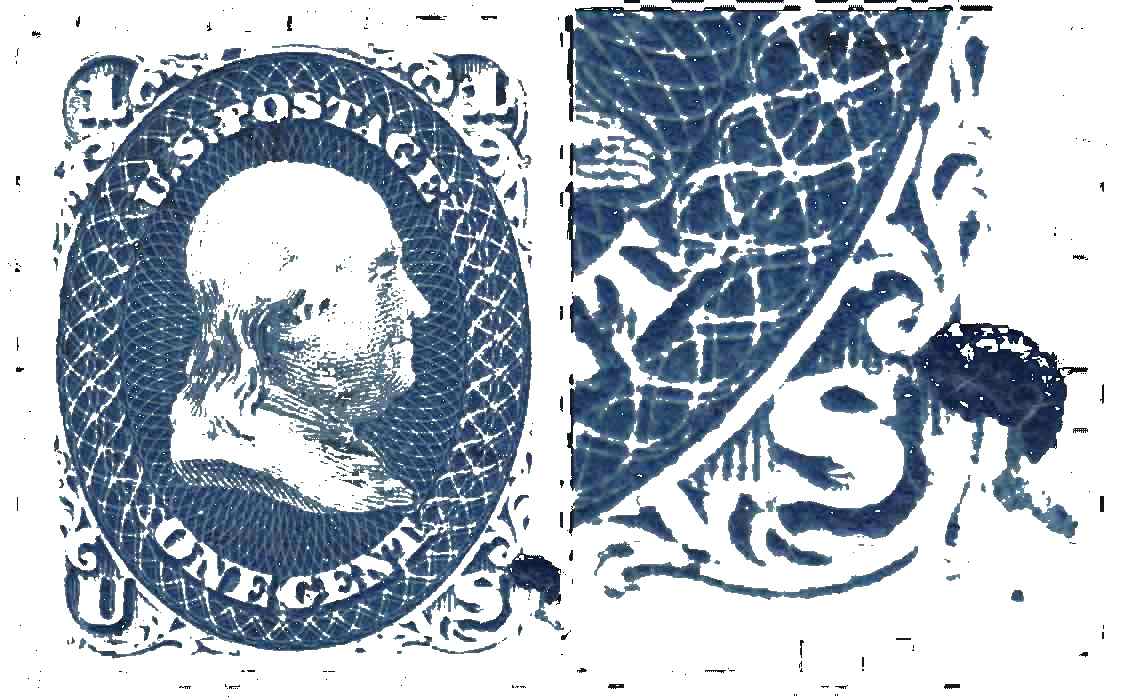 How that "blob" got there is subject to conjecture, but it does appear to consist of the same ink and was an anomaly created during the printing process. It does present as being more "dense" than the intended stamp impression. This makes me think that maybe it was a drip from wiping the plate while the previously printed stamps still sat below while plate preparation for the next imprint on fresh paper was to occur. Regardless, it is nicely centered and a detailed impression. I quite like it and the "blob" adds interest for me. I am very curious to read about how others view the origin of this "blob's" occurrence. |
|
Send note to Staff
|
Ryan = HDNAC = DNA = HDC = Hysterical DNA Collector = Historical DNA Collector = me who just loves stamps :) |
|
|
Pillar Of The Community
United States
1946 Posts |
|
|
I refer to it as a "blob" because it is not merely a darkly colored deposit of ink on the surface. This is actually a 3D "pellet" of dried ink or whatever. Most likely a droplet from wiping that "flew" to a landspot. Why, where, or how is anybody's guess.
Intriguing, no!? |
|
Send note to Staff
|
|
|
Pillar Of The Community
United States
937 Posts |
|
|
It is intriguing. Now knowing that it is three dimensional as in "thick" adds credence to my suspicions. I am hopeful that someone might provide information of how this potential printing anomaly could occur. |
|
Send note to Staff
|
Ryan = HDNAC = DNA = HDC = Hysterical DNA Collector = Historical DNA Collector = me who just loves stamps :) |
|
|
Rest in Peace
7742 Posts |
|
|
essayk...When I was young in high school and taking a printer/lithographer course, we came across these types of oddities..Basically they were blobs of ink/paper fragments that either got into the ink roller tray or transferred to the sheet by other means..My software shows a 3D of that blob where the red arrows are pointing...The green portion is the surface of the stamp and the yellow is also regular ink..Probably just a "one off" and not a constant...In my opinion. Robert 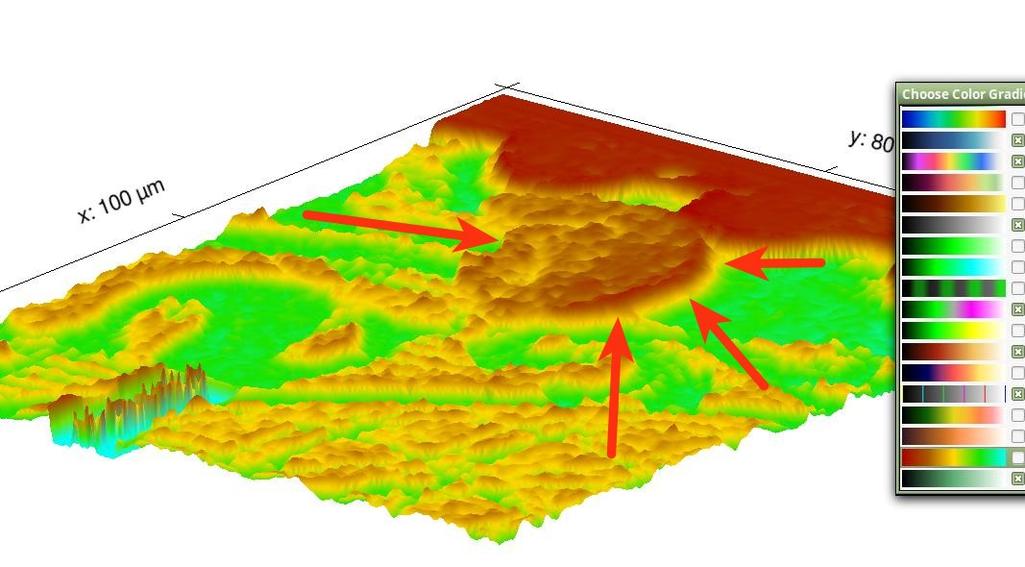 |
|
Send note to Staff
|
|
|
Pillar Of The Community
United States
1946 Posts |
|
|
I'm very impressed by that software and what you can do with it, Robert, and I envy your experience with it and your work in the trade as well. It sounds like you have the right kind of experience to do a failure analysis on this. For that it is usually necessary to observe a performance distinction between automated systems and manual ones. How might the fact that this stamp was produced on a press operated entirely by hand impact the kinds of production error we might be seeing here? Would manual wiping be more or less likely to leave something like this behind?
|
|
Send note to Staff
|
|
|
Moderator

United States
12330 Posts |
|
|
Sigh. Only problem is in understanding what Wert's image actually shows. This software is adding 'height' based upon the COLOR, not actually the z axis of the stamp. In other words, if the blob was black it would show it even higher. No software can add 3D attributes to a 2d bitmap image, it requires additional information which bitmaps do not contain. It is a 2d image, period. Just because it looks like we can add height to a 2D bitmap using this kind of filter does not mean the z axis is there. Notice that the image Wert posted has been cropped, he removed the black border in the original 2d image. If he not cropped the image, it would show the black border as being 'high'! I am stepping out of this discussion now because I know it is going get defensive and no one is going to be able to produce any solid evidence that the mapping is actually the z axis (because it is not and there is no software that can generate a 3D image from a 2D image). If anyone has any documentation that says it can add z axis information please post it. I am familiar with the structure of bit file formats and want to understand where the information is stored in the actual file. (FYI, it isn't.) Now if we were talking bout a vector mage, then yes it contains z axis data in the file itself. Think about it. Take a 2d bitmap and then extrapolate it into a 3d image? Wow. If this could be done, it would become a 'killer app' in the graphics industry. All kinds of new apps would be on the market. Don Edit: to prove what I am saying, simply add a big black circle on the image and then run it through he same filter. It will come back as the black circle as being 'higher' than the rest of the image! edit2 here is a link which shows how Adobe After Effects can add 3D z axis attributes to a 2d image. https://library.creativecow.net/art...deo-tutorialNote how the HUMAN adds the new layers and camera angle to achieve the 3D affect. |
|
Send note to Staff
|
| Edited by 51studebaker - 03/25/2015 12:44 pm |
|
|
Pillar Of The Community
United States
3268 Posts |
|
|
Quote:
Would manual wiping be more or less likely to leave something like this behind? I would think that it would depend on the person doing the wiping, was it late in the day, was that person being careless or carefull? |
|
Send note to Staff
|
|
|
Rest in Peace
7742 Posts |
|
|
Here is the BLACK circle you requested Don..As you can see it is NOT raise as the blob is..Just seeing what the software shows me..sorry if that bothers you..only trying to get involved with guys/girls on the stamp forum and bringing 21st century software in as a tool for this great hobby. But if you like I will go back to the Canadian side where I feel safe...haha Quote:
I would think that it would depend on the person doing the wiping When I did roller wiping in high school, we used a strong solvent and SOMETIMES we didn't get 100% of debris off. Robert 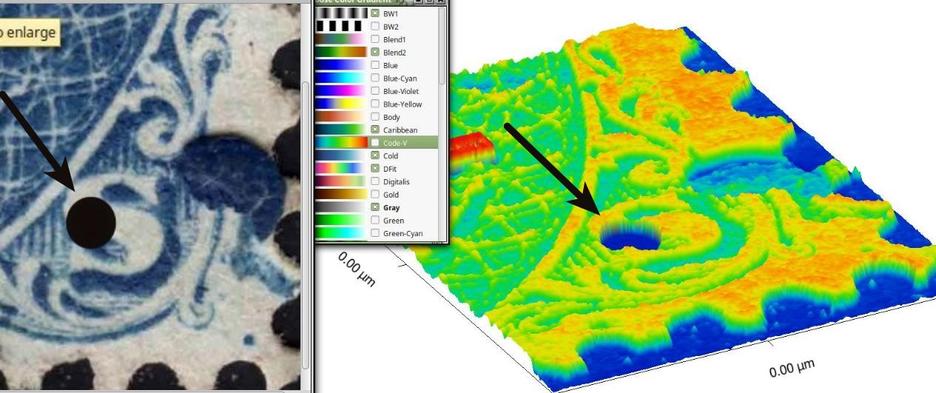 |
|
Send note to Staff
|
| Edited by wert - 03/25/2015 12:54 pm |
|
|
Rest in Peace
7742 Posts |
|
|
Moderator
United States
12330 Posts |
|
|
Robert,
You actually have proven what I am saying, that the color histogram is simply reflect the color shift in the image, it is NOT showing z axis information. Did you watch the link I provided? Do you have any documentation that shows the filter you are using can produce z axis data? Getting 3D data REQUIRES z axis information, whether it is already there or if it is being generated. As the video shows. you would have to add layers and then let the software add a camera angle to produce a 3D image. In other words, if your software was actually showing the image in 3D you would be able to post a image like in the video and not just a color histogram. Your software would be able to take the next step and apply the z axis data in the original image; giving you an actual image with depth.
I respect and admire your efforts to use technology to enhance the hobby; but we need to be careful about making claims or implying that something is when it is not. You are assuming that the color histogram APPEARS to reflect 3D image that this is the case. It is not. It is simply extracting the color map of the image and applying a histogram to it. It has nothing to do with any height or depth beyond the color shades.
Don
Edit; Note that in your second image the black blob is shown as a dark blue. Now look at the original blob; it too is a darker blue. This is a clear indication that your software is simply using the color mapping to generate the histogram.
|
|
Send note to Staff
|
| Edited by 51studebaker - 03/25/2015 2:05 pm |
|
|
Pillar Of The Community
United States
1946 Posts |
|
|
I understand what you are saying, Don, I really do. However, the gradation of light does give a sense of dimensionality to a 2D image, and it appears that his software is extrapolating a 3D shape from that gradation. What is surprising to me is that it comes close to rendering a view it cannot actually have.
I would like to test that out by providing one or two other 2D images of this feature, just to see what his software will do with them. However, I can't get to that just now because the stamp is tied up in another project. When I get it loose I will make the other pics and post them. |
|
Send note to Staff
|
|
|
Pillar Of The Community
United States
845 Posts |
|
|
Don is absolutely correct. Using only the 2-D image of the stamp you have only, well, two dimensions (width and height of the stamp) and not the depth (z-axis) of the actual object the image was taken from. The "depth" Wert shows is not actual physical dimension of the stamp at all, but an extrapolation from color data. There is no relationship between that extrapolated depth and the actual depth of the stamp. There can't be. |
|
Send note to Staff
|
|
|
Pillar Of The Community
United States
845 Posts |
|
|
That's not to say it wouldn't be possible to write some software that could infer layers of color from the image (not depth), but such an effort would be very difficult and not something available in a commercial or free-ware product (if available at all except a university laboratory). |
|
Send note to Staff
|
|
|
Replies: 30 / Views: 4,773 |
|




 Posted 03/24/2015 7:05 pm


