| Author |
 Replies: 10 / Views: 2,521 Replies: 10 / Views: 2,521 |
|
|
Valued Member
United States
189 Posts |
|
|
I started going through the stamps with grills. There are 12 of the 114s and since the Scotts says 'dbl impression' for the 114, I thought I would look a little more closely. The 3 on the right hand one has 4 or so areas of missing ink, that no other(s) of the 12 have. Would that just be an 'inking issue'? The other one is there because I can't tell the different paper and while the paper is suppose to be the same, to me, it looks different and both have the grill. So, opinions on the two stamps would be appreciated. 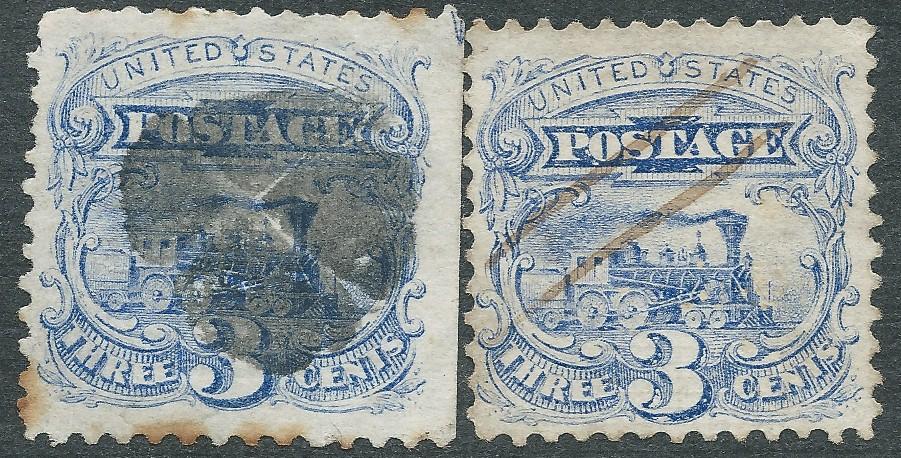 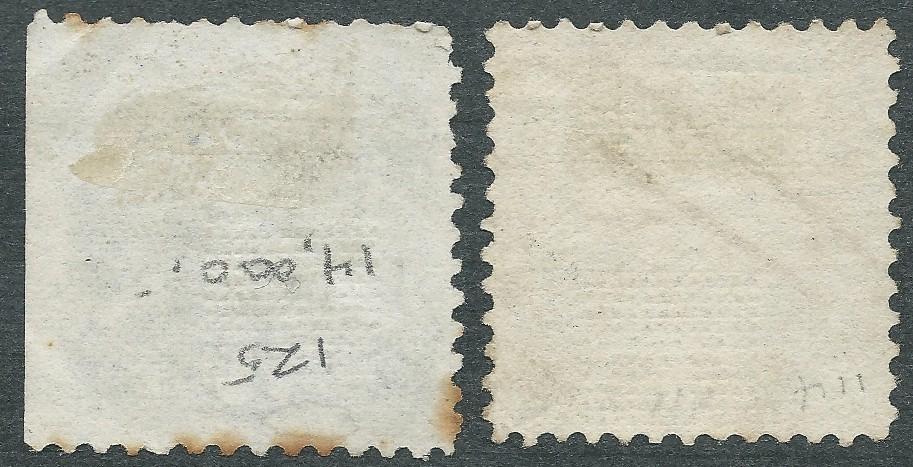 |
|
Send note to Staff
|
|
|
|
|
Rest in Peace
United States
7097 Posts |
|
|
Pillar Of The Community
United States
1116 Posts |
|
|
Both are Scott 114, with a grill. The left stamp is a sheet margin copy showing a partial arrow (also someone optimistically wrote "125" and "14,000", but is clearly a 114).
The missing ink is a printing oddity, so some might consider it an interesting EFO. |
Send note to Staff 
|
|
|
Pillar Of The Community
United States
1946 Posts |
|
|
In printing stamps by line engraving, the paper is kept moist until put into the press. This improves the way the ink "sits up" on the paper. As the paper dries the ink does not behave as well. A true "dry print" has lots of white patches and spots marring the surface. What you are showing on the right is still well within the "normal" range of acceptability despite the breakup around the numeral "3." It illustrates the point about printing on dry paper, but it is not an EFO item.
To qualify as an EFO it has to be really bad to be good. |
|
Send note to Staff
|
| Edited by essayk - 04/09/2015 09:22 am |
|
|
Valued Member
United States
189 Posts |
|
|
I-Love_Stamps & orstampman - Thank you both. I suppose that is what comes of dealing with something in which one has no experience. I notice things like perhaps a difference in paper color or texture but, with no experience of having to compare them in a qualitative manner, noticing doesn't help much.
As for the '125' and 14,000.', that could have come from anywhere. The gentleman had collected stamps, on and off, all his life and even helped out in the stamp shop of a friend of his, sorting stamps, for a period of time after he retired. In those years, I heard that a lot of collections came into the shop from all over Santa Barbara county - before the internet and all the connectivity. |
|
Send note to Staff
|
|
|
Valued Member
United States
189 Posts |
|
|
essayk - Thank you for elaborating. Ain't it the way, though? Just like the TV - If it's bad enough, it's good enough to be news. |
|
Send note to Staff
|
|
|
Rest in Peace
7742 Posts |
|
|
Old ink left in the engraved lines could also dry out, causing these areas to become more shallow. If the plate was not thoroughly cleaned between printings, these dry areas would gradually build up, and soon there would be no open engraved areas to pick up fresh, wet ink, causing white gaps (due to lack of ink) in the printing.
essayk is completely correct on half the cause of white spots...
Robert |
|
Send note to Staff
|
| Edited by wert - 04/09/2015 11:28 am |
|
|
Valued Member
United States
41 Posts |
|
|
Wasn't sure if I should start another thread. My apologies if I should have. Thought that while we were on the subject of US #114's I would post a couple of mine that I have been wondering about.  On this one please note the overall "blurry" appearance, and look closely at the tops of the letters "Three Cents" in comparison to other examples. The tops of the letters seem to be cut off. Scott mentions a cracked plate for these I think, and a double impression. Anyone think it might be either of those? The back of the stamp:  On this stamp there is no apparent grill. I have read here about pressed out grills for this one. In good light, from different oblique angles I haven't been able to see a grill. Front:  Back:  Any thoughts on these? |
|
Send note to Staff
|
|
|
Valued Member
United States
189 Posts |
|
|
wert - Thank you for that bit of info. I wasn't really looking for it to be an EFO or 'variety'. However, I don't seem to find or read about too many (comparatively speaking) instances of 'ink or inking issues'. Just trying to fill in the blanks. Also, it is good to have the confirmation that the paper is the same on both because that is another area I'm still quite green in. |
|
Send note to Staff
|
|
|
Pillar Of The Community
United States
937 Posts |
|
|
Columbian12, I am not an expert on these. I do not see evidence of a cracked plate nor a double impression. Your specimen that doesn't show an obvious grill could be due to the difficulty of scanning a grill so it is visible. The grill could also have been pressed flat such that an existing grill is no longer visible. |
|
Send note to Staff
|
Ryan = HDNAC = DNA = HDC = Hysterical DNA Collector = Historical DNA Collector = me who just loves stamps :) |
|
|
Pillar Of The Community
United States
1946 Posts |
|
|
Robert,
Please don't take offense for I mean none, but your comment about ink drying out and building up in the engraved lines of a plate during production sounds like pure conjecture. It flies in the face of the procedures that were used for production in the US. Do you have any evidence that this actually happened with the Bank Note Companies that worked on US stamps?
Columbian12: I have seen many examples of a weakly impressed grill in which the points did not break the paper and barely left an impression. It would be a simple matter to soak one of these and then apply concise pressure on the grill area and so press it out. If done carefully, when it becomes dry you would not be able to tell it ever had a grill. |
|
Send note to Staff
|
|
| |
Replies: 10 / Views: 2,521 |
|



 Posted 04/09/2015 01:01 am


