| Author |
 Replies: 13 / Views: 2,169 Replies: 13 / Views: 2,169 |
|
|
Moderator

United States
5107 Posts |
|
|
Looking through my duplicates, and comparing to listings in "Encyclopedia of Plate Varieties on US Bureau-Printed Postage Stamps, 1979", I couldn't find this one. Any ideas on a mark/crack in the N of Cents? Thanks in advance. 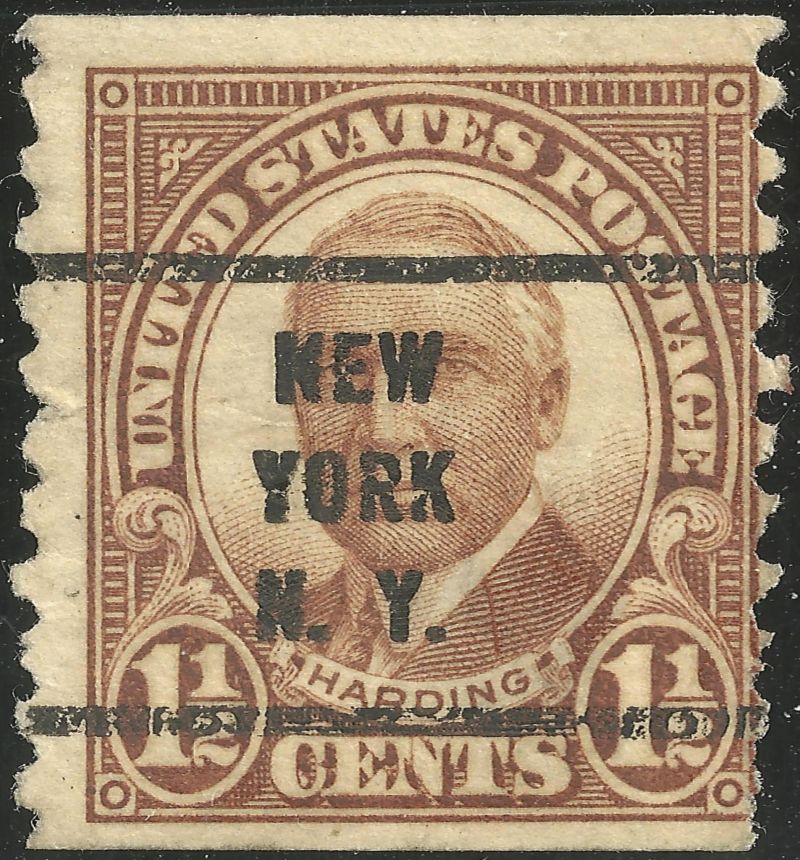 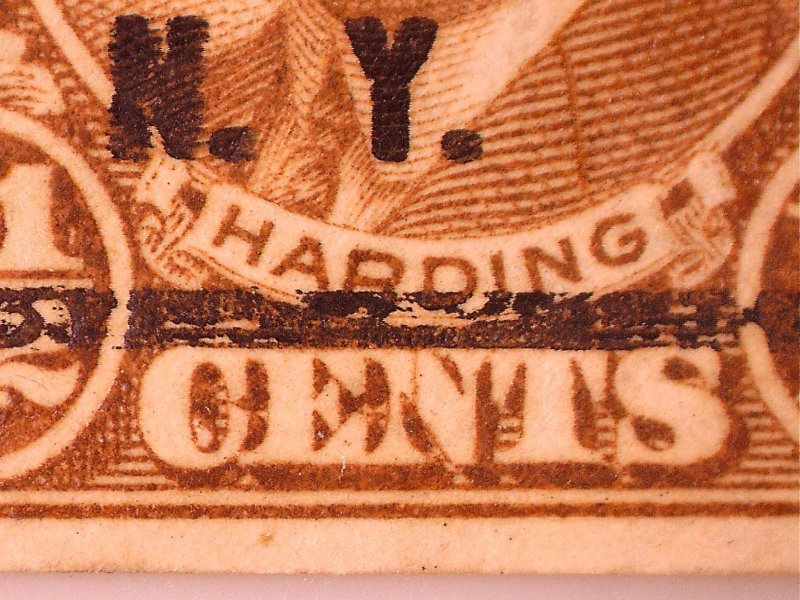 |
|
Send note to Staff
|
|
|
|
|
Pillar Of The Community
United States
937 Posts |
|
|
Partime, I cannot tell you exactly what caused the line in the "N". However, I can speculate. Your post received no replies, but I feel that it should at least have some attention.
The line through the "N" doesn't continue to the edge, so I don't think that it is a plate crack. Specifically it doesn't appear to be a gripper crack.
It seems to only be visible on the "N". The line is pretty clean so I speculate that it was caused by a miscut where someone added definition but slipped and made the line that we see.
Obviously it could be due to many things. Others, please add your opinions about how it came to be.
Let's not leave this post's question without any answer. Speculative answers are perfectly valid. |
Send note to Staff 
|
Ryan = HDNAC = DNA = HDC = Hysterical DNA Collector = Historical DNA Collector = me who just loves stamps :) |
|
|
Pillar Of The Community
United States
1179 Posts |
|
|
It appears to be a "scratched" plate. Possibly caused by a dropped tool, would be my guess. (like a screwdriver used to lock in a plate) |
|
Send note to Staff
|
|
|
Moderator
United States
5107 Posts |
|
|
Thanks for replying, Historical and Hal. I almost forgot about this one. As you surmised, I was wondering if it was a crack, but, if so, I was expecting more jagged and longer ... maybe to the edge. So I like the idea of a dropped tool, or an engraver's slip. But, if an engraver's slip, I would have expected this to be discovered by now.
Anyway, thanks for the ideas and ... yes ... I like to see speculation. |
|
Send note to Staff
|
|
|
Pillar Of The Community
United States
1179 Posts |
|
|
It very well could be the start of a crack and it was spotted. I'm going to a precancel show in Md. this weekend. It will give me something to look hunt for in my spare time. |
|
Send note to Staff
|
|
|
Moderator
United States
5107 Posts |
|
|
Pillar Of The Community
United States
1946 Posts |
|
|
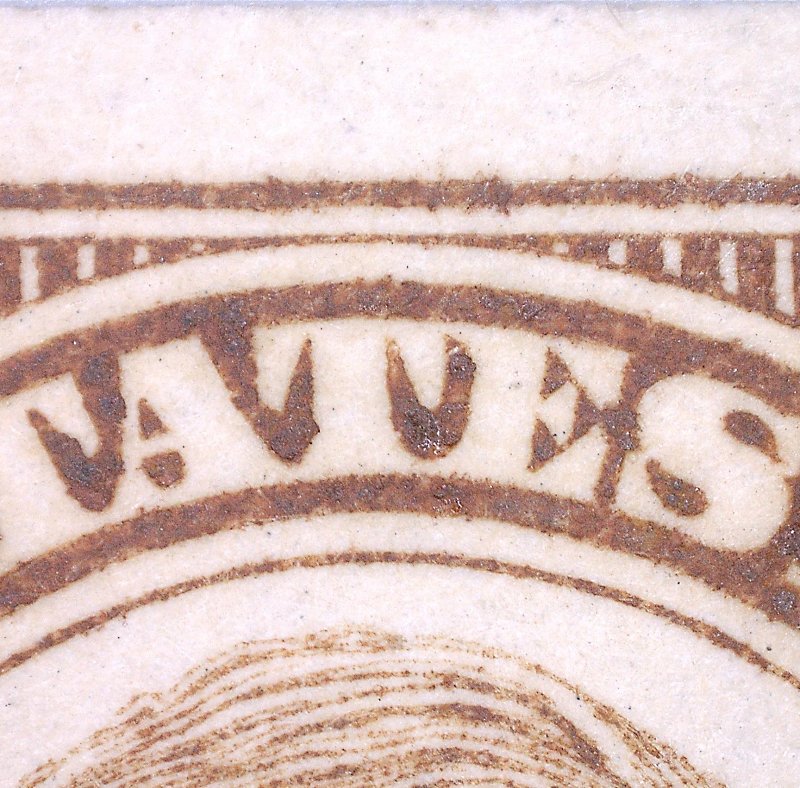
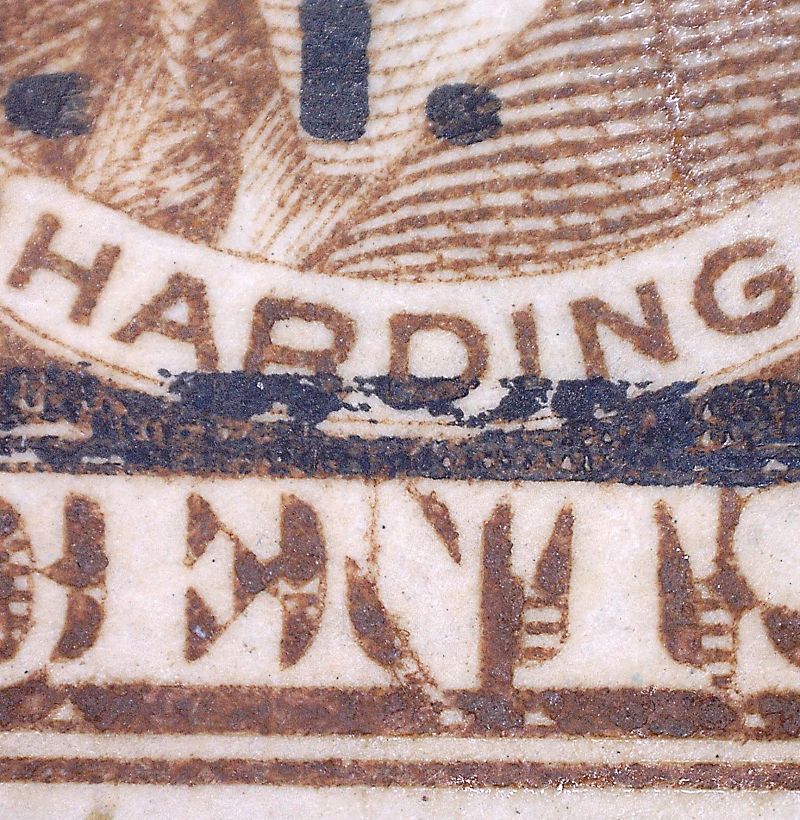
The line is so straight that I would like to rule out the possibility that it is bit of a layout line that didn't get burnished out entirely. [For the record the mark you see is not listed in the "Encyclopedia" by Cloudy French of which Dave reminded us.]
Could you give us a good closeup view of the area just below the second T of "STATES" above the vignette? Include the "T". If there is a residual of a line there, even just a couple of aligned dots, then you need to use a strong glass and look for other remnants of a line for the full height of the stamp. But remnants high and low would pretty well convince me that the line was on the plate before the stamp image was entered.
Don't think of that as confirming a hunch, but as removing a doubt. A super close look at the lower line might show it to be more irregular than a layout line would be. But I can't tell from the pic. This is one I would have under the microscope. |
|
Send note to Staff
|
| Edited by essayk - 04/24/2015 09:35 am |
|
|
Rest in Peace
7742 Posts |
|
|
Partime..I am going to through in my two cents worth...I created a 3D effect of the area you are concerned with..The blue line points to a indentation in that area...I agree with a tool scratch or something along that line...Not a plate crack...Just my opinion and could I be wrong. Robert 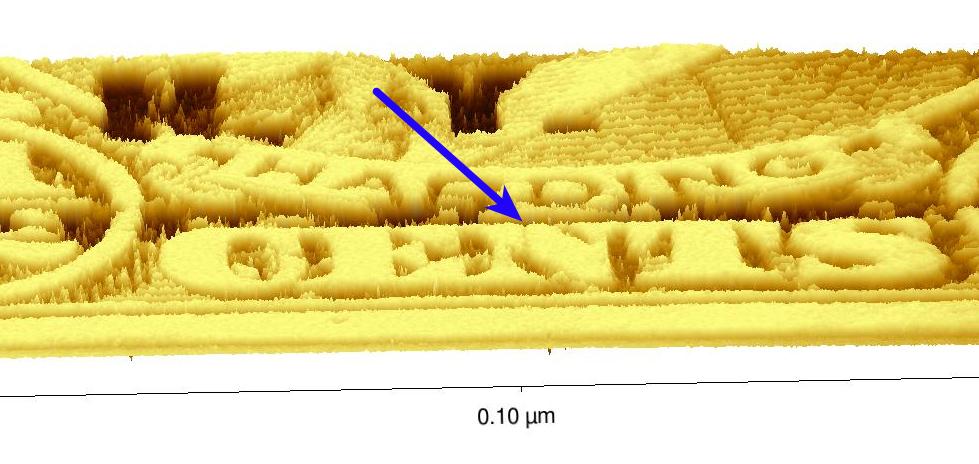 |
|
Send note to Staff
|
|
|
Moderator
United States
5107 Posts |
|
|
Thanks everyone. Unfortunately, I'm at work, then have to hop off directly for a weekend date. I'll be able to show better close-ups of the areas in a couple of days. Sorry for the delay. |
|
Send note to Staff
|
|
|
Pillar Of The Community
1151 Posts |
|
|
wert, how did you create that 3-D affect?
How would this 3-D affect be used in examination of stamps? As I've never seen an image like the one you posted, very interesting. My first thoughts are that it would be help in identifying double transfers or re-entry, but perhaps I'm wrong.
What kind of results (if any) has this 3-D affect achieved with stamp collecting?
Really nice, interesting to say the least.
In the "C" of CENTS, there appears to be an object, could this be a dust speck, some part of the printing?
Again, most interesting.
Dave |
|
Send note to Staff
|
|
|
Moderator

United States
12330 Posts |
|
|
Wert used an application that takes the color map and extrapolates it into "3D". It is not true 3D data. You cannot take a 2D file format and somehow magically turn it into 3D file. The z axis information simply does not exist in a 2d bitmap file format. It's a fun thing to play with but it cannot be used to determine any z axis information.
Don
|
|
Send note to Staff
|
|
|
Pillar Of The Community
United States
1873 Posts |
|
|
Don is correct. The virtual 3D image reflects a color difference in the original image at the blue arrow and nothing more. That virtual image cannot be used to say that the stamp or plate have a dimensional indentation. At most the virtual 3D image shows a virtual indentation that the software has created on its own based on the color difference of adjacent pixels in that area, rather than based on a physical variation in depth. |
|
Send note to Staff
|
|
|
Pillar Of The Community
United States
1179 Posts |
|
|
WERT -- That's a fantastic image! I'll stick to my original thought: tool scratch. What did we do before computers!
51studebaker - Thanks for the 3D explanation.
Hal |
|
Send note to Staff
|
|
|
Moderator
United States
5107 Posts |
|
| |
Replies: 13 / Views: 2,169 |
|




 Posted 04/19/2015 11:53 am