| Author |
 Replies: 13 / Views: 3,178 Replies: 13 / Views: 3,178 |
|
|
Pillar Of The Community
United States
4183 Posts |
|
|
Just picked up this one: 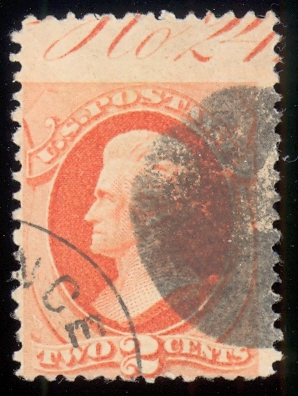 I don't know how to tell yellowish wove from soft porous paper, so I don't know if it s a 178 or a 183. 183 is lightly penciled on back, but my Durland suggests it is a 178. When I came across it, I said How much, and the seller just tossed uot $10, and I just shrugged and said sure. Yes I know the perfs at the bottom aren't perfect, but I like the plate number (even if the last digit doesn't show so I don't know wexactly which one it is). |
|
Send note to Staff
|
|
|
|
|
Pillar Of The Community
United States
1756 Posts |
|
|
When you receive it, hold it up to the light...
you'll know which it is instantly... |
Send note to Staff 
|
|
|
Pillar Of The Community
United States
578 Posts |
|
|
From the looks (color, paper, perfs, etc.) I'm 95% sure (maybe 99%) this is going to turn out to be a Scott 183, not Scott 178. The current Durland lists both plates #241 & #242 for Scott 183, but notes that they "may have been for a misidentified #178".
IMO, this stamp is likely to "conclusively" identify that at least one of those plate numbers was used for Scott 183, so might be worth reporting. FWIW, since a tiny sliver of the 3rd number shows, it may even be possible to determine exactly which plate number it is. |
|
Send note to Staff
|
|
|
Pillar Of The Community
United States
1946 Posts |
|
|
How recent is that Durland cat, Ken? I ask because several years ago Matt Kewriga (Mr. 2c vermilion) included in his exhibit this: 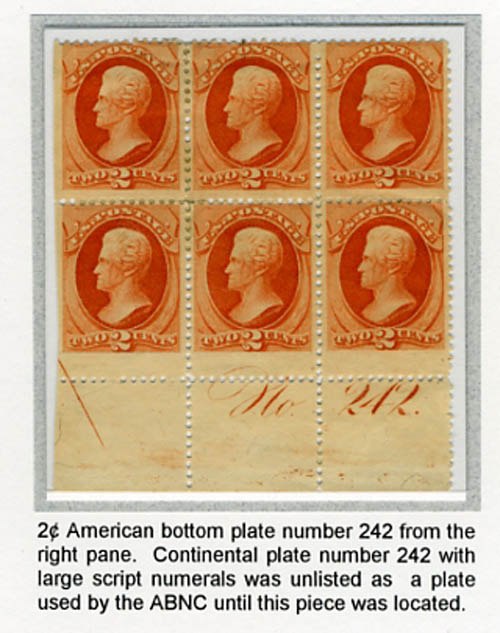 So if the new Durland isn't showing it, somebody dropped the ball. |
|
Send note to Staff
|
|
|
Pillar Of The Community
United States
578 Posts |
|
|
Pillar Of The Community
United States
1946 Posts |
|
|
Here is another capture piece from my collection, which shows a bit more of the "tiny sliver." [The paper is soft paper.] 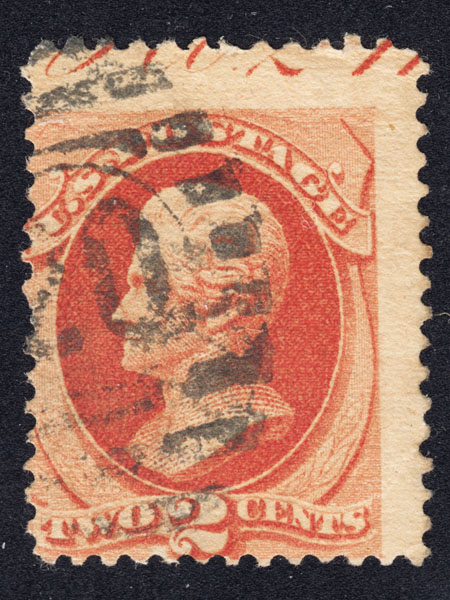 That "sliver" part of the numeral "2" appears the same on both 2s in Matt's example. On my example and the one eyeonwall showed us the sliver is not identical to the LL stroke of the "2". Dare we suggest that this is a downstroke for a numeral "1"? I won't be satisfied with that until I see a clear example of the cursive numeral "1" that Continental used late in their game. The earlier stuff, before 1875 at least, used die punched numerals of a completely different font. Edit: Here's a closer look at the capture numeral, to show it is a 2-4-x combo. You can see some of the crossbar of the "4" on a couple of perf tips. 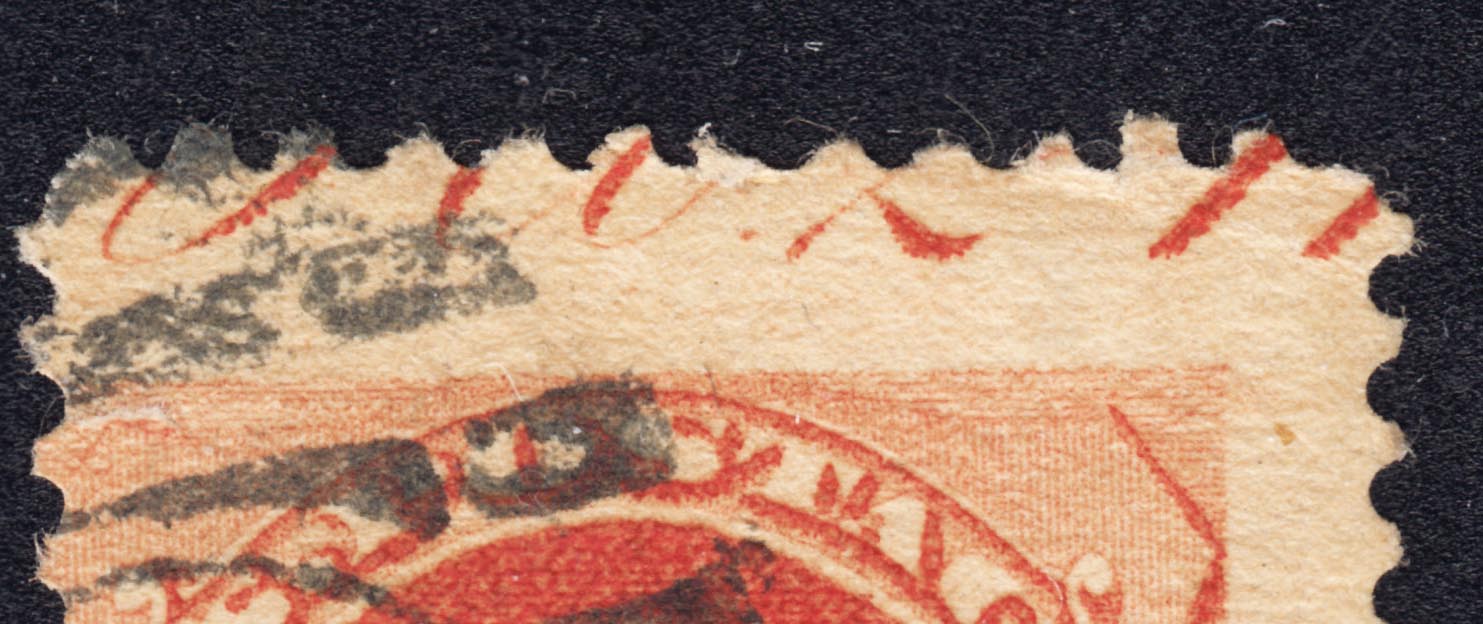 |
|
Send note to Staff
|
| Edited by essayk - 04/20/2015 12:11 pm |
|
|
Pillar Of The Community
United States
4183 Posts |
|
|
Quote:
FWIW, since a tiny sliver of the 3rd number shows, it may even be possible to determine exactly which plate number it is.
The sliver is wider than the left edge of the foot of the leading 2, so it looks to be a 241 and not a 242 (assuming those are my only 2 choices). |
|
Send note to Staff
|
|
|
Pillar Of The Community
United States
4183 Posts |
|
|
Quote:
When you receive it, hold it up to the light...
you'll know which it is instantly... As I said, I don't know how to tell the two different papers apart, so holding it up to the light tells me nothing (and I don't have a bunch of other stamps from this era to compare to - I've only gotten interested in the clssics relatively recently and don't own very many). I think I'll take it to Westpex and see if I can find some help. |
|
Send note to Staff
|
|
|
Bedrock Of The Community
United States
10865 Posts |
|
|
If you hold it up and you see a lot of shadows on the paper it is soft (183), if you don't see them it is hard (178). |
|
Send note to Staff
|
|
|
Pillar Of The Community
United States
4183 Posts |
|
|
Rest in Peace
United States
763 Posts |
|
|
Pillar Of The Community
United States
4183 Posts |
|
|
Here is another one I just picked up. It has the type E1 imprint (smaller numerals) while the one I showed earlier to start this topic had the type E2 imprint (larger numerals). All I can make out is a 2. Choices for the second digit are 3, 4 or 9. Clearly not a 4, but I don't know what the 3's and 9's look like. I'm not good with papers, so I don't know if the Scott number is 178 (yellow wove) or 183 (soft porous)[yes, I know the porous has more fibers at the ends of the perf tips and looks more splotchy when back lit, but without seeing one of each side by side that doesn't help], but 183 is 3 times cheaper, so blind luck suggests 183. 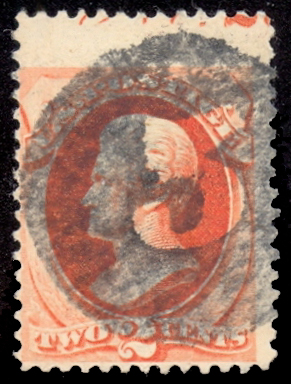 |
|
Send note to Staff
|
|
|
Pillar Of The Community
United States
4183 Posts |
|
|
ok, I dug out the earlier one which was ID'd as a 183, and I think this new one matches it for paper type
edited to add - can anyone tell me whether the cancel is a "5" or a poorly printed "3"? |
|
Send note to Staff
|
| Edited by eyeonwall - 12/19/2015 1:20 pm |
|
|
Pillar Of The Community
United States
1946 Posts |
|
|
The numeral in the cancel is a "5". It is one of the Boston numeral cancels used from 1879-83. Blake and Davis #1782A to be exact.
Edit: [That period of use skews the probability toward soft paper for the stamp.]
If the paper of your two examples looks about the same when held to the light side-by-side, they probably are the same paper.
BTW the Scott description of the Continental paper as "yellow wove" is a bit misleading in that many collectors expect it to be more "yellowish" than the soft paper. Not so. The comparison is with the hard papers of the National Bank Note Co. alone. The Continental papers tend to be more dingy, but they still tend to be brighter (to my eye at least) than the later soft paper.
Part of the problem, however, is that the Continental paper stock gradually worked over to include an early version of "soft" paper which we call "intermediate." That stuff really is confusing, and gets you into paper thickness, mesh, period of usage, printing shades, luminescence, and other headaches. For the non-specialist you are best off to treat intermediate paper as soft unless there is compelling evidence that it is something else. But to the naked eye, if the paper has a sheen to it that is devoid of mottling, it is hard paper irrespective of the color of the paper. This is an oversimplification, but it keeps you in the ballpark. |
|
Send note to Staff
|
| Edited by essayk - 12/19/2015 2:03 pm |
|
| |
Replies: 13 / Views: 3,178 |
|



 Posted 04/19/2015 10:52 pm


