Ah, 'tis late Spring and we're running out of doors. Time to tend to lawn and garden, and general cleanup. So, in the lull I thought maybe I could get away with putting this out there.
Those of you who know how to use the Siegel website "Power Search" feature may wish to bring up the results for a search on Scott number 216. Those of you who don't know how to use it, now's a good time to learn it, but hopefully the images here will allow you to get around what you don't know. I will try to give you a link that will help, but if it doesn't work, you are on your own.
http://siegelauctions.com/lot_grd.p...lledfrom=lkp br /
Not everyone enjoys stamp stories, but here goes
Not long ago we had a thread on the breaking of rare multiples for profit. Because of a recent purchase on
ebay I'd like to add an item to that discussion. I bought this stamp on
ebay about a week ago, and yesterday it arrived.
http://www.ebay.com/itm/261904303907 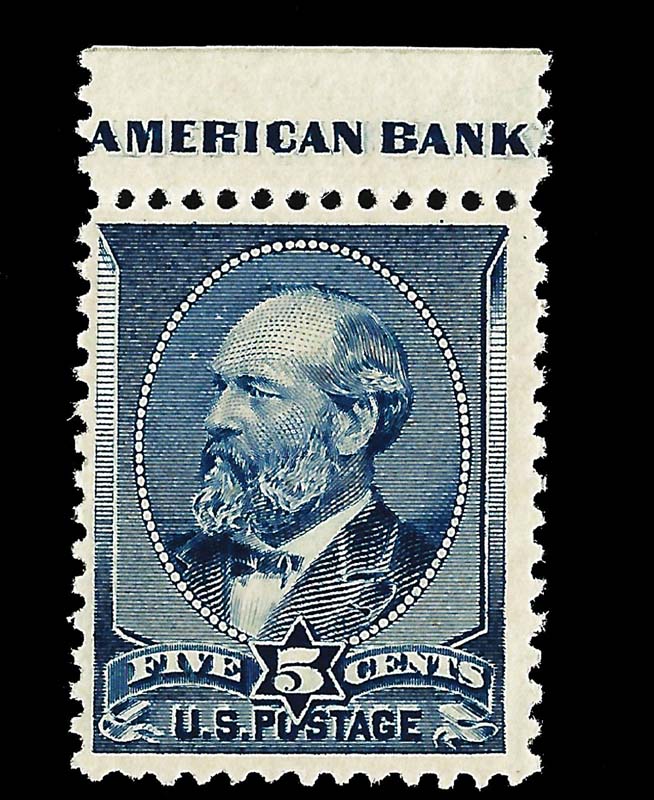
I was very pleased to get it at my price. When I opened the package I found that the seller had also sent a color photocopy of a PF certificate for a strip of three from which it was taken. I recognized the strip:

This had been in the William Fekete collection, sold by Siegel last October, as lot 395 sale 1082. The strip has some very interesting features but only realized $450 against a catalog value of $1150. At first it just looks like a busted up plate number strip, which it is. But this strip was ripe for further breaking, and it now is broken up altogether. As the cert notes, the two stamps on the right are "previously hinged" while the stamp on the left is
NH. But the left stamp has some blind perfs between the stamp and the selvage, which is mentioned in the cert. The stamp on the right has a plate scratch not mentioned in the cert but mentioned in the auction description. What is not mentioned by either is that someone had called attention to that line by scribing a marker and the word "line" in the selvage. We will come back to that.
What first surprised me is that this strip had a PF cert at all. I saw that the
ebay seller was the buyer of the strip from the auction and had submitted it for a cert. Then I noticed the date on the cert, which was barely 20 days after the date it had been in the Siegel sale. Not only had the seller submitted the strip, but had anted up for expedited service. That meant his tally for the strip amounted to the hammer price plus house surcharge plus 5% of cat for the cert plus 20% for expedited turnaround; a total of $586.50. So his outlay for each stamp was almost $196, but he had accepted my purchase offer for way less than that for the single I bought. Whatever he was seeing in this strip it wasn't in the stamp I bought. That got my attention. What was he after? Was it the single with the line in it or the
nh single at the other end?
I decided to take a look at what this stamp was doing at auction, and the Siegel search tool came to my aid. Seven months earlier in March 2014 Siegel had sold a stamp which is very similar to the one I just bought, but in a much higher grade of centering and with never hinged original gum. Here's its pic.
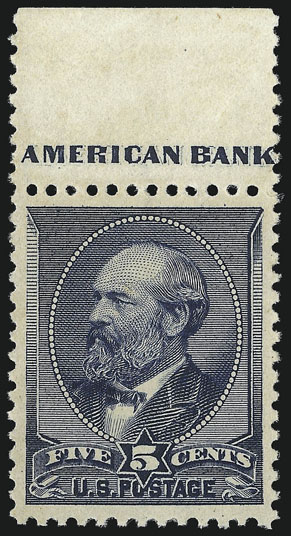
That stamp realized $1200. Was that difference due to the centering or the fact that it is
nh, or perhaps the combination of the two?
Centering can certainly have a profound effect. Just two weeks after the Fekete sale, in a sale of part of the Curtis Collection, Siegel sold a premium used single for $275 against a cat of $17:
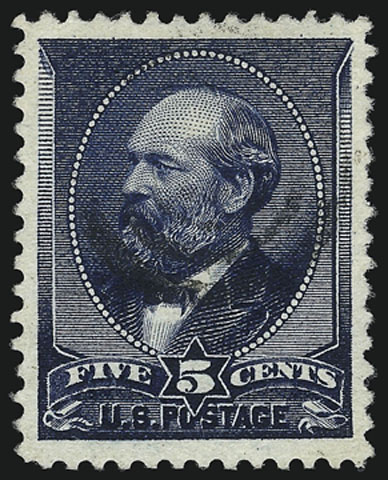
On the other hand, here is the picture of a stamp Siegel sold a month later:
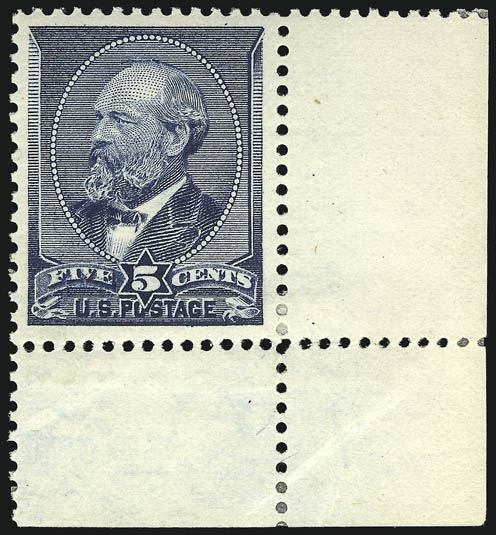
Although that stamp is every bit the equal of the imprint single, it has a tab reinforcing some perfs and so is
hr (hinge remnant) not
nh. It realized $275 against a cat of $225. Still better than cat but hardly a premium item.
It was starting to look like the
nh factor was the key, but two months after the Fekete sale Siegel sold this
nh stamp:
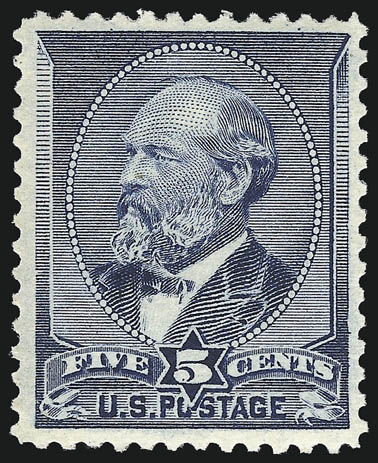
Against a cat of $700 for
nh it only realized 550, despite better centering than the stamp on the left in the strip of 3. So it appears that for mint stamps the
nh and centering factors combine. Which means that for the stamp on the left in this strip the magic wasn't there.
So then, the stamp on the right end of the strip must have been the key. Was the magic in that scratch?
That plate scratch is a known flaw for position 6 in the right pane of plate K537, but apparently not for its entire period of use. This scratch is known on other examples of 216, but although this plate was also used for late printings of 205 so far the scratch has not been found on those stamps. This strip of the 5c SAMPLE overprint, which was only printed in 1889, and not from old stock, also shows the scratch on the stamp farthest to the right, on a line with the "T" of NOTE:
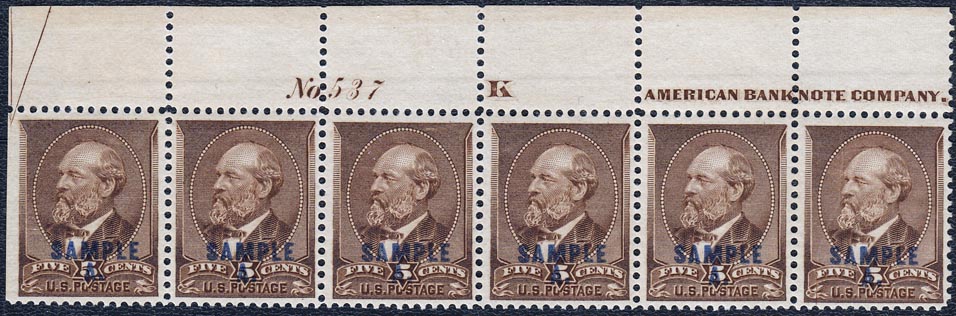
Want a closer look?
It just so happens that in their rarities sale last June, Siegel sold a Garfield blue that was the first to rate a superb 98 jumbo, and it also happened to have the scratch:
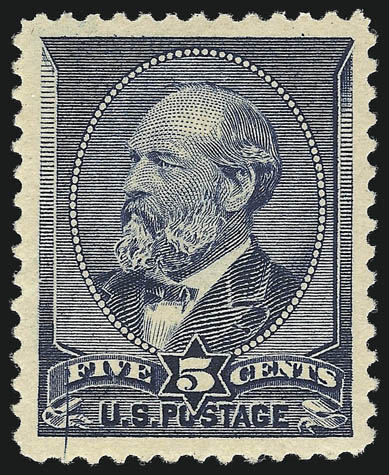
Against a catalog of $700 that stamp realized $12000.
Was that because of the scratch?
or because it was the first, and only, to grade that high?
on that day.
One thing that came out of this foray into auction realizations for me was the confirmation of an old adage that the value of a stamp is really whatever someone will pay for it, with the corollary that a stamp's realization at auction is more about who is doing the bidding in a particular sale on a particular day than it is about any theoretical book value. Another day, a different dollar.
N'est-ce Pas?





 Posted 06/05/2015 09:18 am