| Author |
 Replies: 55 / Views: 19,307 Replies: 55 / Views: 19,307 |
|
Valued Member
92 Posts |
|
|
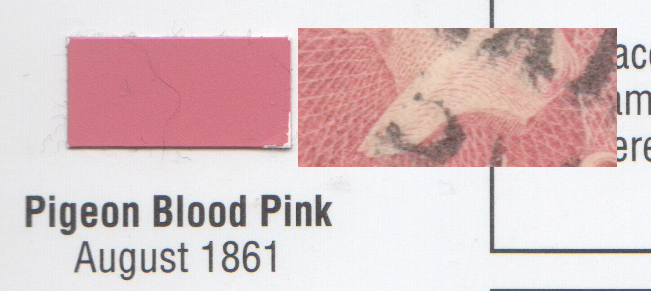
I just came across this stamp in a recent lot I purchased. The stamp's color seemed a bit compelling, so I used photoshop to compare the stamp's color to that of all of the 1861 issue colors in the Scott Color Guide. It was much too light for anything but the "pinks." It was too dark for #64 (pink) and too light for the #64b (rose pink). However, it did seem to match the Scott pigeon blood color sample. Not bad. Of course, I'm going to have it expertised just to make sure. What do you think? 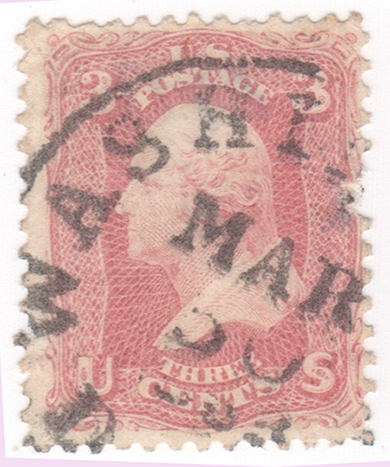
 |
|
Send note to Staff
|
| Edited by Mizar - 07/08/2015 12:07 pm |
|
|
|
|
Pillar Of The Community
3865 Posts |
|
|
In those days, passenger pigeons existed (now extinct) which may perhaps refer somewhat to them in this description. |
Send note to Staff 
|
|
|
Pillar Of The Community
United States
5894 Posts |
|
|
Online color determination is faulty at best. I would say by all means have it expertized. It will be a learning experience however it turns out. |
|
Send note to Staff
|
|
|
Pillar Of The Community
United States
1125 Posts |
|
|
Certified Pigeon Bloods are usually from the earliest printings. This has an 1863 datestamp, which would predispose most examiners against it. Good luck with it. It would be interesting to hear what they say if the colors matched the reference copies. |
|
Send note to Staff
|
|
|
Valued Member
92 Posts |
|
|
I understand your point about the 1863 cancellation, but according to the Scott Identification Guide, the next issue date after 1861 for the Washington 3¢ is 8/13/1867, which would be Scott #79. The remainder came out in 1868 and a very rare #104 in 1875. This means that, since all of the 64's came out in 1861, they had to have still been in use between 1861 and 1868. Therefore, it seems logical that the stamp in question cancelled in 1863 could still be a 64a. But, then again, it's often the challenge of identification that makes stamp collecting, particularly 19th Century issues, so interesting. |
|
Send note to Staff
|
| Edited by Mizar - 07/08/2015 11:14 am |
|
|
Pillar Of The Community
United States
845 Posts |
|
|
I think the point is that Scott 65's are also from pre-1867 printings and are by far the most common compared to 64's, at about a 10,000-to-1 ratio and 64's were printed earlier than 65's (i.e., the first 100,000 printed out of 1.8 billion) |
|
Send note to Staff
|
|
|
Valued Member
92 Posts |
|
|
I agree. The #65's certainly existed in abundance prior to 1867. The stamp in question, however, didn't match the #65 in color, but did "seem" to match the color of the #64a. Is it a #64a? At the moment it's still a mystery and so is subject to varying degrees of conjecture, but that, to some extent at least, is what makes the Stamp Community so successful, right? |
|
Send note to Staff
|
| Edited by Mizar - 07/08/2015 12:51 pm |
|
|
Pillar Of The Community
United States
1876 Posts |
|
|
It looks like you scanned the stamp and the color guide page(s) separately, and then digitally placed them side by side using Photoshop. If so, it is not a reliable comparison because one cannot guarantee that the lighting produced by the scanner and the excitement of the scanner head were the same across two different scans, even when done a minute apart. I note, for example, that the white perimeter of the stamp image is not the same shade of white as the white background of the color guide page.
To make it accurate, you would need to physically place the stamp on a blank area of the color guide and scan them concurrently, then move things around digitally within that joint image to facilitate side-by-side comparison.
If the color guide extends over multiple pages, you would need to place the stamp on each such page, and scan only that page plus the stamp, then use imaging tools to compare a region of the stamp only to that scanned page.
We're pulling for you here, but it's important to have good data. |
|
Send note to Staff
|
|
|
Pillar Of The Community
United States
845 Posts |
|
|
Yes I agree (edit: with Mizar's last post). Still could be a #64. I certainly looks close to at least pink to me from the scanned image. I've had the same problem trying to match my potential 64's against the Scott color guide. It would be better to have some real benchmark stamps to compare against, wouldn't it?
Edit: And cjpalermo1964 makes a good point. I'm assuming you are comparing to a hard copy of the Scott guide. I can't imagine trying to compare to a scanned copy. I have enough trouble using the real thing. |
|
Send note to Staff
|
| Edited by HungaryForStamps - 07/08/2015 1:26 pm |
|
|
Pillar Of The Community
United States
1414 Posts |
|
|
Stamps were in very short supply because the new issue was required after the 1951-1850 issues were demonetized after the Civil War started. In addition to the shade, the early printings in pink have very clear detail throughout because the plates were new. The stamp appears to be rose red, not pink. The only sure way to know for sure is to compare with a reference copy. Under long wave UV light, a pink stamp should appear to be more blue than orange, but I haven't looked at enough to make a definitive statement.
Clark |
|
Send note to Staff
|
|
|
Pillar Of The Community
United States
1125 Posts |
|
|
The 3c pinks were from the first batches printed of the 1861 issue.
As has been mentioned, these stamps were in short supply for the first few months and the exchanges of the 1857s and demonetization of those earlier stamps occurred on a rolling basis as postmasters were shipped their first supplies of the '61s. Elliott Perry and his readers collected this information by city by researching old newspaper notices outlining the exchange periods. These dates can be found in the "Pat Paragraphs" publication.
The color was deemed unsatisfactory by the end of 1861 and the formulation was changed, leading the the more common colors found today.
So, here are the basics surrounding the 3c 1861 that play against your stamp being a pigeon blood pink:
- The "true" pinks were printed in the first printings in 1861
- These stamps were in short supply during this period, so it is unlikely that they were stockpiled for any significant period of time
- It is estimated that there were about 100,000 3c stamps issued during the "pink" period - of all the pink shades.
- It is estimated that there were about 1.7 Billion non-pink 3c stamps issued from 1862-68 - of all the non-pink shades.
I'm not going to deal with the fact that the scans match, as this can't be commented on from scans taken at different time. Things like the scanner, lamp age and whether or not the lamp was warmed up, background color of the thing being scanned, etc. make comparing two scans for color non-conclusive.
As I said, good luck with the expert committees. If it matches their tests for pink or pigeon blood, they'll issue an opinion stating that.
By the way, there is a somewhat famous story of a multiple of the pigeon bloods that was split up. When later submitted as individual items, some were certified as pigeon blood, and some had faded to basic pink and were certified as such.
Please let us know what you hear. |
|
Send note to Staff
|
|
|
Pillar Of The Community

United States
1273 Posts |
|
|
During the life of the 1861 issue, there were multiple printings. The ink batches were not necessarily consistent from printing to printing resulting in a rather large color variety for this issue. Unfortunately, Mike McClung's web site where you could see a break down of a good variety of colors for the issue by year is no longer on the web. He shows about 80 different shades used from 1861-1868 printings. All pinks including the pigeon bloods were used up by about Feb. or early March of 1862. Yours does not appear to be a pigeon blood. Stamps were purchased and used at the time of purchase so its unlikely a 1861 shade would have been kept on-hand and used In March of 1863. Your example is most likely on of the late 1862 or early 1863 Rose shades. Hard to tell from a scan just which it is.  |
|
Send note to Staff
|
|
|
Valued Member
92 Posts |
|
|
Al, that makes sense. As I said before . . . it's a mystery. The odds don't favor it being a #64a. |
|
Send note to Staff
|
|
|
Valued Member
92 Posts |
|
|
Then, there's this: Although it may be true that most of the 1861 issues of these stamps were used right away, particularly by those who were not very well off, we could logically assume that others, those who were financially secure and comfortable would have bought more stamps than they needed. The money didn't matter to them; it was the convenience of having extra stamps that did. It's more likely than not that many of the unused stamps came to us from their estates. That, of course, would include samples of the various "pink" 1861 issues. It is quite conceiveable that "pink" 1861 issues were, indeed, used throughout the first half of the 1860's. Ergo, one with an 1863 cancellation is not beyond the realm of possibility or, at the very least, shouldn't be.
Finally, if every single stamp of this 1861 issue was bought and used, unused stamps wouldn't just be rare or extremely rare, they would be entirely non-existent. That isn't the case. Also, there are still remnants of 19th Century estates that are yet to be discovered out there and imagine what philatelic delights they might hold. |
|
Send note to Staff
|
| Edited by Mizar - 07/08/2015 7:37 pm |
|
|
Pillar Of The Community
United States
925 Posts |
|
|
yes, an 1863 use absolutely "could" be a pigeon blood pink - just as if I go to 7-11 and buy a lottery ticket it "could" be worth millions of dollars. The odds of your stamp being pigeon blood pink might be a bit better than my lottery example, but it is still a longshot. |
|
Send note to Staff
|
|
|
Pillar Of The Community
United States
1360 Posts |
|
|
There are 2 shades from the 1863 printings that cause confusion, and are "near pink", actually pinker than rose pink, and yet have the
Scott cataloge number of #65. The shades were identified by Ashbrook as pinkish rose and deep pinkish rose. Also known as "Brooklyn Pink", and Bill Weiss has also mentioned these shades in the past-- and if I remember correctly, he was instrumental in persuading Scott to list the pinkish rose as an official shade.
The Pinkish Rose and Deep Pinkish rose are both more difficult to find than Rose Pink #64b, but they're not #64 or 64a. With the 1863 date on the stamp, there isn't any way that any expertization service would ever give a cert as pigeon blood or as pink. You may see a cert as pinkish rose, or as deep pinkish rose.
From my pinkish rose copy I bought from Jack Daley: "The key to the pinkish rose shades are that they are blurry between the edge of the three and the adjacent lattice work. The shade is almost always seen in December of 1863, which may have been a short production run designed to get back to the desired pink shade. Due to the poor performance of the ink, it was quickly discontinued, and thus rarer than the 64b, but not as rare as the 64."
Hope this helps. If it's certed as a pinkish rose, that's not a bad thing at all. It won't be 64a.
Ray |
|
Send note to Staff
|
|
|
Replies: 55 / Views: 19,307 |
|



 Posted 07/08/2015 09:48 am


