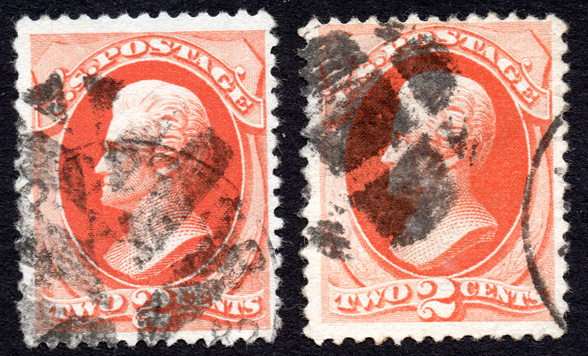
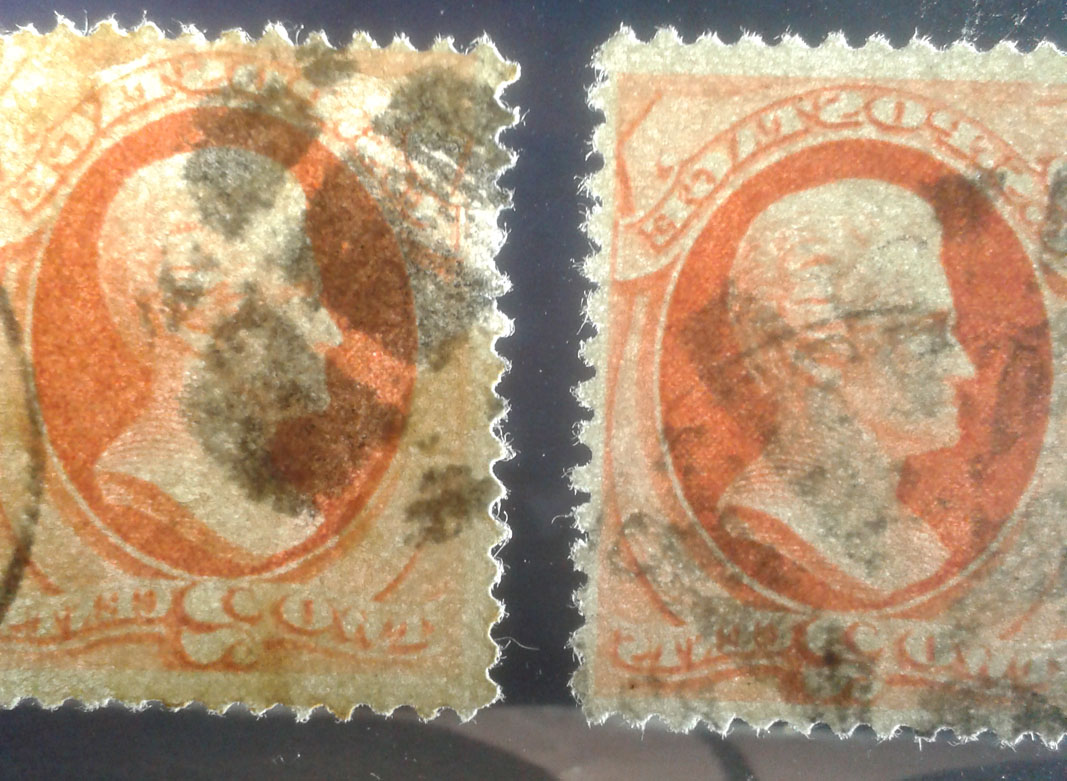
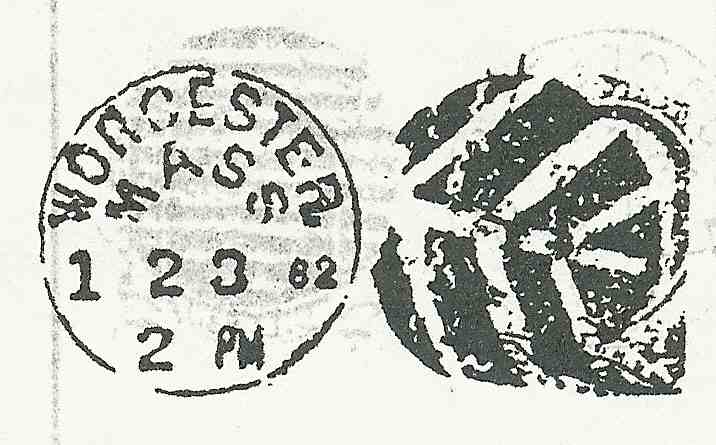
Quote:
kev, but what about the missing (?) secret mark? That's what would lead me elsewhere.
I sympathize with your conundrum. This very subject was taken up by William Stevenson in an article which appeared in Mekeels Weekly Stamp News back in 1913. He illustrated four views of the intersection where the secret mark should be seen and made some comparative notes.
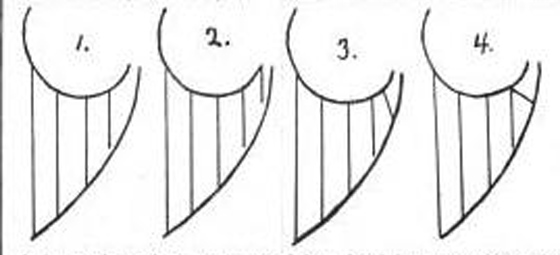
His notes:
Quote:
No. 1 shows what can be seen just below the ball at the left of the "S" of U. S. in the upper label, in the National 2c. The two curved lines do not join. The space bounded by the two curved lines and the shortest of the verticals is vacant.
No. 4 shows how the secret mark is always illustrated as far as I have seen.
No. 2 shows how the mark appears on a very great majority of the 2c brown, Continental, which I have examined.
No. 3 and No. 4 show how it is to be found on occasional copies. I have these two in a vertical pair as well as in a few singles. These generally show an apparent joining of the two curved lines in a point. This may be only apparent but it looks actual to me.
Here is one of his summary statements:
Quote:
In many copies of the Continental printing it is difficult, from the nature of the ink or paper, to say more than that a line exists. In the 2c vermilion I have found but a very few copies where anything could be made out definitely. I shall not tell you what I found just yet. In the American printings I have found no copies where any thing was certain.
here is a link to the entire article:
http://books.google.com/books?id=ke...2C736&edge=0I hope this helps to redirect your thinking and expectation regarding the Continental secret mark for their 2c stamps and later.





 Posted 10/18/2015 10:32 am