| Author |
 Replies: 47 / Views: 10,933 Replies: 47 / Views: 10,933 |
|
Pillar Of The Community
571 Posts |
|
|
Good Day to all...But these are little different than what I have shown in past with Benjamin Franklin one cent green. These block of 4 are definitely 11 perforations on top and bottom with straight edges on both sides for used stamps. Can these truly be Scott 594's? I checked twice that on the gauge as perf. 11's, and not 10's at all. I want to know if this is a strike or a homerun. smiles Looking forward to your comments. Thank you in advance.. 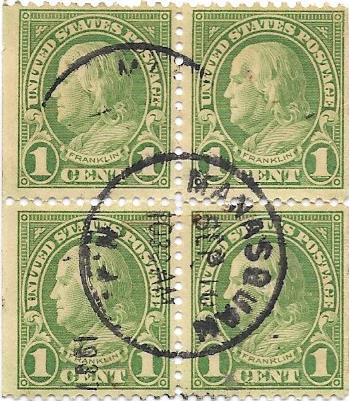 |
|
Send note to Staff
|
|
|
|
|
Valued Member
United States
161 Posts |
|
|
Sorry, not #594's. That's a block of 4 from a booklet pane of 6 Scott #632's. |
Send note to Staff 
|
|
|
Pillar Of The Community
571 Posts |
|
|
let me ask this simple question. I used the perforation gauge expressing 11, how did you determine that it was 11 x 10 1/2? and not 11's? I placed a 551 on top of it and matched the perforations perfectly..is that one way how to measure for this stamp?
|
|
Send note to Staff
|
|
|
Valued Member
United States
161 Posts |
|
|
For one thing, the vertical perforations appeared to me to be slightly further apart from each other in comparison to the horizontal perfs. Secondly, the color looks yellow-green, not green or deep green. However, since you're reading perf. 11 on all sides, it must be a block of 4 from Scott #552a (a booklet pane of six).
To my knowledge, Scott #594's were not printed in booklet panes. Also, their design size measures 19 & 3/4 x 22 & 1/4 millimeters, which is wider than the standard #552. |
|
Send note to Staff
|
| Edited by themachine99 - 11/07/2015 2:20 pm |
|
|
Pillar Of The Community
United States
8956 Posts |
|
|
Blazenstar, you still seem to have a lot of trouble with the perforation gauge. If you don't mind, may I ask you what kind you are using? Like what material is it made of?
Peter |
|
Send note to Staff
|
|
|
Pillar Of The Community
United States
6668 Posts |
|
|
Blazenstar, for US I find the Scott multi-gauge to be excellent.  Your booklet block looks to be rotary press 632a, the 552's are flat plate and a darker green.  |
|
Send note to Staff
|
|
|
Pillar Of The Community
571 Posts |
|
|
This is what I did to check the sizes too when I placed the 551 ontop of it..matched the perforations. I use a correcto gauge- metal, including showgard gauge too. I measured the bottom and top on the correcto gauge.. 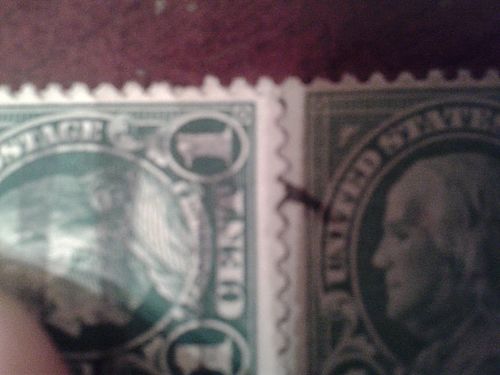 |
|
Send note to Staff
|
|
|
Pillar Of The Community
571 Posts |
|
|
why is this always so complicated with my stamps? lol I expressed before I should keep away from George and Benny stamps.. |
|
Send note to Staff
|
|
|
Pillar Of The Community
United States
6668 Posts |
|
|
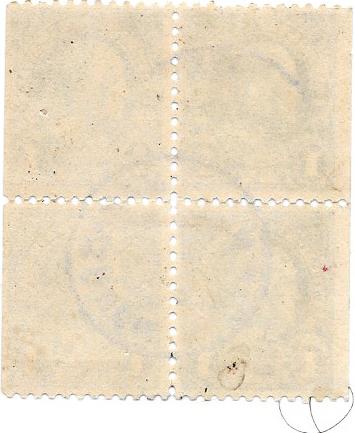
Please scan the back. The 2 you show side by side look a completely different shade of green the the block you originally posted. |
|
Send note to Staff
|
| Edited by stallzer - 11/07/2015 2:55 pm |
|
|
Pillar Of The Community
571 Posts |
|
|
i know I measured correctly the top and bottoms perforations..they are definitely 11's. it was the side perforations I was concern with the measurements |
|
Send note to Staff
|
|
|
Pillar Of The Community
571 Posts |
|
|
yes..i place another stamp that is a perf 11 onto of it to show that the perforations matched with the block of 4 |
|
Send note to Staff
|
|
|
Pillar Of The Community
571 Posts |
|
|
Valued Member
United States
161 Posts |
|
|
Like I said at first, the side (or vertical) perforations appear to be gauge 10.5, not 11. I am certain your stamps are a block from 632a, which is perf 11 by 10.5.
EDIT: According to the image of the back, your stamps are definitely 632's. Flat plate printed stamps (like the #552) have flecks of ink on the back. |
|
Send note to Staff
|
| Edited by themachine99 - 11/07/2015 3:28 pm |
|
|
Pillar Of The Community
United States
1414 Posts |
|
|
Please keep in mind that a perforation gauge is not a measuring device in the conventional sense. It gauges how many perforations and half perforations fit between a pair of lines two centimeters apart. As a result, flat plate and rotary perf 11 are considered to be "the same" when, in fact they are not. Machinists who built perforating machines spaced the perforating pins to a tolerance of about 0.001 inch. Flat plate perforating pins were spaced at 0.072 inch apart. Rotary perf 11 pins were spaced 0.070 inch apart. The difference is easily seen in a laydown test comparing a flat plate and rotary press perforations. The only gauge that may be helpful is the Kiusalas US Specialist Gauge or the modern Precision U.S. Specialty Multi-Gauge available from multiple sources. See http://www.slingshotvenus.com/stamp...tyPerf5.htmlAlso, the horizontal perforations on 11 x 10 1/2 sheet stamps were produced by a bar perforator and the pins will be aligned between the top and bottom of the stamp, whereas flat plate or coil waste perforations probably will not. In any case the booklet pane fragment pictured initially is the light green used during the 1930s. Also, a Scott 594 would be wider than a flat plate or rotary sheet stamp. The design would be the same size as the 597 coil stamp or the perf 11 x 10 (.072 x 080 spacing labeled 11-72 x 10-80) Scott 579 coil waste stamp. Flat plate perf 10 stamps are 10-79, not the same as the rotary perf 10. Clark |
|
Send note to Staff
|
| Edited by cfrphoto - 11/07/2015 4:46 pm |
|
|
Pillar Of The Community
571 Posts |
|
|
Thank you all..apppreciate your assistance. This is what my identifer expresses: 1c deep green is a perf. 11, flat plate 552, 552a, 1c green perf 11, rotary press 19 3/4 x 1/4mm is a 594, 1c green, same is 19 1/4 x 3/4 mm is a 596,1c green perf 11 x10, rotary is a 578, 1c green perf. 10 is 581,1c yellow green 581a, 1c green perf. 11x10 1/2 is a 632.. is a rotary press printing, not flat plate..
Have a wonderful day all.
Blazenstar |
|
Send note to Staff
|
|
|
Pillar Of The Community
571 Posts |
|
|
fabulous information Clark! Thank you for your well explained comment..smiles
Blazenstar |
|
Send note to Staff
|
|
|
Replies: 47 / Views: 10,933 |
|



 Posted 11/07/2015 1:09 pm