| Author |
 Replies: 22 / Views: 5,052 Replies: 22 / Views: 5,052 |
|
Valued Member
24 Posts |
|
|
|
What was the motive for the Kansas and Nebraska overprints? Is their value purely a matter of scarcity? How does one detect possible forgeries?
Some other stamps I don't understand: the Hawaii issues (647-48), and the "Molly Pitcher" stamp. Why did they take existing postal issues and stamp an overprint on them here, instead of issuing new commemorative designs?
|
|
Send note to Staff
|
|
|
|
|
Pillar Of The Community
United States
6756 Posts |
|
|
Quote:
What was the motive for the Kansas and Nebraska overprints? The Kansas-Nebraska overprints were an experiment to combat the problem of post office burglaries, and keep the stolen stamps from being sold in another state. Only about a 1 year supply of stamps were overprinted. After which the experiment was discontinued. |
Send note to Staff 
|
|
|
Pillar Of The Community
United States
6756 Posts |
|
|
Quote:
How does one detect possible forgeries? Because of the significant price difference between some of the overprinted and non-overprinted stamps, this series was subject to considerable forgery attempts. There are several steps to weed out forgeries. I can only go over some of the basic steps. 1. On mint stamps, genuine K-N overprints appear only on stamps that have gum breaker ridges spaced 22mm apart. If you do not see gum breaker ridges, or you see 2 gum breaker ridges that are not 22mm apart, then you have a forged overprint. 2. The overprint was applied after the stamp was printed but BEFORE the stamp was gummed. From the back side of a MINT stamp, you should NOT be able to "see" the overprint impression in the gum. Things get much more complicated for used stamps. ALL stamps with a genuine K-N stamps are perf 11x10.5, the overprint measures between 9.0-9.25mm. Additional forgeries are then weeded out by comparing the font (size/spacing/alignment), color shade, plate number (when available)... This gets more complicated. There are a few fairly decent websites that document some of these. Let me see if I can find the links. [EDIT: I corrected the perforation] |
|
Send note to Staff
|
| Edited by khj - 04/20/2009 7:19 pm |
|
|
Pillar Of The Community
United States
6756 Posts |
|
|
I can't find the old links. But here is a link that provides some of the info you need all on one site. http://everything2.com/node/1541992Please note the correct perforation is 11x10.5 (horizontal x vertical); it is an unfortunate error that has propagated through many websites and even some reference books. Even I accidentally type it backwards sometimes. Also note that even if your overprint doesn't look exactly like the pics, don't worry too much. There are actually 3 slightly different overprint styles; they are documented in literature, but I cannot seem to find the online link. |
|
Send note to Staff
|
|
|
Valued Member
24 Posts |
|
|
Thanks very much for the detailed information! This was one of those things I couldn't remember from when I was much younger. Bits and pieces are starting to come back, though. |
|
Send note to Staff
|
|
|
Valued Member
24 Posts |
|
|
In 1973, Schoen estimated (6) that "no issue of United States stamps is so extensively imitated and over 60 per cent of the used copies are not genuine."
Wow.
|
|
Send note to Staff
|
|
|
Pillar Of The Community
United States
6756 Posts |
|
|
 I'm sorry, I cannot seem to find those better links. I need to organize my links better. Maybe someone else will have better luck. If for some reason you need to know what the 3 genuine overprint styles look like, let me know and I'll mail you a photocopy. |
|
Send note to Staff
|
|
|
Pillar Of The Community
United States
6756 Posts |
|
|
Quote:
In 1973, Schoen estimated (6) that "no issue of United States stamps is so extensively imitated and over 60 per cent of the used copies are not genuine." Fortunately, most of the forgeries on used stamps can be readily weeded out. Unfortunately, most collectors do not know how or do not have the resources available to weed them out. Some issues of other countries (early Persian overprints, early Belgian semipostals) were counterfeited in such large quantities that >>90% found in collections are fake. When I rummage through general WW collections, every once in a while I spot a genuine stamp mixed in with the counterfeits! |
|
Send note to Staff
|
|
|
Pillar Of The Community

Canada
3963 Posts |
|
|
First of all Welcome Stahlhart( can't remember if I did so yet) and thanks for bringing up this subject. Khj Thank you for the detailed info on these. It never ceases to amaze me how much info I gain from this site. Dianne  |
|
Send note to Staff
|
Don't grumble that the roses have thorns, be thankful that the thorns have roses |
|
|
Valued Member
24 Posts |
|
|
Thank you -- I agree that this site is a great source of information...
|
|
Send note to Staff
|
|
|
Valued Member
United States
211 Posts |
|
|
I don't mean to hijack the thread or anything, but did you say: Quote:
Some issues of other countries (early Persian overprints, early Belgian semipostals) were counterfeited in such large quantities that >>90% found in collections are fake. When I rummage through general WW collections, every once in a while I spot a genuine stamp mixed in with the counterfeits! So, 90% of all early Belgian semi's are fakes? What other countries does this apply to? |
|
Send note to Staff
|
|
|
Pillar Of The Community
United States
6756 Posts |
|
|
Quote:
So, 90% of all early Belgian semi's are fakes? What other countries does this apply to? Sorry I wasn't more clear. Not all of them. The Belgian 1914 semi-postals (Scott #B25-#B30). If you have Scott Volume 1, you will see the prices italicized. The footnote mentions the counterfeits. Scott does a decent job of notating when there are severe counterfeiting problems, but they don't always mention it. Too many Persian stamps were faked for me to list. Also have to be careful with Italian States. |
|
Send note to Staff
|
|
|
Pillar Of The Community
United States
6756 Posts |
|
|
Sorry for having taken this thread slightly off topic. There are many stamps that have been counterfeited (even modern US stamps are being counterfeited). However, the issues/"countries" I mentioned above have some stamps that were counterfeited in extremely large quantities that exceed genuine stamps by a huge margin. At least with the K-N stamps, you have an almost even chance of getting a genuine stamp. Below, I show an example of how to distinguish between genuine and counterfeits of the Belgian semipostals of 1914. Using Scott catalog, the stamp shown is a genuine Belgium #B26 (middle value of set of 3, same design, different denomination/color). 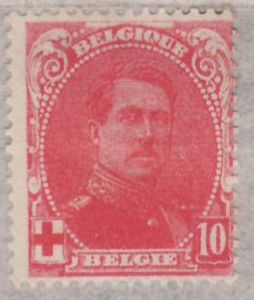 There are many ways to differentiate, but the easiest way is to look at the leg of the Q in BELGIQUE. If the leg is isolated from the "O" part of the letter "Q", then it is genuine. If the leg is not completely isolated, it is likely a counterfeit. In the scan below, this feature is enlarged and is circled in blue. The red stamp at left is genuine, while the violet stamp at right is counterfeit. 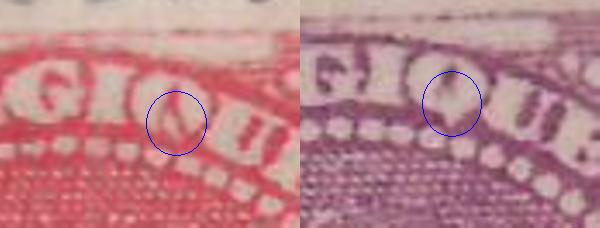 Hope you found that as interesting as when I first learned about it. Again, I apologize for having taking the thread slightly off topic; bad habit of mine. |
|
Send note to Staff
|
|
|
Moderator
United States
4788 Posts |
|
|
khj: DUDE! That's the worst looking Kansas-Nebraska overprint I've ever seen  Just kidding. Very interesting information. It's amazing how savvy one has to be with some of these fakes. Very subtle. Thanks for sharing, KirkS {edited for spelling} |
|
Send note to Staff
|
| Edited by kirks - 04/21/2009 9:54 pm |
|
|
Valued Member
United States
73 Posts |
|
|
This topic has been most helpful! It is a question that I have wondered about abit. Thanks for bringing it up, stahlhart! As always, khj, you are king of good info! |
|
Send note to Staff
|
|
|
Pillar Of The Community
United States
6756 Posts |
|
|
Quote:
DUDE! That's the worst looking Kansas-Nebraska overprint I've ever seen Kirk, are these better?  k |
|
Send note to Staff
|
|
|
Replies: 22 / Views: 5,052 |
|



 Posted 04/20/2009 6:16 pm


