| Author |
 Replies: 25 / Views: 3,869 Replies: 25 / Views: 3,869 |
|
|
|
Valued Member
129 Posts |
|
|
#545 or #525? 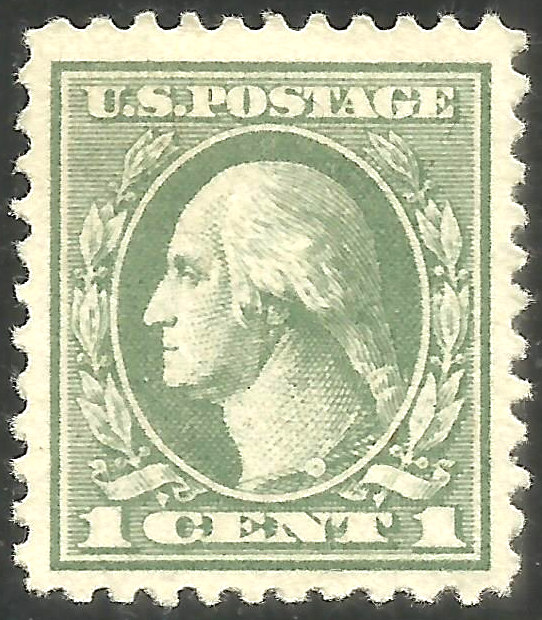 Chasa, here's my greenish gray #525. 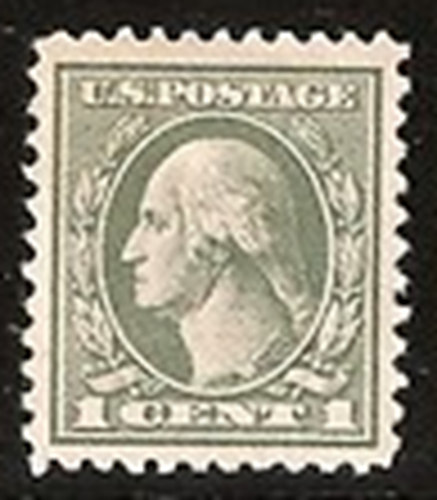 |
Send note to Staff 
|
| Edited by carlberky - 12/08/2015 08:20 am |
|
|
Valued Member
129 Posts |
|
|
Here's #76 ... 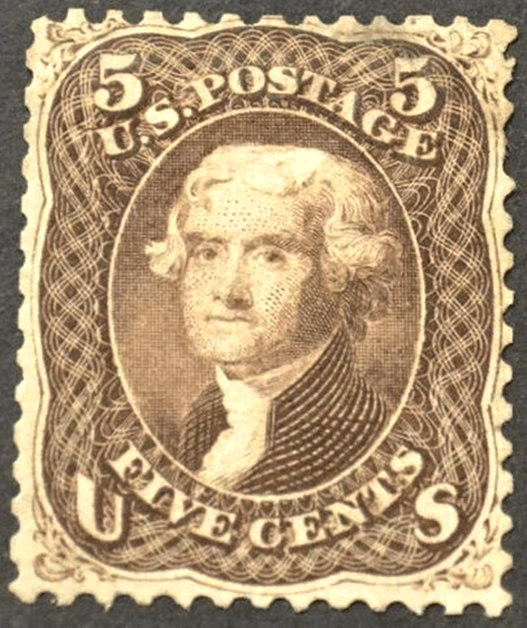 Obvious (now!) re-perforating on top and left side. Gone in 60 seconds! |
|
Send note to Staff
|
|
|
Pillar Of The Community
United States
2547 Posts |
|
|
Pillar Of The Community
United States
1946 Posts |
|
|
Carl,
I wonder if you might be overdoing it in your rejection of items due to perf differences. Based on the pics you are giving it would appear that you are lining up the edges of the design and then checking to see if the perfs line up. If that is what you are doing, then you may be dismissing good stamps due to incorrect procedure.
Line up the perf teeth at one end of a side with the reference perf set. Check to see if everything stays in good concordance (up. down, left, right) for the troughs and peaks on that side vis a vis the reference set. If so, then the perfs check out.
Search this forum on "Srail test" for a thread that describes a procedure for making the comparisons to which I am referring. It would be a shame to have you withhold good material which has been wrongly condemned.
If you are already doing that, then please ignore my lunatic ravings. |
|
Send note to Staff
|
|
|
Valued Member
129 Posts |
|
|
" ... it would appear that you are lining up the edges of the design and then checking to see if the perfs line up."
Essayk, that is precisely what I was going. Thanks for the heads-up! |
|
Send note to Staff
|
|
|
Pillar Of The Community
United States
1414 Posts |
|
|
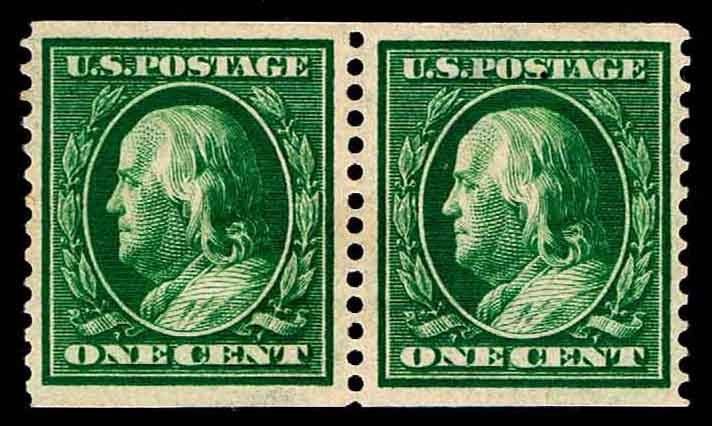
Some fake flat plate coils were made from imperforate coils using a template resulting in pin alignment between rows which rarely happens with genuine perforated flat plate coils. Richard Kiusalas mass produced fake flat plate coils with aligned perforations.
Aligned perforations are a fundamental characteristic of rotary press coils because of the perforator used.
Clark |
|
Send note to Staff
|
| Edited by cfrphoto - 12/08/2015 3:23 pm |
|
|
Pillar Of The Community
United States
1756 Posts |
|
|
Pillar Of The Community
United States
1414 Posts |
|
|
We all learn as we expertize. Bill and I had many discussions about how to expertize Washington/Franklin coils. Like the Philatelic Foundation and the APS, early certificates were not always accepted in the light of new knowledge. The perforations look good, but the imperf edges are another matter. Adding to the complexity of the problem is the single line watermark perf 12 coils were produced at the time of the transition from hand assembled to auto-wound coils. The top and bottom edges of auto-wound coils must be parallel unless hand trimmed at a paste up. Perf 12 and perf 8 1/2 auto-wound coils were cut from half sheets pasted together. Initially, only ten cutting knives were used leaving the edge where the sheet was cut in half untrimmed. That edge did not have to be exactly parallel to the interior edge, but the characteristics of the half sheet cut would be that of any straight edge. I can see the bottom edge wandering here. Bill's later coil certificates were more accurate. Clark 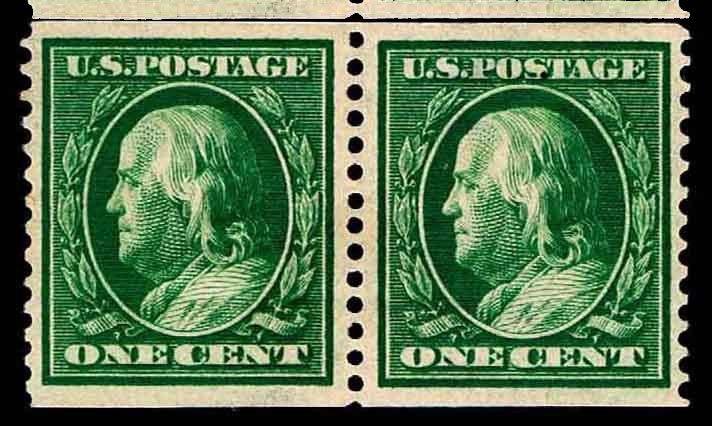 |
|
Send note to Staff
|
| Edited by cfrphoto - 12/08/2015 8:16 pm |
|
|
Pillar Of The Community
United States
1756 Posts |
|
|
Quote:
Bill's later coil certificates were more accurate.
Clark... Bill's cert on this one was from 2011... Are you suggesting Bill might have gotten this one wrong? Randall |
|
Send note to Staff
|
|
|
Pillar Of The Community
United States
1414 Posts |
|
|
It is possible. Later on, I got to see scans of some of the more difficult ones. Keep in mind that many early PF and APS certs from the 1990s were later overturned. Bill's core expertise was in 19th Century US stamps. Although I knew Kiusalas, I didn't start expertizing coils seriously until about ten years ago. Examining 1200 DPI and higher resolution scans was very useful using some methods described by Scott Trepel at the PF symposium at Washington 2006. Later, I was able to acquire a 356 line pair with a PF cert to validate observations. However, because of the transition, 387 coils could potentially be made two different ways. I am not sure how well that is documented. Ken Lawrence may have some additional information. An auto-wound leader for a 388 coil is known to exist, suggesting that some production occurred before the sudden switch to perf 8 1/2 to avoid frequent web separations using the new coil winding machine. I don't know how much, if any, of the perf 12 coil production was auto-wound before the switch. My guess would be not much.
I would not give this coil a good cert without examining it. The edges look bad to me. It would be necessary to examine the characteristics of the top and bottom edges to be sure.
Clark
|
|
Send note to Staff
|
|
|
Replies: 25 / Views: 3,869 |
|




 Posted 12/08/2015 12:57 am