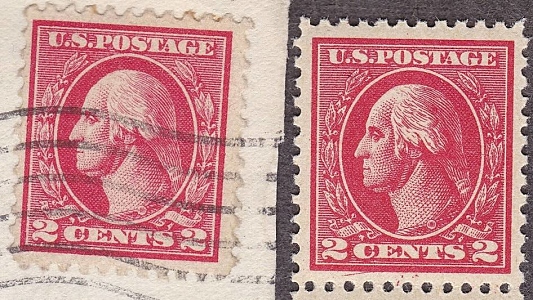
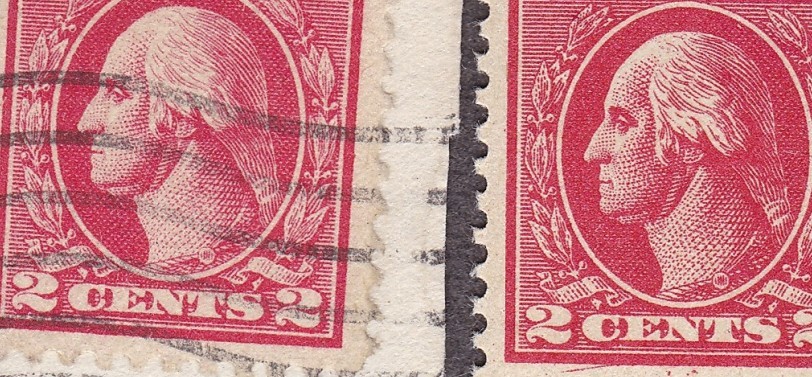
Hello again Caper123,
You mention a discrepancy between your stamps and the type VII characteristics. A concept that takes a while to learn and become familiar with is that there are many variations inside of any stamp type. Some printings are heavier than others, some share characteristics between types, and many of these stamps are not plainly obvious as to which type that they are. Also, things like cancels and abrasion damage can obscure identifiable features.
Let's work our way from type IV through VII.
Pay careful attention to the "Identifies Type" column in the table in the StampSmarter link.
Could it be a type IV? By reading the table we need to look at "Area on Map" #2, #3, #6, and #7.
Area 2: Neither of your stamps have the "DID" pattern in the toga button, so they appear to not be type IV.
Area 3: Neither of your stamps have a weak top toga line.
Area 6: Neither of your stamps show the lesser detail in the left ribbon. It's difficult to see the left stamp's detail there, but the criteria for area #7 will negate this ambiguity.
Area 7: Neither of your stamps have limited detail in the laurel leaves. It's not as easy to see on the left stamp compared with the right one, but both have detail that is absent on type IV.
Conclusion: neither stamp is type IV.
So:
IV V Va VI VII
Could it be a type V? The "Identifies Type" column doesn't list an area that is specific to type V, so including/excluding it will be a matter of elimination of the other types.
So:
IV V? Va VI VII
Could it be a type Va? The table indicates that we should look at area #5; specifically the pattern of dots above the nostril. The associated image is does not clearly explain what to look for. Here I have added an arrow pointing to " The third row of dots above the nostril " witch matters:
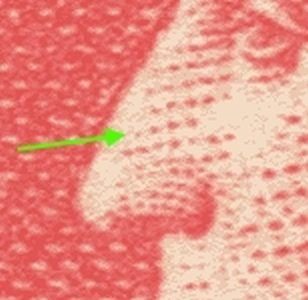
Neither of your stamps show only 4 dots which are characteristic of Type Va.
So:
IV V? Va VI VII
Now, could either be type VI? The StampSmarter table indicates that we should look at "Area 1" which is the characteristic of the lower line in the left numeral. Specifically: "The line separating the base and the top of the numeral is strong and thick. This is quite apparent and is the distinguishing feature of Type VI stamps."
Neither of your stamps show that strong characteristic.
So
IV V? Va VI VII
We are now left with only types V and VII as possibilites.
Finally, could either be type VII? The StampSmarter table indicates that we should look at areas #4 and #8. Let's start with area #8: "The Added Dots at the Top of the Head". Both of your stamps show a significant number of dots there, but not quite as defined by the image that depicts type VII. This is where familiarity with each type and understanding that printing variations of each type comes in. The detail on your stamps is questionable, so let's now consider area #4. Neither of your stamps definitively display the "There are four horizontal rows of three dots each. This is the key element in the determination of a Type VII stamp."
So
IV V? Va VI VIIThe only remaining possibility is that both are type V. The process of elimination to come to this conclusion is quite lengthy. There are shortcuts, but I suggest you go through this entire process until you become familiar with identifying 2c offset stamp types.
In the grand scheme of things, none of the perforated 2c offset types are particularly valuable, so don't worry too much about identifying them unless you are working on an imperforate type which are orders of magnitude more valuable. Blocks of perforate 2c offset mint stamps are also worth identifying for yourself due to their significant monetary value.
Don: If you're watching, the addition of an arrow to the image of area #5 would be quite helpful.





 Posted 04/18/2016 4:06 pm