|
This page may contain links that result in small commissions to keep this free site up and running.

Welcome Guest! Registering and/or logging in will remove the anchor (bottom) ads. It's Free!
To participate in the forum you must log in or register.
| Author |
 Replies: 25 / Views: 13,909 Replies: 25 / Views: 13,909 |
|
|
|
Pillar Of The Community
United States
1946 Posts |
|
|
Quote:
If I was in the US, I probably would just have sent the stamp in for certification without asking, but being in the UK (as cjpalermo1964 recognizes) does make it more complicated: Yes, but not extraordinarily so. Because the PF is the chief authority for classic US material in particular they have many, many clients worldwide. Don't waste time on anyone else. When you speak with them, as CJ suggested, make sure to discuss how you note the stated value for Customs coming and going. Until certified it is not to be assumed to have the full value of the catalog listing. OTOH the PF will ask you to submit a fee based on the assumption it is what you think/hope it is. It might be advantageous to submit it as a fake to see if they agree - if they will let you - and settle up for the real deal if they certify it that way. Lots of combinations, but what will they allow? {Ask. And let them advise you.} Ditto what CJ said about letting us know how it turns out. BTW if they say it is a fake, do a followup inquiry to get them to say more, and ask whether the fake is an established/known type and from whom. If you need a North American agent to help you with all this, contact me offlist. |
Send note to Staff 
|
|
|
Valued Member
United Kingdom
21 Posts |
|
|
Thanks to everyone for these great replies and to essayk the offer of assistance, though it looks like I will be able to work directly with the PF. I called them on Friday, and they were very helpful, and are going to get back to me with advice once they have had a preliminary look at my photos. I'll write again with an update when I know more. |
|
Send note to Staff
|
|
|
Rest in Peace
United States
82 Posts |
|
|
I have visited this site for several years, almost daily, for the purpose of getting more in-depth details from specialists. My business is mostly US stamps and frankly I seldom run across scarcities that are difficult to identify: they either are crystal clear (#245 is a #245) or junk (trimmed or toyed with to appear something it is not) or in some cases, I simply send it right off to be expertized.
This particular topic is by far one of the most professionally discussed I can remember, with all the features of serious philately.
In five days it seems contributors have covered virtually all the bases and have plunged in very deeply in the particulars of the illustrated stamp and those like it.
Moosewood, best wishes in the results of your next steps with this stamp. And contributors, the combined comments in a few days certainly exceeded what a philatelist could find referring to one publication or a website.
Thanks to you all.
|
|
Send note to Staff
|
|
|
Valued Member
United Kingdom
21 Posts |
|
|
It's taken a while, but I now have a Philatelic Foundation certificate for this stamp. It reads: '85C-E VAR; 1868; 3c, rose… Unused, OG, experimental "Z" grill essay, 11x14mm, on wove paper, gummed, perforated 12, and we are of the opinion that: it is genuine, previously hinged.' 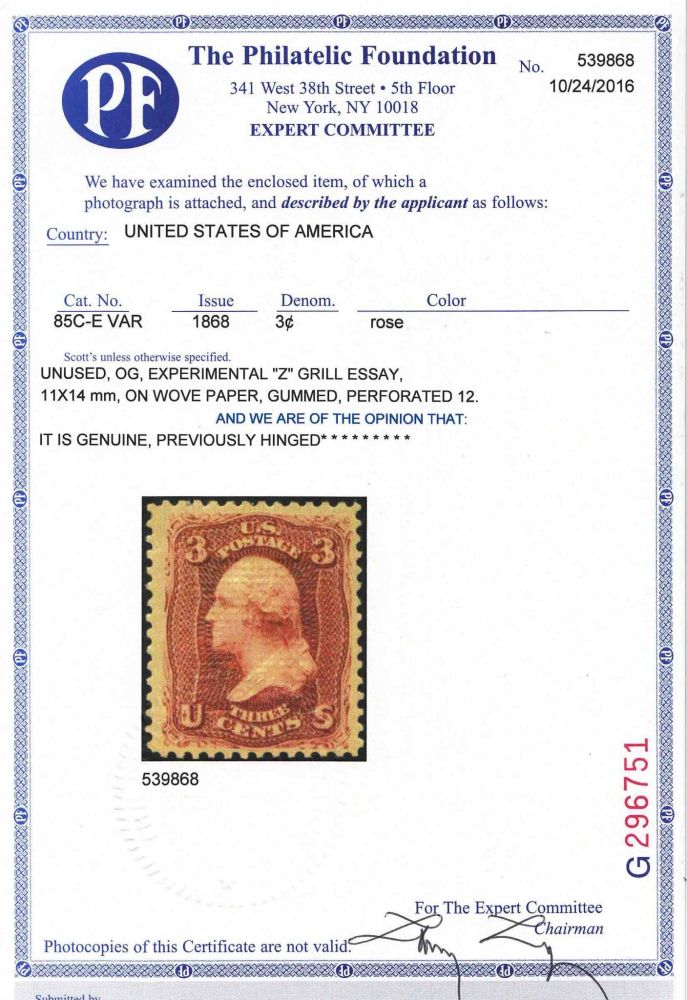 The PF didn't specify why it is an essay rather than the regular "Z", which is also rose, perf. 12, and on wove paper. But I've been able to dig out my old copy of Brookman, United States Stamps of the Nineteenth Century (1966), which sheds light on this. I'm almost certain that the strength of the grill impression is the key. Here's what Elliott Perry (quoted in Brookman, 2: 100) says: 'The Z roller was also used to make many trial impressions or samples—essays. Many of these essays were perforated and gummed exactly like finished stamps, but for various reasons very few of them might be mistaken for issued stamps.' Brookman offers a relevant illustration of an essay block of the 3c (2: 82-83), noting that 'the impressions of the grill are very strong, particularly along the sides of the grill unit. This no doubt is due to the fact that particular care probably was exercised to obtain fine impressions on this trial grilling'. He goes on to suggest that the grilling bed gradually wore down in later impressions. 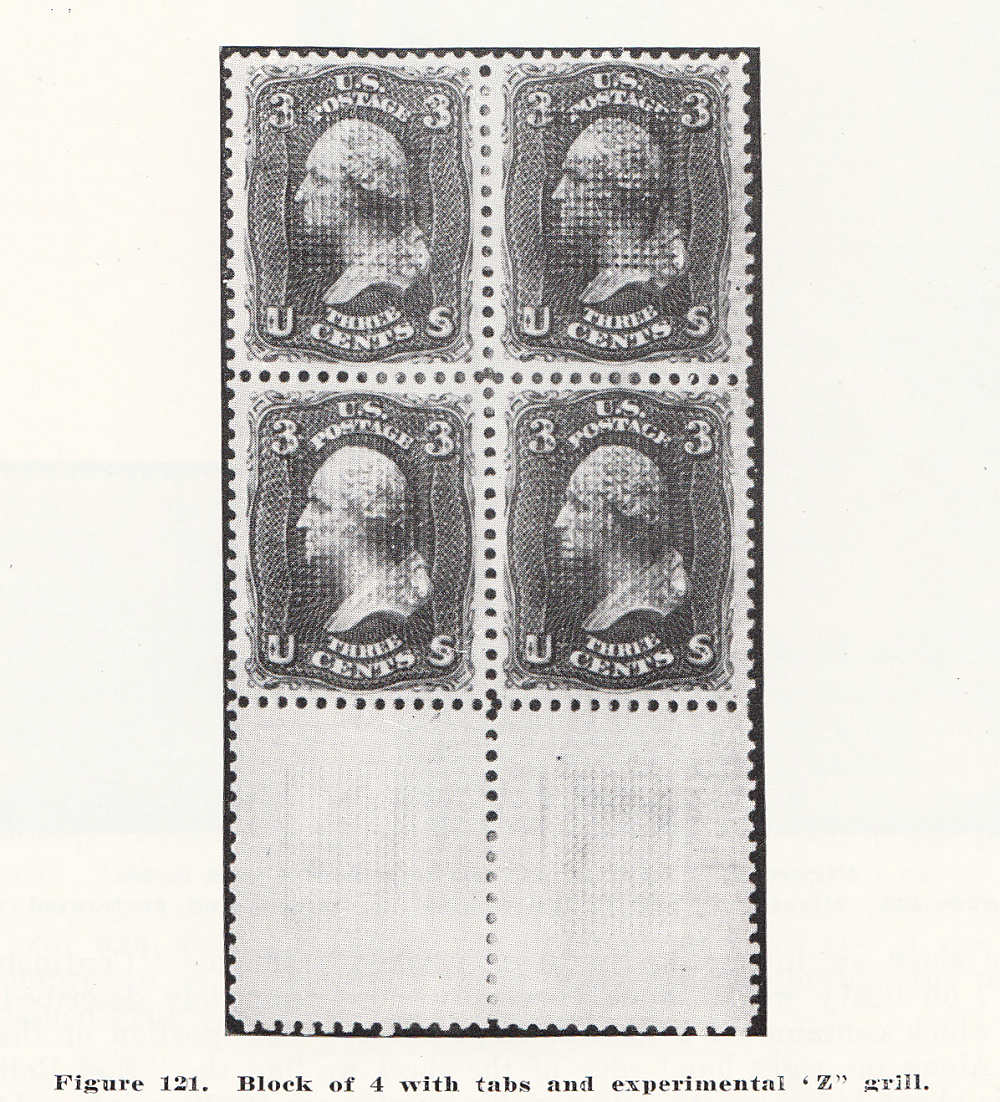 I'm naturally disappointed that this isn't worth $25000, but it certainly is the most interesting stamp that I own. Many thanks to all those on the forum, and especially to my brother in Seattle, a fellow collector of US classics, who helped in the transatlantic travels of this fascinating item. |
|
Send note to Staff
|
|
|
Moderator

United States
12330 Posts |
|
|
Good job, and thank you for letting us know how this turned out. Not a $25k stamp but still worth several hundred dollars.
Don |
|
Send note to Staff
|
|
|
Pillar Of The Community
United States
1043 Posts |
|
|
I enjoyed reading the original post and more importantly the ultimate result from the PF foundation. It is not common to read a thread and ultimately find out the true end result after submission to PF.
I will say I had not read these posts until just now, but have some retrospective comments (not that anyone really cares! but here it is)
Sometimes we forget these classic US issues have tons of "essays" associated with them. I learned that before using the word "forgery" or "fake", I need to check the essays.
Amazingly, in Scott Specialized there is a beautiful picture of the experimental Z grill impression in the essay section. Looks exactly like the OP's scan! Need to start thinking like an expertizer at the PF!
Finally, in my 2010 specialized Scott they do not list Rose as a color under 85C-E2 (they list white, salmon, yellow, greenish, dull violet, pale lilac) Thus, Scott could update catalog with "rose" color for this essay if they choose. Cool to have the only known example! May not make it more valuable but it is cool to have!
|
|
Send note to Staff
|
|
|
Pillar Of The Community
United States
1946 Posts |
|
|
Quote:
in my 2010 specialized Scott they do not list Rose as a color under 85C-E2 (they list white, salmon, yellow, greenish, dull violet, pale lilac) Thus, Scott could update catalog with "rose" color for this essay if they choose. Careful, The colors you mention, which Scott lists in the current Specialized as well, refer to the tint of the paper, not the color of the printing. Here are a couple: 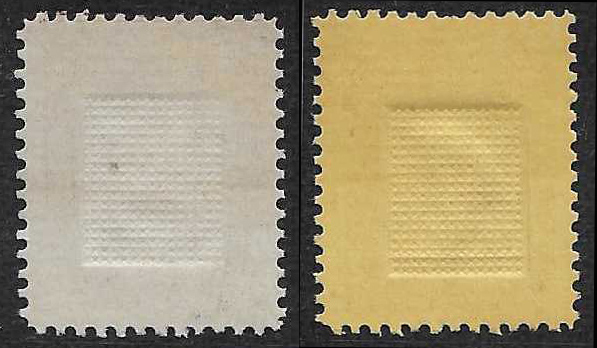 And if you like them with printing: 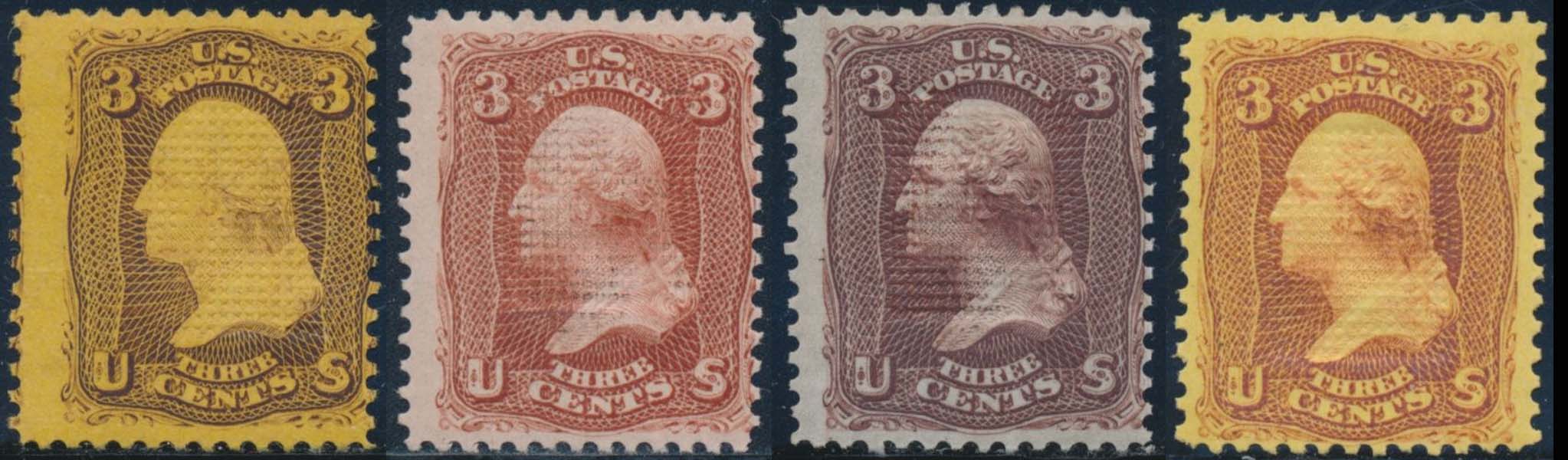 |
|
Send note to Staff
|
| Edited by essayk - 12/04/2016 11:18 pm |
|
|
Pillar Of The Community
United States
1043 Posts |
|
|
Thanks for correction... I didn't realize that. Great pics too. So which color variety does moose wood have here? Would be nice if PF put it in description on certificate? |
|
Send note to Staff
|
|
|
Valued Member
United Kingdom
21 Posts |
|
|
The paper is clearly white--my original photograph is truer to the original than my scan of the PF certificate. I am curious, though, about what the 'VAR' (variety) means in the '85C-E VAR' on the certificate. Is this just one of the various named varieties of essay that they specify in the catalog listing, or is it somehow not fully covered by the description there? I'm hampered (as obviously was the case with my original query) by not having a copy of the US Scott Specialized catalog, and it's not in local libraries in the UK. I collect the world up to about 1960, so normally depend on the Scott Classic Specialized 1840-1940 catalog, which doesn't get to this level of detail for essays.
thanks for all the interesting discussion, from which I've learned a lot. |
|
Send note to Staff
|
|
|
Pillar Of The Community
United States
1946 Posts |
|
|
Quote:
I am curious, though, about what the 'VAR' (variety) means in the '85C-E VAR' on the certificate. They are making a technical point which in this case I agree is well to observe. It is unfortunate that you do not have access to the US Specialized, because it's all about what is going on there. Scott's present treatment of "experimentals" is not consistent yet, and is still very much in a state of flux. The editor is being very careful in verifying the substance of new listing claims, and is therefore very slow about admitting them. Here it is well to recall that the Scott number "85C" refers specifically to the 3c stamp issued circa 1867 with a Z-grill. The number "85E" refers to the 12c of the same grill type. In this case, to put it simply, the Scott listings for 85C-E(1&2) are for grill samples on blank paper - i.e. no printing. Technically, this is not correct, inasmuch as there is nothing but past collector convention to associate design-free grill samples with the 3c denomination. Until the editor either revises or adds a listing (e.g.**85C-E3**) for the examples with a proof impression of the normal 3c design, the only listing reference for them must be 85C-Evar. That such a move must necessarily come is made clear from the manner of the listings for 85E-E1 which features the 12c design on several colors of paper - each with a proof impression Z-grill, of course. I don't think they have yet come to agreement on just how they want to fix the problem, which is going to get worse as they add more experimental types to the listings, some of which were publicly issued, but most of which are unissued trials. Take my word for it, it's a mess. So for now, the 3c Z-grill essay with printed design is 85C-Evar. |
|
Send note to Staff
|
| Edited by essayk - 12/05/2016 12:49 pm |
|
|
Replies: 25 / Views: 13,909 |
|
|
To participate in the forum you must log in or register. | |
 Transvaal Postal History Help Earliest Stamp With In-Design Date? My First Stamps Help Newbie.help With Stamp Identification (J29) Inherited These Stamps, Are They Genuine? APS Membership Discount Metropex Stamp Show: Roseville, Minnesota October 23-24 Weird Covers, 1885,1886, And 1982 For Users Of Two-Post Blue International Albums What Is Your Experience With Binders. New Member Posting Image Of Avatar, Front And Back Of U2 Cut Square, Market Value Or References? Working On An Offline Collection George Washington 3 Cent 1861 With Print On The Back Hello From The Netherlands - New Member Then And Now, From Old Postcards New Member Wanting To Add An Avatar Sparks Auction Fees? 163 VF Nyfm Vertically Ribbed 163 XF Quartered Cork, Labeled Jumbo 136 VF Quadruple Split H Grill Nashville Philatelic Society-Your Invitation To Our Auction Night Meeting Monday, October 26, 2026 Nashville Philatelic Society-Your Invitation To Our Meeting Monday, October 19, 2026 Christmas Around The World 2026 C.e. In The Large Queen Cancel A More Condensed Album Page Experiment. US Scott #3 Postmarked Or Fake? Transvaal Postal History Help Earliest Stamp With In-Design Date? My First Stamps Help Newbie.help With Stamp Identification (J29) Inherited These Stamps, Are They Genuine? APS Membership Discount Metropex Stamp Show: Roseville, Minnesota October 23-24 Weird Covers, 1885,1886, And 1982 For Users Of Two-Post Blue International Albums What Is Your Experience With Binders. New Member Posting Image Of Avatar, Front And Back Of U2 Cut Square, Market Value Or References? Working On An Offline Collection George Washington 3 Cent 1861 With Print On The Back Hello From The Netherlands - New Member Then And Now, From Old Postcards New Member Wanting To Add An Avatar Sparks Auction Fees? 163 VF Nyfm Vertically Ribbed 163 XF Quartered Cork, Labeled Jumbo 136 VF Quadruple Split H Grill Nashville Philatelic Society-Your Invitation To Our Auction Night Meeting Monday, October 26, 2026 Nashville Philatelic Society-Your Invitation To Our Meeting Monday, October 19, 2026 Christmas Around The World 2026 C.e. In The Large Queen Cancel A More Condensed Album Page Experiment. US Scott #3 Postmarked Or Fake?
Disclaimer: While a tremendous amount of effort goes into ensuring the accuracy of the information contained in this site, Stamp Community assumes no liability for errors. Copyright 2005 - 2026 Stamp Community Family - All rights reserved worldwide. Use of any images or content on this website without prior written permission of Stamp Community or the original lender is strictly prohibited.
Privacy Policy / Terms of Use Advertise Here |
| Stamp Community Forum |
© 2007 - 2026 Stamp Community Forums |
| It took 0.34 seconds to lick this stamp. |
 |
|
|
|


 Posted 07/07/2016 3:15 pm


