| Author |
 Replies: 12 / Views: 2,443 Replies: 12 / Views: 2,443 |
|
|
Valued Member
United States
5 Posts |
|
|
I inherited a stamp collection from my grandfather and finally took time to look into the history of each stamp. I found this mint condition never used 1923 Hardy 2 cent stamp in black. It is misaligned so the edges of the border sit directly on the right and bottom perforations. Can you help me identify which issue it could be. I have a very similar stamp that has been cancelled. I have included the images below. I look forward to any feedback regarding these stamps.  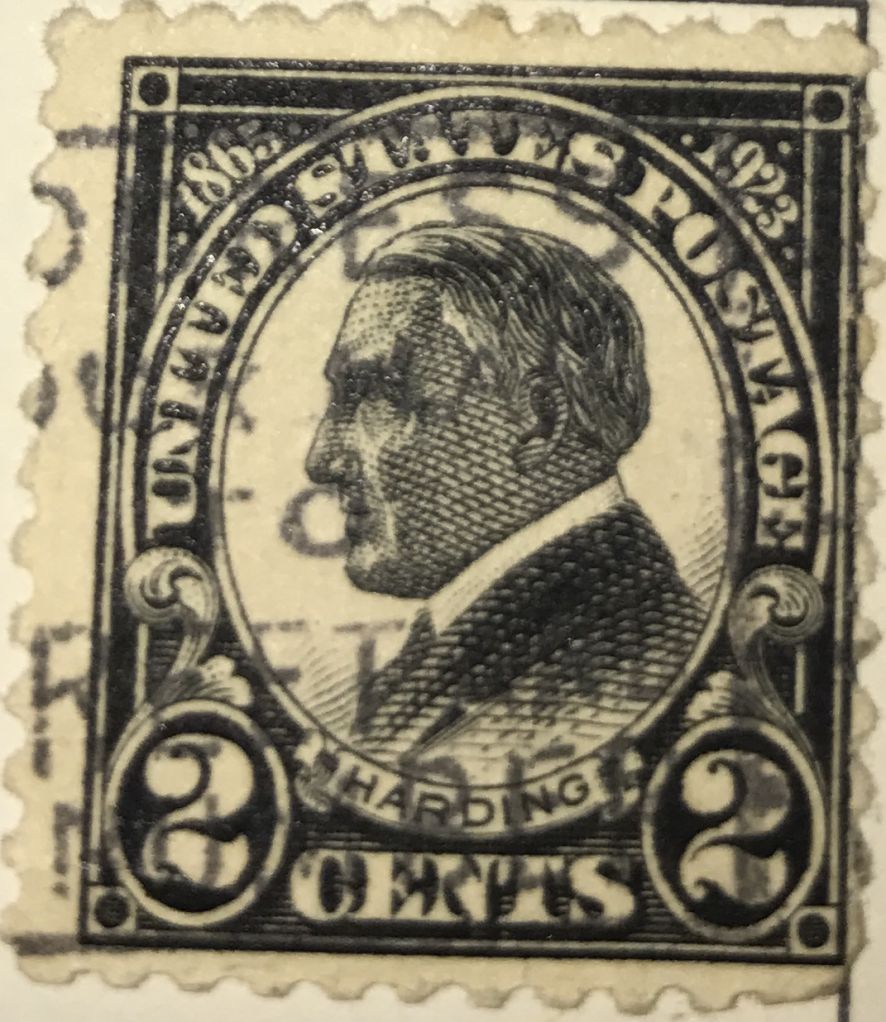 |
|
Send note to Staff
|
|
|
|
|
Pillar Of The Community
France, Metropolitan
3756 Posts |
|
|
Hi ;1)Flate plate printing 19 1/4mm x 22 1/4mm perf.11, 2)Rotary press:19 1/4mm x 22 1/2mm perf.10,3)19 1/4 mm x 22 1/2mm perf.11 You will have too measure the width & height of the frames..to know exactly to which printing it belongs to. https://siegelauctions.com/lots.php...8&page_no=23 |
Send note to Staff 
|
| Edited by perf12 - 03/04/2017 3:16 pm |
|
|
Moderator

United States
12330 Posts |
|
|
Welcome to the community. Here is a link which can help you learn a bit more. See towards bottom of page. http://www.stampsmarter.com/1847usa...ar/1923.htmlNote: You do not have the very rare rotary press stamp, so no need to measure your stamps. The rotary press stamp does not have the same sharp impression as the flat plate. (Plus it is extraordinary rare.) The misalignment does not make the stamp more desirable; it makes it less desirable to many collectors. Don |
|
Send note to Staff
|
|
|
Valued Member
United States
5 Posts |
|
|
Thank you! I'm looking forward to learning more about this interesting hobby via this community. My husband used his calipers to measure the stamps from the outer edge of the black border, length and width. His measurements showed 9 1/4 mm x 22 1/2mm. I don't know how to measure the perforations. Below are images of how my husband measured the stamps. The stamp that hasn't been cancelled, has the lower border slightly cut off by the perfs so its a little more difficult to measure, but if you measure to the bottom edge of the perf, it is 22.5 mm. I will need a professional to asses the stamp before I get too excited though :) 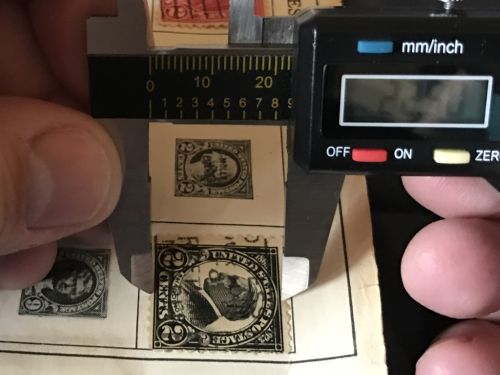 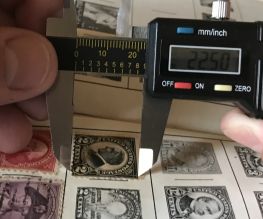 |
|
Send note to Staff
|
|
|
Valued Member
United States
5 Posts |
|
|
Ah, I just saw the post by 51studebaker stating this wasn't one of the extremely rare stamps. :) While I let visions of tossing money in the air go, *smile* I am still intrigued by the entire process of identifying and collecting stamps. My main interest is in learning the history of those that used the stamps in the first place, in what was going on in the world during that time, and how the US Post Office evolved to what it is now.
Thank you! |
|
Send note to Staff
|
|
|
Pillar Of The Community
United States
8956 Posts |
|
|
Like Don above said, measuring the stamp is absolutely unnecessary. To find out the perforation you will need a perforation gauge, readily available from any brick and mortar stamp store or online.
Peter |
|
Send note to Staff
|
|
|
Moderator
United States
12330 Posts |
|
|
The measurements are not going to help you. First, the dimensions supplied in catalogs and websites are just estimates. Second, you cannot measure accurately enough to make an ID. And third, this is one of the most commonly misidentified stamps. You have a flat plate #610, you can tell by the sharpness of the printing. See that link I gave you for images which show this difference.
Its a great hobby but the odds of finding a great rarity are longer than winning the mega-lottery. You last post hits on the real value of stamp collecting; learning history and a great family activity!
Don
Edit: there is a 'printable' perf gauge on the Stamp Smarter site (under Library). This will do until you can buy a good one. |
|
Send note to Staff
|
|
|
|
Pillar Of The Community
6364 Posts |
|
|
To use these as a learning experience. One can often learn as much from the back side as the front. If you look at the back, there is likely to be a small amount of black ink (set-off) from the flat plate printing process, establishing them as Scott 610. |
|
Send note to Staff
|
|
|
Valued Member
United States
5 Posts |
|
|
Thank you Don,
Yes, I read the article and I agree, this is definitely not a rotary press stamp. Also, my 11 year old son and I spent several hours looking at all the stamps, particularly all those during WW2 and the foreign stamps, some of which are from countries no longer existing! It was awesome and a great experience for us.
Thank you for your insight. You have all been a great help. Have a great day! |
|
Send note to Staff
|
|
|
Moderator
United States
12330 Posts |
|
|
Pillar Of The Community
United States
4183 Posts |
|
|
"Also, my 11 year old son and I spent several hours looking at all the stamps, particularly all those during WW2 and the foreign stamps, some of which are from countries no longer existing! It was awesome and a great experience for us."
Yes, for many collectors it is as much or more about what the stamps tell you as it is about the stamps. |
|
Send note to Staff
|
|
|
Pillar Of The Community
United States
6668 Posts |
|
|
There is a lot of value in that stamp.
Harding Flat plate used, Retail value .10¢
Spending hours with your son working together on stamps, retail value $Priceless. |
|
Send note to Staff
|
|
|
Valued Member
United States
5 Posts |
|
| |
Replies: 12 / Views: 2,443 |
|




 Posted 03/04/2017 2:40 pm


