| Author |
 Replies: 11 / Views: 2,607 Replies: 11 / Views: 2,607 |
|
|
Pillar Of The Community
USA
3315 Posts |
|
|
|
I've noticed that sellers are offering PNCs in strips of three, four and five. It would seem to me that three or five would be OK, but four would be "unbalanced."
What is the most common way to collect?
|
|
Send note to Staff
|
|
|
|
|
Pillar Of The Community
USA
1881 Posts |
|
|
Hi Greg......
5's, 3's and singles.......from my experience.......you're right, 4's just don't look right. |
Send note to Staff 
|
|
|
Pillar Of The Community
United States
6756 Posts |
|
|
Normally, PNCs are collected in odd-numbered lengths for the reason you mentioned -- balanced appearance. There are a few exceptions to this. For example, some PNC collectors who specialize in precancel gaps (and a few other very special printing displacements) will sometimes collect them in 4's or longer. Sorry, I don't have a pilfered scan handy to show this, and my PNC collection is mothballed somewhere.  k |
|
Send note to Staff
|
|
|
Pillar Of The Community
United States
2972 Posts |
|
|
Odd # multiples seem to be the standard. I think strips of 5 work in most cases. |
|
Send note to Staff
|
|
|
Pillar Of The Community
Canada
1755 Posts |
|
|
In the early days (early 1980's) of PNC collecting, as most of the PNC's also had the joint-line with the "new" plate number, most collectors were collecting the PNC's as the old style, in joint-line pairs. Once the line was elimintated in later printings, many collectors went to PNC3's. Later, PNC5's became the norm.
For these aforementioned reasons, now you know why PNC5's of early PNC's are expensive and tough to get.
Oh yes, there were some who tried PNC7's, but that was deemed too cumbersome.
David |
|
Send note to Staff
|
|
|
Pillar Of The Community
United States
576 Posts |
|
|
I believe the current convention is for strips of five but I will stick with my personal preference of strips of three albeit at peril. But, then it won't be the first time I have suffered for my own personal asthetics. |
|
Send note to Staff
|
|
|
Pillar Of The Community
1092 Posts |
|
|
ok somebody explain to Tina what a PNC is and now I feel like im not learning fast at all because I should know this by now shouldn't I? |
|
Send note to Staff
|
|
|
Pillar Of The Community
United States
6756 Posts |
|
|
PNC is an acronym for Plate Number Coil. In the old days of coil production, the conventional plate number would be cut off during the coil production. So you would rarely see it unless there was a miscut. Since 1894, with the plate number 1, the plate number is generally unique for each plate, and numbered sequentially (cumulatively). So by 1980, the numbering was closing in on 40000. In the 1980, BEP changed their plate number policy. As part of that change, plate numbers were assigned to stamps starting with the number 1 for EACH plate, instead of the cumulative sequential numbering. As part of that change, the plate number for coils was INCLUDED ON the stamp, instead of being cut off. It is usually (but no always) located at the bottom center. Not every coil stamp has the number. On most stamps, the plate number is spaced anywhere from 10 to 52(?) stamps, depending on the issue. I think there is only one stamp on which the plate designator appears on every coil (that particular stamp doesn't have a plate number, but the plate designator T). The coil with the plate number is known as the PNC. The discussion in this thread relates to how many stamps should be attached on each side to the PNC. I'll try to pilfer and post some scans. k |
|
Send note to Staff
|
|
|
Pillar Of The Community
United States
6756 Posts |
|
|
Here is an example of a miscut coil showing partial plate numbers. During that time, the plate numbers on coils were normally cut off during the production process. 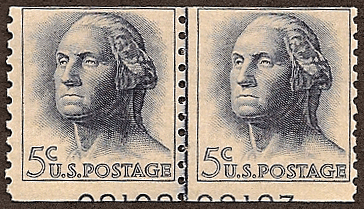 In 1980, BEP changed their plate numbering system and began to add the plate number directly on the stamp, usually (but not always) bottom center. Therefore, the plate number should normally appear. 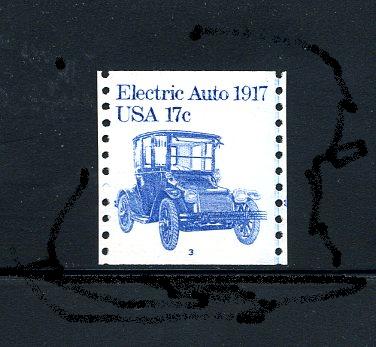 Sometimes, these coils are also miscut, and the plate number can appear at the TOP! 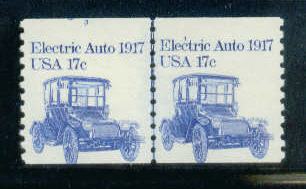 Usually, the plate number does not appear on every single coil, but is spaced through the coil, with the spacing depending on the plate used. However, in one test of the C press, the plate designator "T" was printed at the bottom of every coil. [EDIT: sorry, I left off the final pic] 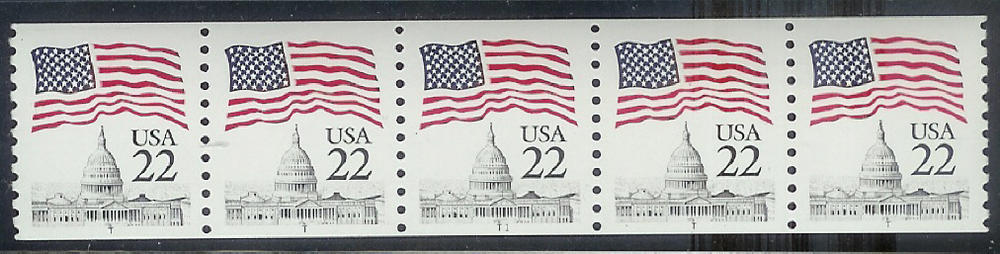 Wow, it's been awhile since I collected PNCs. This thread brought back some good memories.  k |
|
Send note to Staff
|
| Edited by khj - 08/26/2009 12:42 am |
|
|
Pillar Of The Community
Israel
6191 Posts |
|
|
Unless you are British, then it is a Philatelic Numismatic cover !!
Hope you are not confused Tina......it's such a wonderful Worldwide hobby !
Londonbus1.....Pretty Normal Collection |
|
Send note to Staff
|
|
|
Pillar Of The Community
Guatemala
1500 Posts |
|
|
I've been collecting PNCs for years. I knew about test coils but khj taught me something new: A "T" on an otherwise normal appearing flag stamp. |
|
Send note to Staff
|
|
|
Valued Member
Ecuador
159 Posts |
|
|
Hello
I collect Machins, and I use the Robin Harris site, the last year surfing on the Harris site read about the PNCs.
I search on my forgot USA/CANADA kiloware, found it few PNCs, was very proud about this, then back to Machins until try to found people for trade commemoratives againts PNCs.
And I always wondering, why do you have to collect in 3 or 5 stamps strips? Difficult for me found 1, do not talk about a strip!
Thank you
Fernando Moscoso
Ecuador |
|
Send note to Staff
|
|
| |
Replies: 11 / Views: 2,607 |
|




 Posted 08/25/2009 7:06 pm


