Stamp Community Family of Web Sites
Thousands of stamps, consistently graded, competitively priced and hundreds of in-depth blog posts to read


Stamp Community Forum
 
Username:
Password:
Save Password
Forgot your Password?

This page may contain links that result in small commissions to keep this free site up and running.

Welcome Guest! Registering and/or logging in will remove the anchor (bottom) ads. It's Free!

Couple Of General Knowledge Questions

 
To participate in the forum you must log in or register.
Author Previous TopicReplies: 13 / Views: 1,860Next Topic  
Valued Member
Canada
151 Posts
Posted 01/08/2010   12:18 pm  Show Profile Bookmark this topic Add plsllvn to your friends list Get a Link to this Message
If someone can help with questions, I would greatly appreciate it ..
Thanks
Paul
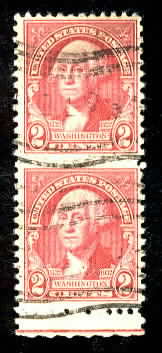
Does the perforation area located on the selvage area of this stamp have a name,was the sheet designed like this or was it cut after printing?

and
Is the green line between the first and second stamp common?
Send note to Staff

Pillar Of The Community
United States
6756 Posts
Posted 01/08/2010   1:05 pm  Show Profile Bookmark this reply Add khj to your friends list  Get a Link to this Reply
When you see a line between coil stamps, it will either be a guide line (back when coils were produced from flat plate press sheet stamps) or a joint line (when BEP began to use rotary press). The guide line is intentional -- used during the production process. The joint line is an unintentional result of the rotary press. When the plate is "curved", there will be a gap. Ink fills that gap, resulting in a line being printed there.

In your particular example, #597, it will be a joint line. These are usually collected in pairs and referred to as joint line pairs. You have a joint line strip of 3. A used joint line pair is 75c in the 2008 Scott catalog.

The spacing of the joint varies. On the Stickney Rotary Press (used to produce #597), the joint line will appear every 15 to 17 stamps. On later larger presses, the joint line will appear at larger intervals (I think the largest was 38, but don't hold me to that). The modern rotary presses are even larger (cylinder sizes up to 52 stamps). However, these modern presses DO NOT produce joint lines.
Send note to Staff  Go to Top of Page
Moderator
Learn More...
United States
4788 Posts
Posted 01/08/2010   1:25 pm  Show Profile Bookmark this reply Add kirks to your friends list  Get a Link to this Reply
Good explanation, KJH.

PLSLLVN, Linn's has an introductory article on their webiste -- sort of a precursor to KJH's explanation. And here's Part 2 of the article.

KirkS

[Edit to Correct Link]
Send note to Staff  Go to Top of Page
Edited by kirks - 01/08/2010 1:28 pm
Valued Member
Canada
151 Posts
Posted 01/08/2010   4:16 pm  Show Profile Bookmark this reply Add plsllvn to your friends list  Get a Link to this Reply
KJH,KirkS
Thanks for your replies, they have been a great help
Paul
Send note to Staff  Go to Top of Page
Pillar Of The Community
USA
3315 Posts
Posted 01/08/2010   11:21 pm  Show Profile Bookmark this reply Add laswabbie to your friends list  Get a Link to this Reply
Some of those joint line pairs are hard to find and/or expensive - as I am finding out.
Send note to Staff  Go to Top of Page
Valued Member
Canada
151 Posts
Posted 01/08/2010   11:41 pm  Show Profile Bookmark this reply Add plsllvn to your friends list  Get a Link to this Reply
I just found a second pair of the same stamp,now I have a pair of pairs!
Paul
Send note to Staff  Go to Top of Page
Moderator
Learn More...
United States
4788 Posts
Posted 01/09/2010   1:03 pm  Show Profile Bookmark this reply Add kirks to your friends list  Get a Link to this Reply

Quote:
I have a pair of pairs


That beats a Full House
Send note to Staff  Go to Top of Page
Pillar Of The Community
Philippines
505 Posts
Posted 01/09/2010   8:24 pm  Show Profile Bookmark this reply Add nic to your friends list  Get a Link to this Reply
very informative topic khj!, had wanted to ask it myself, Thanks!
Send note to Staff  Go to Top of Page
Valued Member
Australia
312 Posts
Posted 01/09/2010   10:46 pm  Show Profile Bookmark this reply Add MmmmBalf to your friends list  Get a Link to this Reply
Anyone have any theories on the top stamp? Scott 707. The bottom perforations failed to punch correctly - has it been rouletted with a serpentine cutter?

Balf
Send note to Staff  Go to Top of Page
Pillar Of The Community
United States
6756 Posts
Posted 01/10/2010   12:43 am  Show Profile Bookmark this reply Add khj to your friends list  Get a Link to this Reply
[I have edited this post yet one more time to correct several errors in my original reply and to simplify things.]

Sorry, I have a bad problem with getting things completely done, and in a timely manner...

The top stamp, US #707, is normal, other than some of the perf holes at bottom are not completely punched out.

Basically, you have a normal stamp from the bottom of the pane, with a bottom selvage attached. The wavy bottom edge is caused by the guillotine blade. I do not know why the guillotine blade used in the production of this stamp has a wavy/serpentine shape for that edge and not a straight blade. It happens on many other issues of that era as well. For small size stamps with the same orientation as this issue, the wavy edge appears at the top/bottom edges of the full press sheet, while the all other cuts are straight.

The red line you see at the bottom, is actually NOT the top frame line of the stamp below. If you look at the left/right ends, you will notice it is wider than the stamp frame. That long red line will either be a guide line (between the panes of the full press sheet) or what I call an ink line (appears near the ends of the flat plate). In this case, I would say it is an ink line. The guillotine trims the press sheet around that ink line. Sometimes the cut is off and you can see the complete line, as in the example below:


Hope that explanation makes sense. I am subject to correction on my statements.

These comments only apply to some pre-ElectricEye issues.

k
Send note to Staff  Go to Top of Page
Edited by khj - 01/10/2010 02:13 am
Valued Member
Australia
312 Posts
Posted 01/10/2010   05:13 am  Show Profile Bookmark this reply Add MmmmBalf to your friends list  Get a Link to this Reply
Thanks Kim, great information for someone just starting to collect US. Something I'd expect to find explained in the Scott US Specialized, which I find sadly lacking (but this isn't the place to go into that! I have thought of starting up a vent thread on that subject. )

I'd realised it wasn't the top frame of the stamp below as you said, but couldn't work out why you'd then cut the selvedge like that. Wonder if we can find out why it was cut in that manner? Interesting.

Cheers
Balf
Send note to Staff  Go to Top of Page
Moderator
Learn More...
United States
4788 Posts
Posted 01/10/2010   10:09 am  Show Profile Bookmark this reply Add kirks to your friends list  Get a Link to this Reply
Balf:

I think you should start that VENT thread. Make a list of topics you find lacking in Scott Specialized and we'll annotate it with web links to other resources.

KirkS
Send note to Staff  Go to Top of Page
Valued Member
Canada
151 Posts
Posted 01/11/2010   5:48 pm  Show Profile Bookmark this reply Add plsllvn to your friends list  Get a Link to this Reply
After looking at the first stamp on the strip of three I noticed a crack/slash on the "S", does anyone know if this is a listed flaw or just dirt etc...
Thanks
Paul
Send note to Staff  Go to Top of Page
Pillar Of The Community
United States
1721 Posts
Posted 01/11/2010   7:46 pm  Show Profile Bookmark this reply Add revstampman to your friends list  Get a Link to this Reply
Over the years I have found a silly number of Plate Flaws, Pressure Cracks and related errors on this issue. If Scott listed all types of flaws on this issue it would take a whole page just by itself. It has been my experience that this issue seems to be very flaw prone. Just my experience. I have often thought it would make an interesting display!
Send note to Staff  Go to Top of Page
  Previous TopicReplies: 13 / Views: 1,860Next Topic  
 
To participate in the forum you must log in or register.

Go to Top of Page

Disclaimer: While a tremendous amount of effort goes into ensuring the accuracy of the information contained in this site, Stamp Community assumes no liability for errors. Copyright 2005 - 2026 Stamp Community Family - All rights reserved worldwide. Use of any images or content on this website without prior written permission of Stamp Community or the original lender is strictly prohibited.
Privacy Policy / Terms of Use    Advertise Here
Stamp Community Forum © 2007 - 2026 Stamp Community Forums
It took 0.33 seconds to lick this stamp. Powered By: Snitz Forums 2000 Version 3.4.05
