| Author |
 Replies: 33 / Views: 4,773 Replies: 33 / Views: 4,773 |
|
|
|
Pillar Of The Community
United Kingdom
3220 Posts |
|
|
I'm happy with using tête-bêche to describe these.
Traditionally tête-bêche stamps would be joined on a single piece of paper but I see no problem in extending this to cover self-adhesive stamps like this.
The only problem I could see would be in expertising pairs like this in the future. How easy will it be to say with confidence that a stamp hasn't been removed carefully, turned and put back. With some of these stamps it's not clear whether they will stay attached to their backing paper for long anyway or will they just fall off.
|
Send note to Staff 
|
|
|
Bedrock Of The Community
Australia
38679 Posts |
|
|
Interesting observation Nigel.
The scan was not clear enough, and I was presuming
the die-cut selvedge still surrounded each stamp, thereby
offering proof of printing. (I don't think you can physically
rotate a die-cut stamp, the perf wave would not accomodate)
|
|
Send note to Staff
|
|
|
Pillar Of The Community
Australia
3547 Posts |
|
|
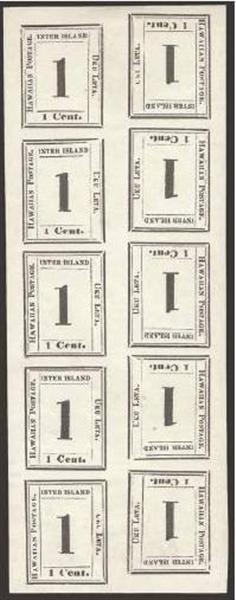
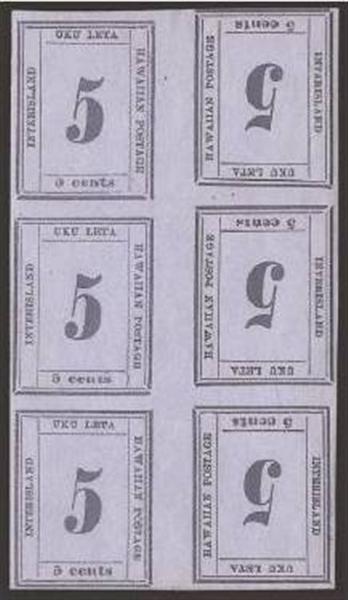
This (Charkhari SG 37a)  is tête-bêche, and this (Charkhari SG 31a)  printed on different sides of the paper is tête-bêche. But no physical joining of the two stamps, no tête-bêche  |
|
Send note to Staff
|
|
|
Pillar Of The Community
Israel
6191 Posts |
|
|
On the Horizon labels, the selvedge [Matrix] surrounds each stamp. But I am pretty sure it is possible to turn them around as Nigel suggested, if not on this item specifically, then on another S/A TB pair. On some GB Booklets, the matrix is removed. So what then ? Very easy indeed to turn a stamp around. And Tony, for what it's worth, I believe your Blue Charkhari's ARE Tete-Beche !  |
|
Send note to Staff
|
|
|
Pillar Of The Community
Australia
3547 Posts |
|
|
They really are, Londonbus. I could turn them around and scan the other side if you like ... |
|
Send note to Staff
|
|
|
Pillar Of The Community
2664 Posts |
|
|
Rest in Peace
Canada
6750 Posts |
|
|
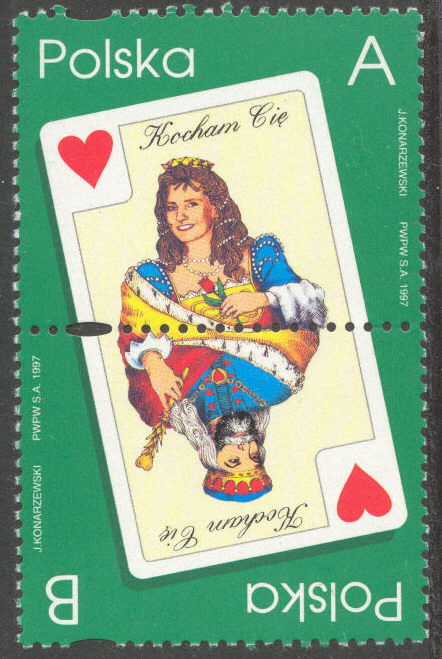
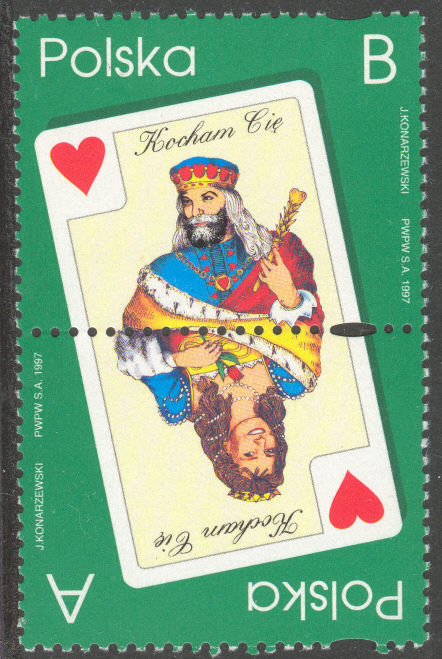
Poland 1997, Michel 3486-7 Valentine's Day Stamp. Polish 'Kocham Cie' = English 'I Love You'. I just saw these stamps being sold separately on ebay and looking around at the Polish Post site it has a pic (see below) of them attached together. Not sure if they are self adhesive though. And what does the A and B mean? Local and Europe? Europe and International? http://www.poczta-polska.pl/znaczki/en/1_1997.php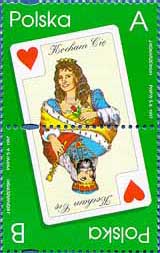 |
|
Send note to Staff
|
| Edited by Puzzler - 03/07/2011 8:46 pm |
|
|
Pillar Of The Community
United States
2547 Posts |
|
|
Bedrock Of The Community
Australia
38679 Posts |
|
|
Pillar Of The Community
Australia
3547 Posts |
|
|
Barwani used to regularly pull its printing plate (of four clichés) of the ½ Anna value apart and put it together again. At one stage, around 1927, this resulted in  This must have looked so nice, the printers tried it on with the ¼ Anna value as well: 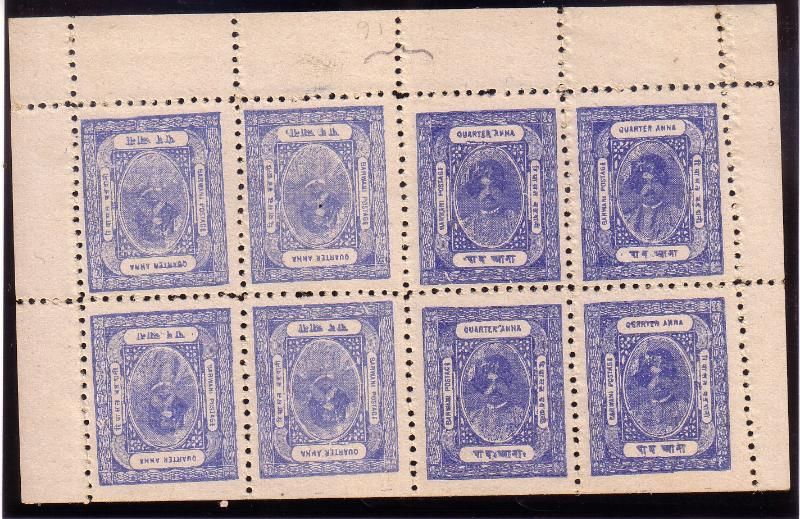 |
|
Send note to Staff
|
|
|
Pillar Of The Community
Australia
1865 Posts |
|
|
Puzzler - re the Polish se-tenant stamps above:
Polish stamps marked with an "A" can only be used for sending domestic letters of up to 20 grams.
Polish stamps marked with a "B" can only be used for sending domestic postcards.
These stamps are B = SG3661, A = SG3662
I'm sure that they are not self-adhesive. |
|
Send note to Staff
|
|
|
Rest in Peace
Canada
6750 Posts |
|
|
Thanks 22crows. I think it's a great marketing scheme. They won an award for the 2009 I Love You stamp. |
|
Send note to Staff
|
|
|
Pillar Of The Community
Israel
6191 Posts |
|
|
An unusual item. Even the single elliptical perf is off centre. And would you call this s Se-Tenant pair, Tete-Beche ? Mmmm  |
|
Send note to Staff
|
|
|
Pillar Of The Community
United States
7104 Posts |
|
|
Rest in Peace
Canada
6750 Posts |
|
|
Replies: 33 / Views: 4,773 |
|




 Posted 06/11/2010 08:41 am