bridger and kay cancellation guage
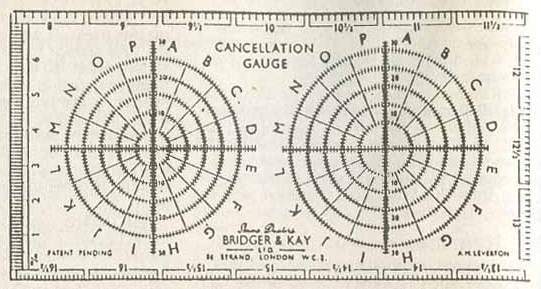
Cancellation Gauge
In the last issue, mention was made of a Thirkell gauge used for
positioning flaws on stamps.
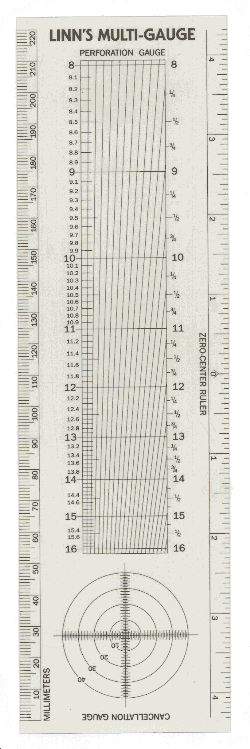
Another gauge I recently acquired at a Society auction was a "B and
K Cancellation Gauge" incorporating a perforation and mm gauge.
The description on the gauge states that; "This gauge has been
designed with two purposes in mind.
1. To measure the diameter of a full or part of a circular cancellation.
2. To give an easy form of reference for the letters or figures in a
cancellation, thus enabling material (postmarks) to be compared by
correspondence."
The gauge was evidently designed by Bridger and Kay Ltd, 86
Strand, London . The price on the protective cover was 7/6d, hence it
may be some years ago that this particular item was produced. Its
availability at this time is uncertain.
The instructions for the use of the gauge are as follows: "In use the
two thick lines are placed so that their intersection is over the
cancellation to be measured, the concentric circles being used as a
guide. It will be noted that the two sets of circles have different
diameters in order to simplify this operation.
The gauge consists of two sets each of five concentric circles. These
circles are each of such a radius so as to allow an exact number of
mm in each circumference and an exact number of mm in each of the
16 equal sections of the circumference, which are lettered A to P.
(The diameters of the concentric circles are not of great importance
for these circles are only used for guidance. The thick cross lines
being used to read the off diameters.) These thick cross lines of the
gauge are each graduated in mm and half mm measuring from the
centre. (When measuring under and over inked cancellations,
allowances have to be made. In practice it is better to take the
measurements of the diameter, at the centre of the inked line forming
the circumference of the circle.)
Oval cancellations may also be measured but care has to be taken to
find the centre; in measuring oval cancellations, width is given before
neight.
Positional references of letters and figures may be taken from a
cancellation with the aid of check letters placed around the
circumference. Placing the gauge so that the top dead centres of the
cancellation and the gauge coincide, a letter in the circumference
which is for example 2mm along section B, will be given the
reference number 2B. It will be noted that the sections of the
circumference are each graduated in full mm, the height of any letter
around the circumference may be measured by turning the gauge and
using the thick cross lines."
This type of gauge should be of particular interest to postal historians
and postmark collectors. As stated earlier, the original designers were
Bridger and Kay of London. Enquiries for supply should be directed
to that firm. However if that firm no longer exists, I have
experimented and a reasonable facsimile could be produced on
overhead projector cellophane material. The approximate cost of
producing the facsimile would be $2. I would be interested to learn if
this cancellation gauge is still available, and the address if it is, for
the benefit of other philatelists.





 Posted 07/08/2010 3:57 pm






 . But my discovery, made possible by using the clear plastic gauge.