| Author |
 Replies: 46 / Views: 4,334 Replies: 46 / Views: 4,334 |
|
|
|
Bedrock Of The Community
Australia
38679 Posts |
|
|
Valued Member
United States
111 Posts |
|
|
Hahah, $0.20, wow, well I LOVE this stamp, probably my real favorite out
of all the ones I have, cus its so old, and simple, and from spain. :D
Thanks for the ID Rod :D |
Send note to Staff 
|
| Edited by Luisvillalobos - 07/13/2010 11:41 pm |
|
|
Valued Member
United States
111 Posts |
|
|
How do you find the name of all the stamps soo quickly?
Do you have them all or do you own the Catalogs?
Is there a place online to searh for them somehow? |
|
Send note to Staff
|
|
|
Bedrock Of The Community
Australia
38679 Posts |
|
|
Your stamp also exists perforated (unofficially) I find my stamps quickly because I type every stamp I have into a database, for Spain I just typed in 01c and up yours popped along with every other 1c issue. All of us start with stamp catalogues. we spend our life leafing through them  It doesn't matter if you are young and poor, catalogues can be readily had for $1 Your best bet (always) is to join a stamp club, collectors just love fostering new collectors and often will give you stuff. Your stamp is listed in a catlogue of mine I originally purchased for a dollar, it's old, dog eared and out of date but so what? lots of juicy info, and you can buy a better model when the wallet gets fatter. This is what it looks like (1963) prices are way out of date and in pounds shillings and pence but who collects for money anyhow  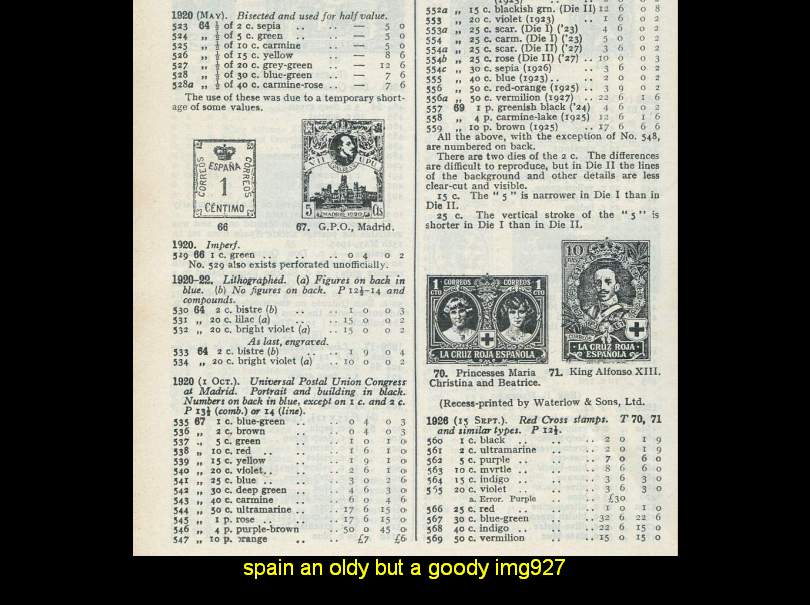 |
|
Send note to Staff
|
|
|
Valued Member
United States
111 Posts |
|
|
Ooh, thanks :D
aha
Really interesting, but what does perforated mean? whats the difference?
Well im glad I joined this forum, im really getting into stamps :D
Thanks for the responses by the way.
|
|
Send note to Staff
|
|
|
Bedrock Of The Community
Australia
38679 Posts |
|
|
"The tooth, the hole tooth and nothing but the tooth!" --Anon.
Perforations.
bars with tiny round steel pins descend on the
printed sheets of stamps on paper and punch holes (perforations)
into the paper surrounding the images, so the stamps can be seperated
easily.
From University Philatelics :
A Short Essay on Postage Stamp Perforations
The Language of Stamp Dealers
Other short essays
No, we are not taking our ease in the dentist's chair. Rather, we are examining the
holes (perforations) that separate postage stamps from one another in an intact pane in
order to expedite the detachment of individual stamps from the pane.
Technically, perforations are but one method of facilitating stamp separation. They
involve removing bits of paper at the margins of stamps so they can be readily torn
apart. Other methods not involving the actual removal of paper are also common
(rouletting, die cutting, etc.). For our purposes, I shall employ the rubric of
"perforation" to encompass all the devices used to facilitate separation of stamps from
one another. I'll bet you didn't realize what a large topic this is.
You may well ask, can there possibly be a less significant subject than this? To the
philatelist these perforations are significant indeed. The number of such holes along a
2-centimeter distance on a stamp's edge is often an identifying characteristic. The
perforation may dramatically influence the value of a stamp. Thus, if you are the
proud owner of an unused US 50 cent stamp issued between 1916 and 1919 it might
be worth $1500 if it measures 10 holes/2cm (called perf.10) or $110 if it is perf.11.
Otherwise, the stamp design is the same and the colors similar.
Holes do make a difference! So how can one tell which is which? You could take a
ruler marked in metric units, align it with the stamp and simply count the number of
holes over a 2-centimeter distance. After examining a dozen or so stamps this way,
you would be ready for the "ga-ga" unit of your local asylum.
There are many devices for accurately measuring perfs. The simpler ones allow you
to slide your stamp along a perforation gauge until the perfs. align with the markings
on the gauge. Such gauges can be purchased for under $10. and should last for
decades. However my personal preference is a German-made electronic perforation
gauge.
It requires no mental input on my part beyond properly placing the stamp in the
machine. A digital read-out tells me within seconds what the perforation is. Neat,
accurate, and not tiring or mentally taxing but significantly more expensive than the
manual gauges
Ah, but philatelic life is not quite so simple. In 1932, the United States issued a
series of 12 stamps for the George Washington bicentennial. These showed various
portraits of Washington. The horizontal perforation gauge differed from the vertical
resulting in a perf. 11 x 10-1/2 configuration. This compound perforation means that,
for certain stamp issues, one must measure two sides of the stamp. In practice, the
horizontal dimension is given first and then the vertical.
Well, you say, that's not too difficult. To keep your interest heightened, some
countries have produced stamps with perforations differing on three or even all four
sides. New Zealand and some Australian states are notable in this regard. These
stamps are described giving the top measurement first and then proceeding clockwise
for the rest. Wait! Don't feel smug yet. Some stamps have one perf. gauge part of the
way along one dimension and a different gauge for the rest of the way! We refer to
stamp catalogues to help us know which stamp issues are so afflicted.
Ready to give up because of these complexities? Don't. The difficult perforation
combinations are restricted to a relatively few issues. We are not required to worry
about such things. We can enjoy the immense pleasures of stamp collecting without
going in to such detail. Only those of us who are fascinated by such things need be
involved with the intricacies of perforation measurements. However, we are more or
less compelled to do so if evaluating our stamp collections accurately becomes
necessary.
Want more perforation profundities? Next time we shall examine such delights as
syncopated perfs., gambling with roulettes, perce en points, rough perfs., microperfs.,
and the world of die-cutting. As space permits, we shall comb through what we know
about how these holes are made. Perhaps we can also briefly examine the history of
making holes to separate stamps and why compound perforations came into being.
Hopefully we shall come to better realize that understanding such holes is a deeper
subject than it appears from the surface.
|
|
Send note to Staff
|
|
|
Rest in Peace
Canada
6750 Posts |
|
|
Thanks Rod, that was such a nice read. Do you have any further articles from the same saries, mentioned in the article itself?
|
|
Send note to Staff
|
|
|
Valued Member
United States
111 Posts |
|
|
That was a mouth full :D thanks, now I know about perforations, i
hope its the last time I read about it ahahah ;P
thank you for the short essay, you've been really helpfull. |
|
Send note to Staff
|
| Edited by Luisvillalobos - 07/14/2010 12:39 am |
|
|
Valued Member
United States
111 Posts |
|
|
Ok, im keeping up with the title of the thread :D These I all got from a lot that was supposed to be from Yugoslavia, but some of them say otherwise, I think some of them are from slovenia like Khj said, but I have questions about some other ones. From the research I have, these should all be from the 1918 State of SHS, (Slovenes, croats, serbs) valid stamps until 1921. #1-Slovenia? because of "KRALJEVSTVO"  #2-Again, Slovenia?  #3-Slovania again?  #4-???  #5-Croatia?  #6-Croatia?  |
|
Send note to Staff
|
|
|
Pillar Of The Community
United States
6756 Posts |
|
|
The last one (#6) is from Croatia-Slavonia. The others are Slovenia. The #5 picture is a postage due stamp. |
|
Send note to Staff
|
|
|
Bedrock Of The Community
Australia
38679 Posts |
|
|
Hi Puzzler, No I don't, sorry, take some text perhaps, and google may rescurrect the link. OK Luis, how well did you read the article ?  Can you tell me what type of perforation is on your first stamp of Yugoslavia / Slovenia? The holes are not round are they? (in fact your first stamp of Greece is similar) hehehe |
|
Send note to Staff
|
|
|
Valued Member
United States
111 Posts |
|
|
thank you :D
But, what does Postage due stamp mean, and where is that one from?
And how can it be from Croatia-Slavonia?
where they the same country and then separated? |
|
Send note to Staff
|
|
|
Bedrock Of The Community
Australia
38679 Posts |
|
|
Pillar Of The Community
United States
6756 Posts |
|
|
Was it just me, or about 1 hour ago did others have problems accessing SCF for roughly 15 minutes? Quote:
But, what does Postage due stamp mean, and where is that one from? The postage due stamp is from Slovenia. When someone fails to pay sufficient postage on mail, the recipient has the option of paying the shortage. The postage due stamp is then affixed to the mail and canceled to indicate the missing amount has been paid. Quote:
And how can it be from Croatia-Slavonia?
where they the same country and then separated? Just to clarify, your LAST stamp (#6) is from Croatia-Slavonia, not the postage due. Here is a link to some decent background info http://en.wikipedia.org/wiki/Kingdo...tia-Slavonia k |
|
Send note to Staff
|
| Edited by khj - 07/14/2010 02:06 am |
|
|
Valued Member
United States
111 Posts |
|
|
I had problems accesing it too. I was freaking out :D haha Quote:
When someone fails to pay sufficient postage on mail, the recipient has the option of paying the shortage. The postage due stamp is then affixed to the mail and canceled to indicate the missing amount has been paid.
So is this still a normal stamp? or is it its own kind? Wow, you guys are really putting me to read alot, :P but thanks for the link, ill go read through a bit. And thanks for the ID's too |
|
Send note to Staff
|
| Edited by Luisvillalobos - 07/14/2010 02:18 am |
|
|
Replies: 46 / Views: 4,334 |
|




 Posted 07/13/2010 7:31 pm


