Scan courtesy and generosity of Philb.
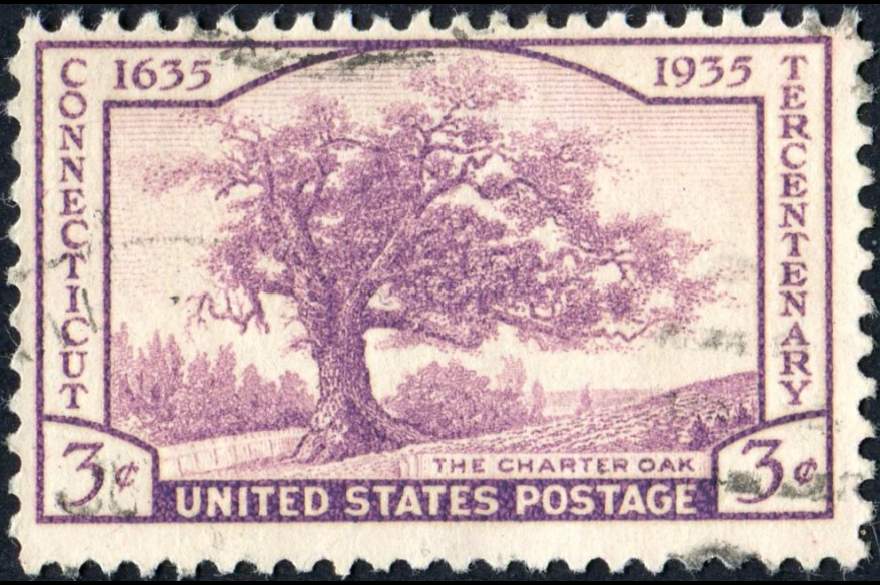
Connecticut and the Charter Oak
COMING up over the eastern horizon, the nearly-full moon shone through the trees and lit up the river and the
hills. As our boat moved down stream between its wooded banks, it might easily have been a night in 1635 instead
of 1935. The moon, river, and hills were all the same, and in the shadows it seemed as though I could see the dim
forms of the Indians, paddling their birch canoes up and down the river, calling it "Quon-ek-to-cut," which in their
picturesque language meant "Long River."
Down along this river just three hundred years ago journeyed a group of brave men and women, seeking a home
where they could worship and live according to their own ideas. They came from His Majesty's Massachusetts Bay
Colony and settled near what is now the city of Hartford. They called the river, and their colony, "Connecticut,"
which was the nearest they could come to pronouncing the quaint Indian name for the river.
Under the leadership of the Rev. Thomas Hooker, they purchased a plot of ground from the Indians, and in solemn
ceremony a bill of sale was drawn up and buried at the foot of a large oak tree on the outskirts of the settlement. For
generations the Indians had held their tribal meetings under this oak tree, and in selling the land on which it stood,
they made the white men promise never to cut it down, for to them it was a sacred thing.
The colonists drew up a Charter, which, unlike the Massachusetts Charter, was quite liberal and allowed the people
more religious freedom than they had enjoyed previously. This form of government did not quite agree with the
ideas that King James II. had for his American colonies, and he therefore sent Sir Edmund Andros over to America
to demand this Charter in the name of the king.
Expecting some opposition, Andros was agreeably surprised, upon his landing, to find the colonists most
hospitable. They greeted him warmly and went in a body with him to the assembly hall where the Charter was
spread, out before him. While all were around the council table examining it, the lights in the hall were suddenly
extinguished, and when they were again kindled the Charter had disappeared. The colonists had spirited it away,
and unknown to anyone had hid it in a hollow portion of this oak tree, where it was kept until after the death of
James II.
To-day the Charter Oak is gone, but it still protects the first Charter of Connecticut. In our state capitol building you
may examine this; charter, framed in wood taken from the tree' when it was blown down in a windstorm in 1856, In
the city of Hartford there stands a plain little monument which marks the site of this oak. Here, in the midst of a
busy, modern city it stands as a tribute to the traditions and ideals of a small, quiet state, and its people who
believed, in the government they had established.
Upon the ideals of this Charter and the government of this tiny state with a big Indian name, a nation formed a
similar government nearly 150 years later. That nation honors Connecticut and its Charter Oak by issuing a special
stamp.
A disturbance in my immediate vicinity warned me that my companion did not approve of my day-dreaming in her
company, and soon I was talking about other things, while the moon lit up the river and the hills—Connecticut
hills.
(By L. G. Shepard.)
February 1, 1936. THE AUSTRALIAN STAMP MONTHLY,





 Posted 08/10/2010 11:02 am


