Macau (or Macao) 2001 Souvenir sheet of 8 stamps.
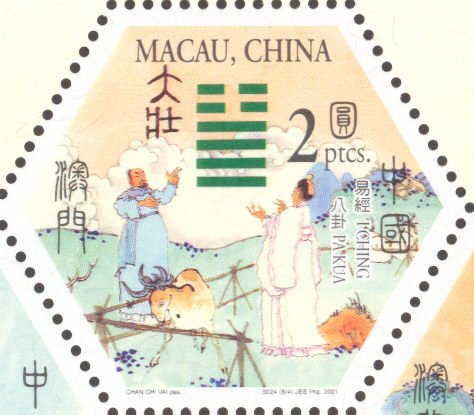
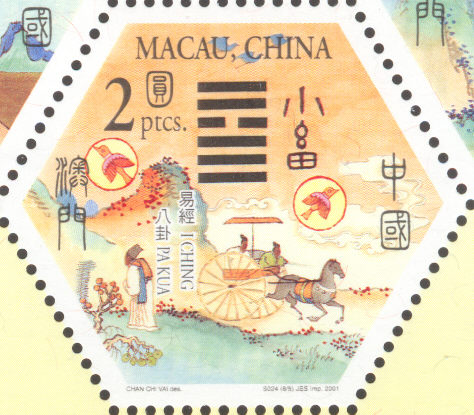
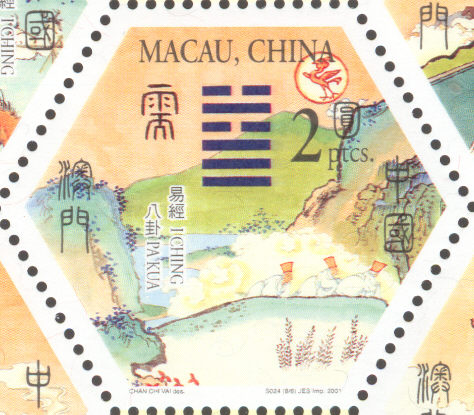
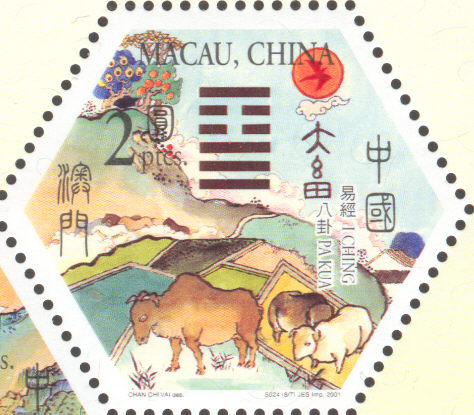
http://en.wikipedia.org/wiki/MacauThis is the first of a series of eight sheets, issued one per year, showing scenes of the I Ching, which has 64 hexagrams.
A hexagram is a group of solid and broken lines arranged in groups of six rows.
Each group of three rows represents an idea and is called a trigram. Put two of them together for six rows or a hexagram.
Two types of lines, closed (solid) and open (broken). These represent the creative or Yin or male and the receptive or Yang or female.
There are eight trigrams possible (111 to 000 in binary) and mathematically eight ways to put these trigrams together. 8 years x 8 stamps a year = 64 stamps or 64 hexagrams.
The I Ching is an old Chinese text that is used as a basis for many philosophies in Chinese thought such as Taoism and Yin-Yang and lends itself in some interpretations to being used as a divination method.
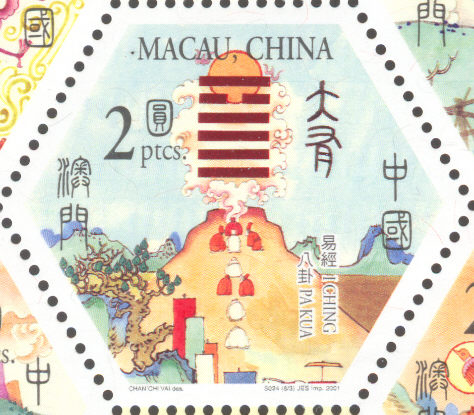
http://en.wikipedia.org/wiki/I_chingWhat is fascinating to me is the art-work on these stamps.
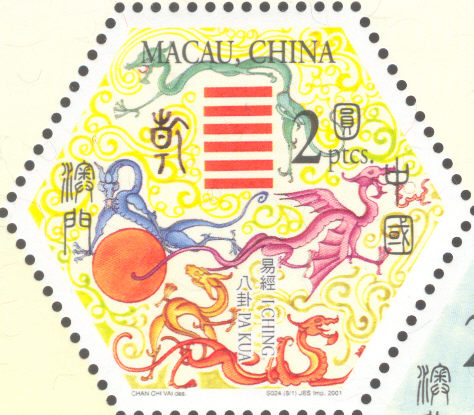
Each trigram or group of three lines has a meaning. Three solid lines together are called The Creative Force or Heaven or Sky or Dragon. So the first stamp with Dragon below and above has dragons on it and the sun as heaven or sky (I think).
Since I do already enjoy Taoism ideas or philosophy and Tai Chi (years ago) and recently hexagons, this is all fitting together nicely for me. Macau also issued a souvenir sheet of artwork to go along with each year's issue with just one rectangular stamp on each one.
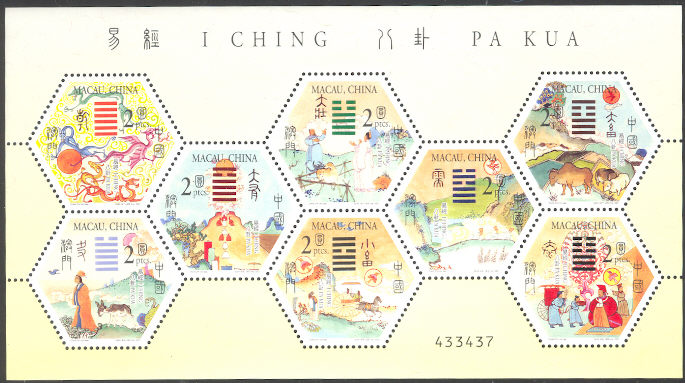
I may have the stamps or hexagrams out of order as I do not know their proper order.
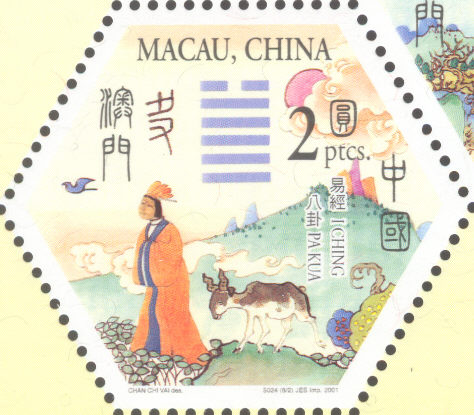
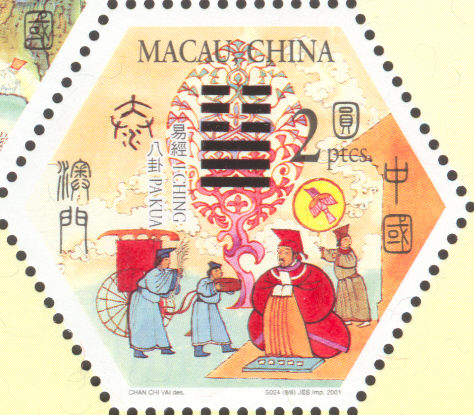
The symbols or ideographs for Macau (at least I think they are) reminds me of Confucious with his hands in the arms of his robes.
Patience Grasshopper!





 Posted 11/18/2010 12:55 am


