| Author |
 Replies: 22 / Views: 11,452 Replies: 22 / Views: 11,452 |
|
Moderator

United States
4788 Posts |
|
|
Forgive me for showing my ignorance of Canadian history, but I'm trying to get my mind around the provincial stamp issuing authorities. I realize an entire book could be written about the subject, but right now, I'm just trying to get the big picture. So I made my own big picture and I wonder if some of you experts would give me some feedback....  Comments welcome (no matter how harsh), KirkS Edit: -- Perhaps I should add a bit; the diagram is lacking in explanatory notes. The timeline essentially shows the periods the various provinces issued stamps; e.g. The Province of Canada issued stamps from 1851 until 1867 when it became part of the Dominion. N.B. and N.S. issued stamps beginning Sep 1851. Vancouver, as I understand, issued only one stamp. Newfoundland was, of course, the last to join the Dominion in 1949. |
|
Send note to Staff
|
| Edited by kirks - 01/26/2011 12:44 pm |
|
|
|
|
Pillar Of The Community
Canada
923 Posts |
|
|
There are oodles of historical sites that can give as much detail as you wish but essentially it runs like this. Great Britain developed seperate colonies in North America. The Canadian ones, like the American ones were given limited autonomy (legeslative assemblies) but were essentially run from England. The grouping of the "13 colonies" rebelled with some unsuccessful attempts to persuade or invade the Northern colonies and these formed the United States. The northern ones remained as individual units except for Upper and Lower Canada (Ontario and Quebec) which more or less joined in the 1840's and the colonies of Vancouver Island and British Columbia which joined together in the 1850's. When postage stamps were issued each colony issued their own. Serious talks about Confederation really began during the American Civil War when there was a real concern that, once the war was over, the U.S. would use their armies to invade. Economic advantages of Union were kind of iffy because, for the most part, there was quite poor land communication between the colonies. As various parts of the country came together, starting in 1867, the provincial stamps were replaced by those of the Dominion of Canada. The earliest "Canadian" stamps were those used by Upper and Lower Canada, not by the current Confederation. British Columbia was brought into the fold by a promise of building a transcontinental railway. The last "colony" to join the Confederation was Newfoundland in 1949. Prior to that, the island itself and a large chunk of the mainland (Labrador) was a seperate nation. There are still two tiny islands off the coast of Newfoundland, St. Pierre and Miquelon, that are controlled by France and issue their own stamps. These are all that remain of the huge French Colony, New France, that was ceded to Britain at the close of the Seven Years War, 1760s. Battle for Quebec was won by James Wolfe in 1759 though both he and the French General were killed, and the territory was occupied by the British from that point on. |
Send note to Staff 
|
|
|
Rest in Peace
Canada
5701 Posts |
|
|
Very good backroads! I wish my high school history teacher kept it as simple as that! |
|
Send note to Staff
|
|
|
|
Moderator
United States
4788 Posts |
|
|
Thanks backroads.
Am I misusing the terms Confederation and Dominion? If I were speaking of modern-day Canada, wouldn't it be correct to say the Confederation?
I've seen the "Act" of 1867 called both the "British North America Act" and the "Constitution Act." I'm not sure which is correct/preferred, but isn't that when Upper & Lower Canada became Ontario & Quebec?
|
|
Send note to Staff
|
| Edited by kirks - 01/26/2011 12:49 pm |
|
|
Pillar Of The Community
Canada
923 Posts |
|
|
Confederation just referred to the act of joinging together. When they were discussing the naming of the new country, Sir John A MacDonald (First Prime Minister)really, really, really wanted the official name to be the Kingdom of Canada. Various other proposals were floated (including Republic) and, happily, they settled on the wishy washy, typically Canadian compromise of The Dominion of Canada. At some point, the Dominion part was dropped, (I suspect around 1965 when the current Maple Leaf Flag was adopted) and it became just Canada. The last assault on the older term was when "Dominion Day" became "Canada Day".
|
|
Send note to Staff
|
|
|
Rest in Peace
Canada
5701 Posts |
|
|
Nice accurate graph Kirk. Here is British Colombia in a little more detail. 1849 Vancouvers Island (with an s, yes) is proclaimed a British Colony. 1858British Columbia is proclaimed a British Colony. 1860Stamps issued for use in BOTH British Columbia and Vancouvers Island and inscribed as such. 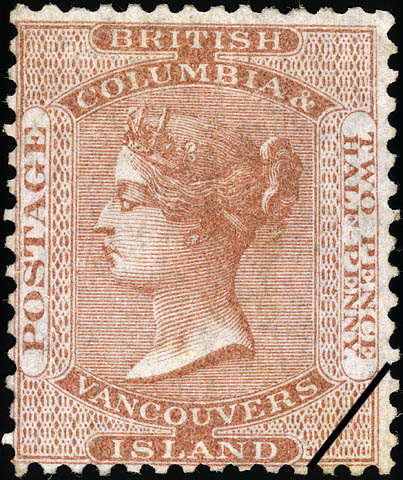 1865 1865Stamps issued for Vancouver Island, because the colony switched to U.S. decimal currency 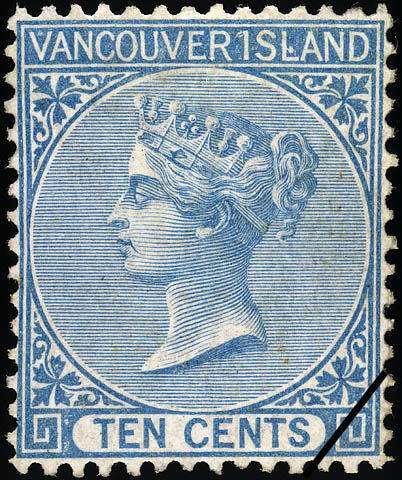 1865 1865Stamps issued for British Columbia, the colony kept British currency. 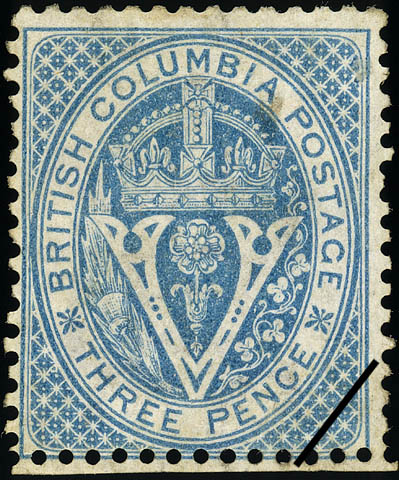 1866 1866The two colonies merged as the Colony British Columbia, using British currency. 1868Decimal currency put into use, stamps overprinted to suit. 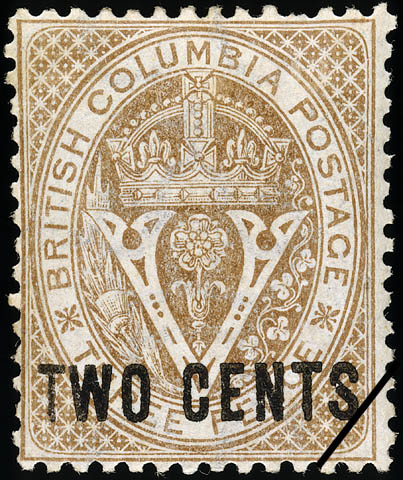 |
|
Send note to Staff
|
|
| Edited by BeeSee - 01/26/2011 1:25 pm |
|
|
Pillar Of The Community
Canada
923 Posts |
|
|
Just had to check on this question. The British North America Act of 1867 was the one which established the original Dominion of Canada. Now, as it expanded to include Rupert's Land (essentially all of Canada West of the Great Lakes which was under charter and control, sort of, of The Hudson's Bay Company) I think in 1869, other colonies as British Columbia, it was under the same Act though I am not sure whether the original was expanded or if seperate agreements were produced. Newfoundland was the only one to be negotiated seperately by the Dominion Government, as control over external affairs was not ceded by Britain to the Dominions (Canada, Australia, New Zealand etc.) until after World War I. The Act of Union generally refers to an 1840's Treaty which brought together Ontario and Quebec, Upper and Lower Canada, Canada East and Canada West, whichever name you choose, in a single entity. You will, by the way, find all those various designations in period post marks from that region.
And BeeSee - one of my earlier incarnations was as a High School History teacher.
|
|
Send note to Staff
|
|
|
Moderator
United States
4788 Posts |
|
|
Thanks BeeSee & BackRoads for the awesome feedback. Here's a revised diagram, still without BeeSee's BC & VI info, but a little clearer on NFLD and PEI. 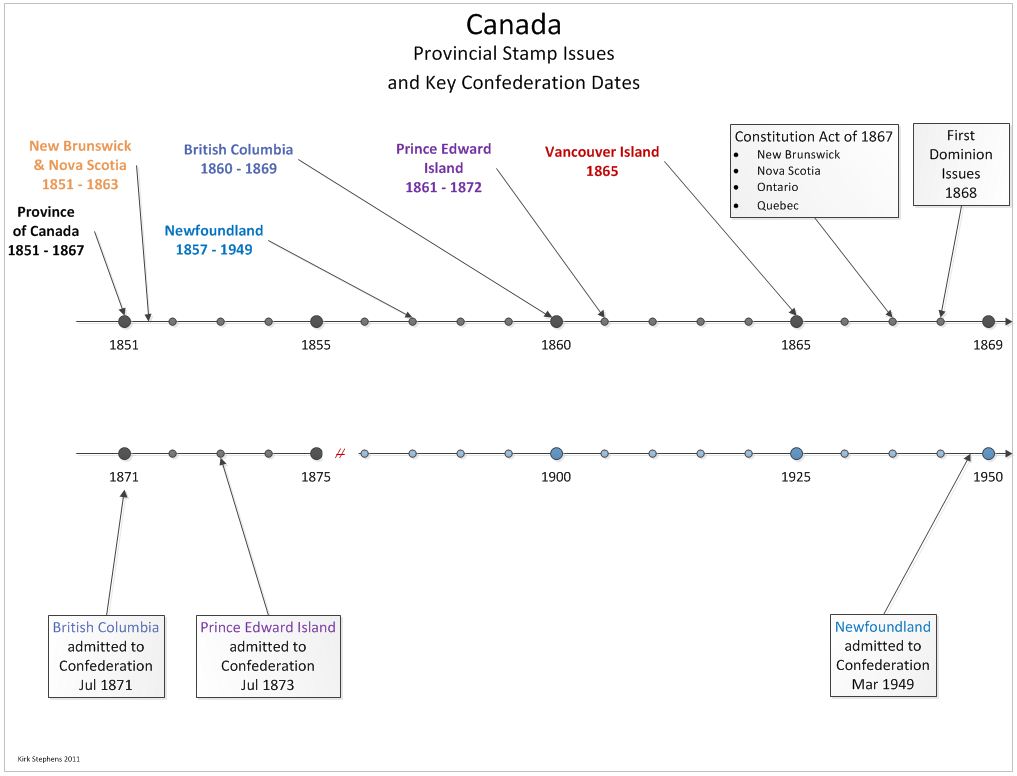 KirkS |
|
Send note to Staff
|
|
|
Pillar Of The Community
Canada
531 Posts |
|
|
>>>>>>>>>>>>they settled on the wishy washy, typically Canadian compromise of The Dominion of Canada.
I am offended. |
|
Send note to Staff
|
|
|
Bedrock Of The Community
Australia
38679 Posts |
|
|
Great post! very informative and fantastic examples of the stamps BeeSee  Ooops, would be remiss in not giving applause to Kirk's diagrams for us Canadian newbies. |
|
Send note to Staff
|
| Edited by rod222 - 01/26/2011 4:07 pm |
|
|
Pillar Of The Community
United States
2758 Posts |
|
|
Pillar Of The Community
Canada
923 Posts |
|
|
Moonbird - Oh, I don't know. Can YOU think of any possible descriptive adjective for an area under one governing body that is a more inoffensive, non-threatening, non-specific, "means whatever you want it to" sort of word than Dominion? Kingdom of, Empire of, Republic of, United Provinces of, Britannic Union of ... all suggested. Speaks well of the spirit of compromise, otherwise known as wishy-washy. |
|
Send note to Staff
|
|
|
Pillar Of The Community
Canada
531 Posts |
|
|
We are not a "dominion" - and have not been one for decades.
Canada is a global leader in diplomacy, peace-keeping and peace -making. We have the highest level academies of learning for growth, change and development. We are leading edge in social and human rights, governance and public policy. Our cities are attractive, welcoming and safe. Our science and technology is as good as it gets - the USA space shuttle program would have been utterly ineffective without Canadian robotics. Our banks are the model upon which the world's financial institutions are modelling their own. We have the best health care system on the planet and stand among the top countries in health care and quality of life indicators. People from all over the world dream of a life in Canada and we take in as many as we can.
You call that wishy-washy? Shame on you if you live here. You are uninformed if you are not.. |
|
Send note to Staff
|
| Edited by Moonbird - 01/26/2011 5:30 pm |
|
|
Pillar Of The Community
Canada
923 Posts |
|
|
Moonbird - I apologize if I offended. Please read the entire thread and perhaps you will see that I am as proud of being a Canadian as anyone who lives here. If the use of the term distresses you, just say that I am making fun of myself as I am the first person to say that the fact that we have, as a nation, always managed to come together in the end through a spirit of compromise and cooperation. Wishy-washy? It is a term I use, or meant at least, as a parody of this ability to see the other person's viewpoint. Some people would prefer to stand by their own principles as the only possibility and do use this as a perjorative where I only meant a mild dig at the characature many apply to "Canadian".
As to Dominion - well, that was what the whole exercise was about. Trying to explain how that historical term was arrived at above others that were being considered 147 years ago was really the whole point of this entire thread.
|
|
Send note to Staff
|
|
|
Valued Member
Canada
290 Posts |
|
|
If you kids don't settle down, I will stop this car right here and there'll be no ice-cream!
Didn't one of you say:
"Canada is a global leader in diplomacy, peace-keeping and peace -making."
Practice it! |
|
Send note to Staff
|
|
|
Rest in Peace
Canada
5701 Posts |
|
|
Replies: 22 / Views: 11,452 |
|




 Posted 01/26/2011 11:26 am


