| Author |
 Replies: 13 / Views: 3,011 Replies: 13 / Views: 3,011 |
|
|
Valued Member
10 Posts |
|
|
Hi, It looks like this stamp is 23mm x 19mm: side x top dimensions. It also looks like 14 perfs per 20 mm exist on the right hand side. A small black number 8 appears on the reverse side which is stuck to the base paper. Although it was stuck on a section of the mounting page entitled 'chalky paper' I am unsure if this is accurate info. If it applies to this particular stamp, what does 'chalky paper' mean? I am unsure of what classification this stamp is nor what its value is. This is really the first stamp I have ever perfed so I hope I did it correct.  Please assist me here. Thank you, mdpmedia 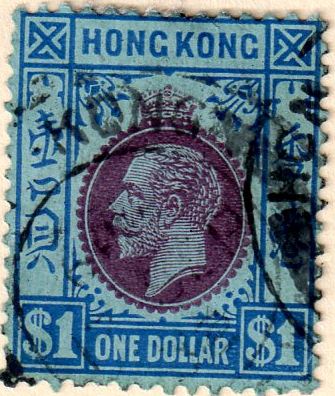 |
|
Send note to Staff
|
|
|
|
|
Pillar Of The Community
United States
6756 Posts |
|
|
All the $1 KGV definitives of Hong Kong were printed on chalky paper. Chalky paper was used as a method of stopping people from trying to wash off cancellations. That means you should be very careful if you try to soak off stamps printed on chalky paper.
There are 2 possibilities for the stamp you pictured (catalog #/value from 2010 Scott catalog):
1912-1914 series
#120, $1 blue and violet on blue paper, watermark #3 ($4 used)
1921-1937 series
#143, $1 ultramarine and violet on blue paper, watermark #4 (60c used)
Color ID using a computer screen is rather tricky, so I will leave it up to you to do the final ID. You can either use color or check the watermark. However, if it has paper adhesion, it may be difficult to see the watermark. |
Send note to Staff 
|
|
|
Rest in Peace
Canada
6750 Posts |
|
|
That's a beautiful blue. Lovely. Chalky paper I think means you had better not soak it or immerse it in water for very long at all or the colour will run. If I am remembering correctly. Ooops, I am not, well not entirely. Fro Wikipedia http://en.wikipedia.org/wiki/Chalky_paper(Nice pic of two stamps there, one normal, one chalky, from early Austria.) Chalky paper was a device adopted by some postal authorities intended to discourage erasure of cancellations and fraudulent reuse of stamps. The paper was first coated with a chalk like powder, and the ink for the stamp was then impressed upon the paper. Attempts to erase a cancellation would also damage the design, making reuse more difficult. Collectors are cautioned not to attempt to remove a stamp printed on chalky paper from an envelope or paper backer by soaking it in fluid, as this may destroy the stamp's design. Also from http://en.mimi.hu/philately/chalky_paper.htmlwhich seems to be a round-up of all kinds of borrowing from different sites (with the sites linked to) A few references mention that chalky paper has a shiny surface. It could be clay instead of chalk. Rubbing with silver will leave a pencil like mark on chalky paper. Thanks for asking, I learned things myself.  |
|
Send note to Staff
|
|
|
Rest in Peace
Canada
6750 Posts |
|
|
I think to remove himges or remove the stamp from paper one would perhaps use an artist's brush and gently daub water on the back paper or hinge to remove. I am guessing but the idea is to not get water on the front if I understand the idea. |
|
Send note to Staff
|
|
|
Pillar Of The Community
Australia
3547 Posts |
|
|
Gibbons calls both varieties purple and blue on blue paper.
The 1912 printings used a watermark of multiple crowns and the letters CA in block letters. This is SG112, valued at £5.50 used. There is also an inverted watermark variety listed at £150.
The 1921 printings used a watermark of multiple crowns and the letters CA in script letters. This is SG 129, valued at 50p used. No watermark varieties are recorded, but it wouldn't do any harm to look!
If you decide to try to soak off the paper adhering to the back of this stamp, be very, very careful. Use cold water, and leave the stamp exposed to water for the least possible time. The colours on these chalk-surfaced papers run - just as the printers intended them to! |
|
Send note to Staff
|
|
|
Pillar Of The Community
Australia
2156 Posts |
|
|
I have one of these too; however, mine has a huge crack in the oval frame: 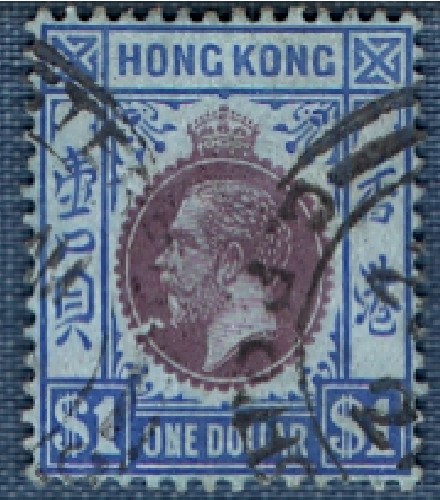 Detail: 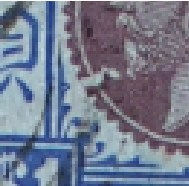 |
|
Send note to Staff
|
| Edited by jimjamtwo - 02/27/2011 01:59 am |
|
|
Rest in Peace
Canada
6750 Posts |
|
|
Quote:
A small black number 8 appears on the reverse side which is stuck to the base paper. No catalog so can't verify number sorry. Quote:
This is really the first stamp I have ever perfed so I hope I did it correct. I think most people tend to measure perfs tooth to tooth (it seems easier) but lately I have been trying to measure center of hole to center of hole (or perforation). Sometimes on some stamps the perfs have a range along the distance measured so the method used by some, just using a ruler and measuring by 2cm or 20 mm is probably fairly accurate and perhaps more accurate. |
|
Send note to Staff
|
|
|
Bedrock Of The Community
Australia
38679 Posts |
|
|
The watermark determines your issue. They are all Perf 14. If you measured your stamp correctly
your stamp is perfed 14.74 x 16.84
I would suggest you have an error,one must measure just the printed image on the stamp not to the tips of the perfs. My error!  You are bang on, your stamp is perfed 13.68 x 13.91 (or 14 x 14) |
|
Send note to Staff
|
| Edited by rod222 - 02/27/2011 04:34 am |
|
|
Pillar Of The Community
United States
7105 Posts |
|
|
If the adhesion makes watermarking difficult, I'd try to sort out the year of the cancel. (I didn't try any manipulations on the scan.) Gibbons lists 7.12.21 for the issue date of SG 129, so any date prior to that would have to be the earlier issue.
[edit: jimjam, neither Scott nor SG mention the broken oval. The 25c has a broken-flower-at-top-right variety in both issues, the 1921 4c has a broken Chinese character, and the 1912 1c has a broken crown that catalogues for quite a lot. I didn't notice any others.] |
|
Send note to Staff
|
| Edited by Cjd - 02/27/2011 11:41 am |
|
|
Pillar Of The Community
Australia
3547 Posts |
|
|
For good measure, the break in the oval doesn't appear in my old Commonwealth Five Reigns Catalogue either, though it does bear a certain family resemblance to the listed break in oval flaw. Still, my first guess with a chalk-surfaced stamp would be surface damage to the stamp, rather than a printing flaw. |
|
Send note to Staff
|
|
|
Pillar Of The Community
Australia
2156 Posts |
|
|
Thanks for the info, guys. There's no surface damage to the stamp, tonymacg. This area was simply not printed on. Probably there was something on the paper at the time. Technically, this is called scuffing, isn't it? |
|
Send note to Staff
|
|
|
Pillar Of The Community
Australia
3547 Posts |
|
|
Scuffing is when the surface has been scraped, and the ink removed. With chalk-surface paper like this, some of the chalk surface could have lifted off after printing, taking the ink with it. It wouldn't necessarily need force applied. It could, for instance have been due to a defect in the original coating. If something came between the printing plate and the paper during printing, you might possibly find signs of the indentation under high magnification, particularly in a surface paper such as this. |
|
Send note to Staff
|
|
|
Pillar Of The Community
Australia
2156 Posts |
|
|
This area of the stamp still has the chalk surface.
I think it was a printing error myself. |
|
Send note to Staff
|
|
|
Pillar Of The Community
Australia
2027 Posts |
|
| |
Replies: 13 / Views: 3,011 |
|




 Posted 02/27/2011 01:18 am


