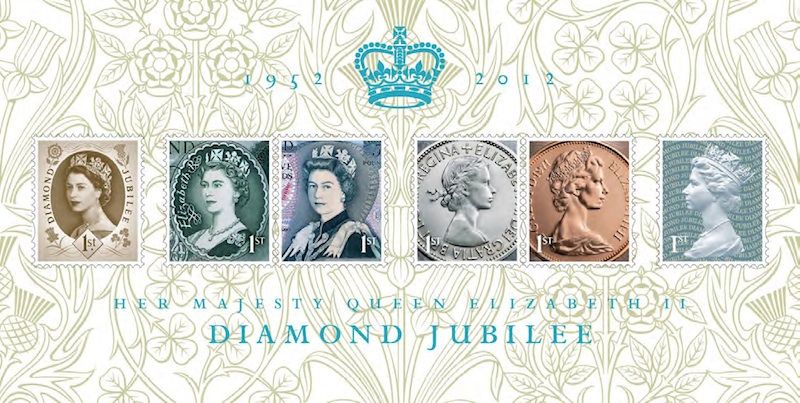
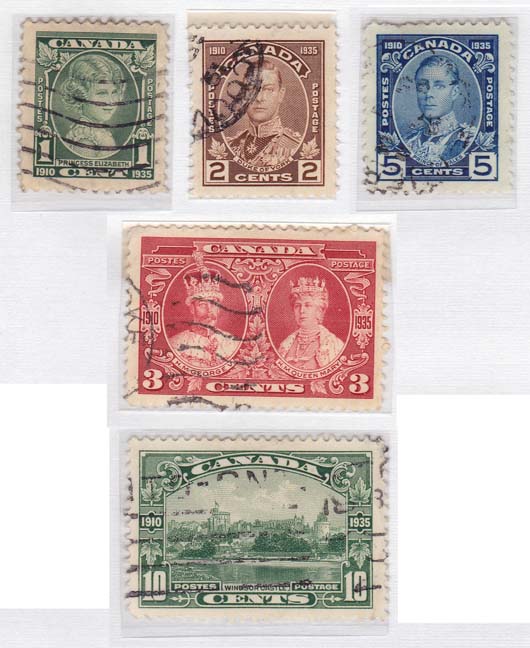
The Silver Jubilee of QE2
...and for those who like a bit of meat in their story,
some observations by Elizabeth.....
The Silver Jubilee Story
by Elizabeth Street
Misadventures of the printers of the Silver Jubilee issue have been the
subject of extensive writings in recent months, mainly in the various
Society bulletins and newsletters, accompanied by some rather naive
and nasty criticism of the so-called "policy of secrecy" of Australia
Post.Just because Australia Post did not rush out a special bulletin as
soon as the printing schedule went wrong, there was no reason to
suppose that it would not, in due course, tell all.Which, of course, it
has now done, in a brief but fully explanatory article in the Philatelic
Bulletin for June.
For the benefit of the general collector who wants only the main'facts
of the matter, the article is reprinted here. For the more advanced
philatelist, I recommend the compilation by Mr. Richard Peck of the
findings by researchers of the Australian Commonwealth Collectors'
Club of N.S.W. as published in the Club's bulletin for May and
June.This monumental report covers more than 50 pages, goes into
minutest detail, and is well illustrated. For information on how to
obtain copies, send an S.A.E. to the Secretary at P.O. Box 85,
Drummoyne, N.S.W.. 2087.
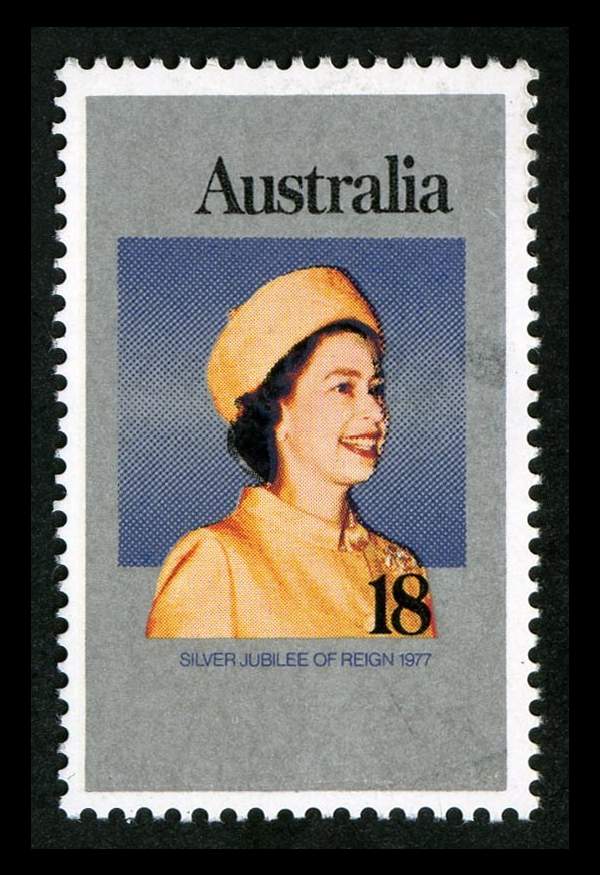
Here is the official version from the Philatelic Bulletin:The printing of
the 18c. and 45c. stamps, issued by Australia Post on 2nd February,
1977, to mark the 25th anniversary of the reign of Queen Elizabeth II,
was undertaken by the Government Printer.The stamps were
reproduced by the offset lithography method which was ;i departure
from the gravure method of printing normally employed by Australia
Post for stamp printing.Offset lithography prints from a planographic
metal plate. The ink is transferred from the plate onto a uniform rubber
surface and then onto thepaper. The definition between the printing
and non-printing areas is maintained chemically.
Two different offset lithography printing presses were employed for
printing both the 18c. and 45c. stamps. Approximately 2% of the
printing of both the I8c. and 45c. values was carried out by the
Government Printer in Sydney, on a Heidelberg four-colour
photo-litho press. As far as can be determined, all stamps printed on
this press were included in the souvenir stamp packs.The balance of the
printing of both the 18c. and 45c. values, approximately 98% of the
total for each denomination, was printed in Melbourne under the
control of the Government Printer, by Norman J. Field, on a Komori
Sprint four-colour photo-litho press.
These stamps were used for general distribution to post offices and
philatelic sales centres.As stated, the printing presses used in both
cases were four-colour sheet-fed presses. Therefore, owing to the
requirement for more than four printing colours and a varnish for each
stamp value, all sheets were passed through the presses twice. The
printing orders of the colours for each stamp varied between the two
presses.Colours in printing order for the stamps printed in Sydney on
the Heidelberg press were:
18c. — white, silver, process magenta and process yellow on the first
pass through the press, then process cyan, reflex blue, black and a
varnish on the second pass through the press;
45c.—white, silver, process magenta and process yellow on the first
pass through the press, then process cyan, warm red, black and a
varnish on the second pass through the press.
Colours in printing order for the stamps printed in Melbourne on the
Komori Sprint press were:
18c. — silver, process magenta, process yellow and process cyan on
the first pass through the press, then reflex blue, black and a varnish on
the second pass through the machine;
45c. — silver, process magenta, process yellow and process cyan on
the first pass through the press, then warm red, black and a varnish on
the second pass through the press.
All of the stamps were printed on KP6T unwatermarked coated stamp
paper incorporating helecon. Each sheet of stamps was printed with
200 impressions of the stamp, in four panes of 50. After printing and
perforating, the 200-on sheets were guillotined into sheets of 100 each,
comprising left and right panels of 50 stamps each.The sheets of
stamps were perforated at the Note Issue Department of the Reserve
Bank of Australia, Melbourne, on the Grover perforator machines,
exactly as for Rembrandt-printed stamps.
Thus, the stamp size for both values accords with that of stamps
printed on the Rembrandt press, e.g., the Performing Arts series
stamps. All stamps were perforated 14 x 13.1 Marginal markings,
referred to as "Signal stripes" or colour bars by printers, appear on the
sheets. As shown in the illustration, they consist of two horizontal
bands, approximately 6 mm deep and running the full width of the
centre margin on each 200-on sheet. The colour bars are printed with
solid and unusually firm tones of each colour used on the stamps.
After guillotining single horizontal bands of colour bars appear at
either the. top or the bottom of the sheets.The colour bars carry the
wording "GRETAGUGRA SW I T Z E RLAND(C) 1969" indicating
that they have been supplied by the firm of this name. Printers use
these solid colour bars to take colour density readings during the
printing process, using densitometers which are usually supplied by
Gretag. Frequent densitometer readings assist in maintaining colour
quality control. In a fine four-colour process illustration, it would ,not
be unusual for solid colours not to appear at all; the provision of these
colour bars therefore permit densi-tometer readings of a colour at its
full strength.





 Posted 12/04/2011 2:36 pm