| Author |
 Replies: 24 / Views: 5,441 Replies: 24 / Views: 5,441 |
|
Pillar Of The Community
United States
1125 Posts |
|
|
|
Trying to learn more about this issue. I have the Duckworth tome on the issue, but it is a bit difficult to keep all of the colors, papers, and print varieties straight in my (small) head.
I have seen specialty pages for the Small Queens with boxes for the different printers and dates for each of the denominations. Is there something similar available for the Large Queens? I'm basically a visual person, so having something that lays out the varieties visually would help me make sense of these.
Thanks for any assistance.
Chip
|
|
Send note to Staff
|
|
|
|
|
Pillar Of The Community
Canada
617 Posts |
|
|
That series of stamp makes my head hurt. Every time I try to sort out new acquisitions I just want to bang my head on the desk. |
Send note to Staff 
|
|
|
Pillar Of The Community
Canada
2277 Posts |
|
|
With large queens at least you don't have so many varieties that pretty well don't make much of a difference. Watermarks are good to search for being stitch or bothwell. Granted the bothwell watermark ony touches about 20 of 100 stamps so it is scarce. Perf variety on the 5 ent is a good hunt, and of course any laid paper would be an absolute bonus. If you can do nice high res scans I'm sure we can help out. Also consider cancels as the vast majority were obliterated and not alot have date/ town information |
|
Send note to Staff
|
|
|
Pillar Of The Community

Canada
3963 Posts |
|
|
|
|
Send note to Staff
|
Don't grumble that the roses have thorns, be thankful that the thorns have roses |
|
|
Pillar Of The Community
United States
1125 Posts |
|
|
Pillar Of The Community
Canada
4648 Posts |
|
|
Pillar Of The Community
United States
1125 Posts |
|
|
Thanks, Bujutsu. I've been there. However, seeing this as the description of the 15c doesn't do much to help me understand them better: Quote:
"The 15¢ Large Queen was first issued on April 1, 1868. Many shades exist." With the early GB stamps (penny blacks, reds, blues), the catalogs do a good job of outlining the varieties and there are specialized dealers who list and price all of the different varieties. This helped me to get a sense of what is out there on what stamps and what the relative values would be for them. Don't see anything similar for this issue and hence, my perambulating through the smaze (walking around in a fog). |
|
Send note to Staff
|
|
|
Pillar Of The Community
Canada
1416 Posts |
|
|
Pillar Of The Community
Canada
2277 Posts |
|
|
Below is a copy from a different thread posted by JimJam2 . The best thing is to have a known copy with bothwell paper to use as reference but I have about 50 large queens and I'm still in the dark. I know I have 2 varieties being the 12.1 perf 5 cent and the baloon dot flaw 12.5cent. Other than that paper types are a science . Quote:Re Canada, I found this online: Bothwell Paper Variety "1868-69, wove, medium to thick with a distinct vertical mesh and WATERMARKED "E&G BOTHWELL CLUTHA MILLS" in two lines of sans-serif letters" (Boggs page 251) "Bothwell paper is watermarked on part of the sheet, singles without watermark (21vii) are identified by the distinct vertical weave of the paper." (2002 Unitrade Specialised Catalogue of Canadian Stamps page 30). "The Bothwell paper copy is unlisted as mint". (Firby, 10 Feb., 2001, lot 87) http://www.canadianstampauctions.co...umber_34.htmand A stitch watermark is an unusual feature of some of Canada's early stamps. Hans Reiche explained this in an article he wrote for the Canadian Forces Philatelic Society Bulletin. He wrote: "A stitch watermark looks like a thinning of the paper but is done unintentionally by the paper manufacturer. A finely woven wire cloth is used to make the paper. To produce an endless wire cloth, the ends are stitched together by fine wires, similar to a staple. These stitches show up as short almost parallel fine lines, like a watermark." http://www.canadianstampauctions.co...umber_81.htm -------------------------------------------------------------------------------- |
|
Send note to Staff
|
|
|
Rest in Peace
Canada
6750 Posts |
|
|
On the 15c large Queens there is also a Script watermark possible, as well as the Bothwell and the stitch type, I noticed in the 2012 Unitrade at he library today. Should have scanned the pic to show here, next time maybe.
|
|
Send note to Staff
|
|
|
Moderator
United States
4788 Posts |
|
|
Pillar Of The Community
United States
1125 Posts |
|
|
Here are what the watermarks look like: 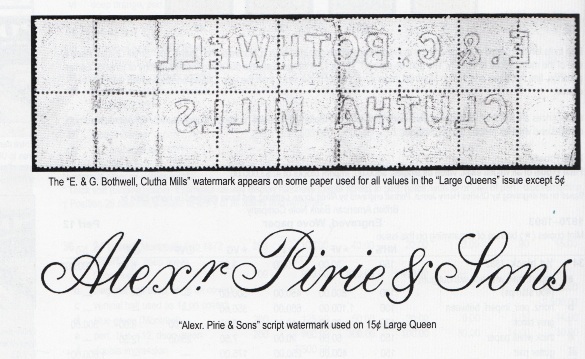 edited to credit the Unitrade catalog for the image. I think this qualifies as "fair use." C. |
|
Send note to Staff
|
| Edited by chipg - 01/13/2012 12:54 pm |
|
|
Valued Member
Canada
450 Posts |
|
|
chipg:
Did you get "permission in writing from The Unitrade Press" (as noted in the copyright page of the Unitrade catalogue) to scan and publish these images on this site?
If not, then I would suggest that it is not "fair use".
[This is just a general comment. I suspect that no one using this site has received written permission from The Unitrade Press to reproduce any part of the Unitrade catalogue here.] |
|
Send note to Staff
|
|
|
Pillar Of The Community
United States
1125 Posts |
|
|
This is from the US Copyright office site:
"Section 107 contains a list of the various purposes for which the reproduction of a particular work may be considered fair, such as criticism, comment, news reporting, teaching, scholarship, and research. Section 107 also sets out four factors to be considered in determining whether or not a particular use is fair:
- The purpose and character of the use, including whether such use is of commercial nature or is for nonprofit educational purposes
- The nature of the copyrighted work
- The amount and substantiality of the portion used in relation to the copyrighted work as a whole
- The effect of the use upon the potential market for, or value of, the copyrighted work
The distinction between fair use and infringement may be unclear and not easily defined. There is no specific number of words, lines, or notes that may safely be taken without permission. Acknowledging the source of the copyrighted material does not substitute for obtaining permission.
The 1961 Report of the Register of Copyrights on the General Revision of the U.S. Copyright Law cites examples of activities that courts have regarded as fair use: "quotation of excerpts in a review or criticism for purposes of illustration or comment; quotation of short passages in a scholarly or technical work, for illustration or clarification of the author's observations; use in a parody of some of the content of the work parodied; summary of an address or article, with brief quotations, in a news report; reproduction by a library of a portion of a work to replace part of a damaged copy; reproduction by a teacher or student of a small part of a work to illustrate a lesson; reproduction of a work in legislative or judicial proceedings or reports; incidental and fortuitous reproduction, in a newsreel or broadcast, of a work located in the scene of an event being reported."
As for the four bullet points:
- My use of the material was non-commercial and educational (and went to illustrate a lesson - from the latter paragraph)
- not sure
- about 1/3 of one page of a 650 page work
- I'd say that the effect was to let more people know about the great resources in the Unitrade catalog. I'd say that it is more likely to increase the sales of the catalog, rather than diminish them.
Should anyone from Unitrade want me to remove the excerpt, I'd be happy to oblige.
PS - Edited to add that the same information is also available in the Duckworth book on the Large Queens on pages 61 and 132.
C.
|
|
Send note to Staff
|
| Edited by chipg - 01/13/2012 4:15 pm |
|
|
Pillar Of The Community
United States
1125 Posts |
|
|
let's try this: here's a composite picture - the front of a 1c LQ; the back scanned with fluid; and the back with the watermark highlighted. 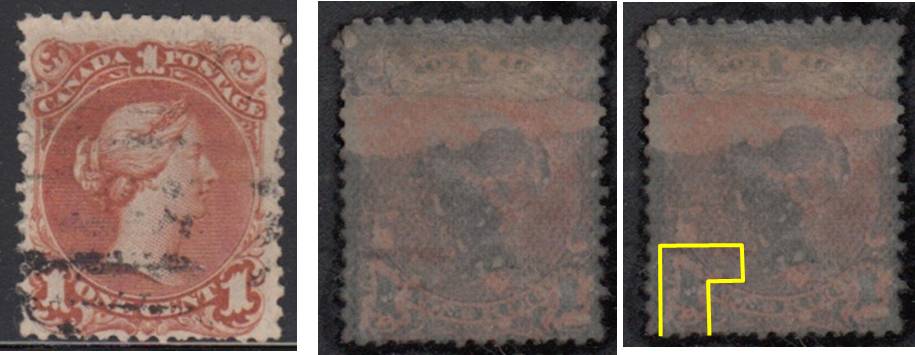 |
|
Send note to Staff
|
|
|
Pillar Of The Community
Canada
2277 Posts |
|
|
Awesome scan chipg - Did you purchase knowingly or discover while searching? The pic also shows the strong mesh pattern associated with the bothwell paper. Even knowing what to look for detecting small portion of a letter is a task. I love buying old lots on paper from old albums with the hopes of discovering hidden gems like that. |
|
Send note to Staff
|
|
|
Replies: 24 / Views: 5,441 |
|



 Posted 12/19/2011 5:53 pm


