| Author |
 Replies: 11 / Views: 2,176 Replies: 11 / Views: 2,176 |
|
|
Pillar Of The Community
Canada
4648 Posts |
|
|
Hi All I am still indexing my collection of Canadian military mail and came across this cover. I bought it some years ago simply because I found it intriguing because the stamp has been bisected. It passed through the regular commercial mail routes w/o getting tagged with a 'postage due' added to it. I have a number of cover that have the 2 cents carmine Admiral stamps applied to the cover during the First WW but this is the only cover (as far as I can remember) that has a bisected Admiral on it. If it was an older cover, iu could guess that the PO that applied this stamp didn't have any 1 cent stamps but the rate at this point in time does not support this reasoning. Can anyome enlighten me on this?? Thanks a lot. Chimo Bujutsu 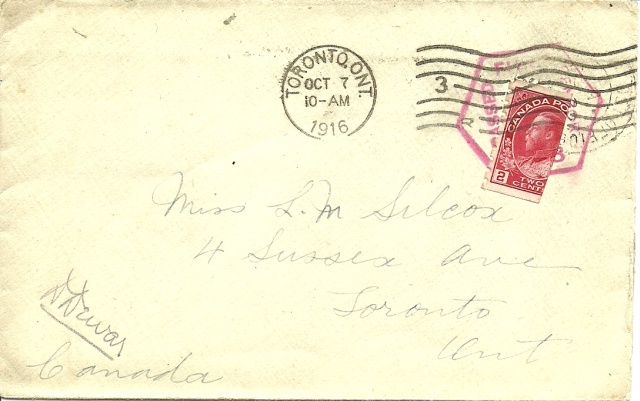 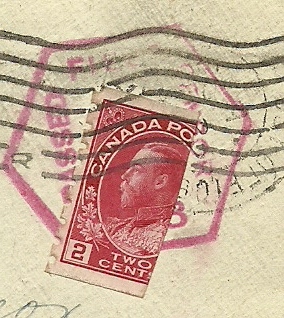 |
|
Send note to Staff
|
|
|
|
|
Rest in Peace
United States
7097 Posts |
|
|
maybe it had to pay some sort of rate like a delivery fee or somesuch as I notice it's on top of the purple-ish hex cancel, but underneath the wavy line killer. I like the WWI. era covers. |
Send note to Staff 
|
|
|
Pillar Of The Community
Canada
4648 Posts |
|
|
Thanks I-L-Stamps. The hex marking is a FPO censor marking and it was common for a stamp to be applied 'on top' of this marking, which makes it difficult to identify plus the rate was free for a soldier overseas & on active duty, until the letter hit Canadian soil. This rate was 2 cents as a rule and nothing less. Also, it is quite common to see a War Tax stamp on cover to pay 2 cents postage plus 1 cent WT for a total of three cents. So, this cover is still a mystery.
Thanks for trying
Chimo
Bujutsu |
|
Send note to Staff
|
|
|
Pillar Of The Community
Canada
2277 Posts |
|
|
Is it possible since military mail was free this was added for the 1c war tax alone? That would make it very interesting although tough to say for certain. |
|
Send note to Staff
|
|
|
Pillar Of The Community
Canada
4648 Posts |
|
|
Thanks Nitro. While it is a possibility alright, I am still not certain because the PO always applied the postage once the cover arrived on Canadian soil. The regular rate would then apply. This is also the reason you can see so many covers from the WW I era where the FPO and / or censor markings are 'underneath' the stamp. This sure makes it difficult to research the location of any given FPO marking. I guess I am getting off-track here  Chimo Bujutsu |
|
Send note to Staff
|
|
|
Pillar Of The Community
United Kingdom
3220 Posts |
|
|
Could this have been accepted as just a damaged coil stamp rather than bisected stamp?
If it had been a bisect there wouldn't have been much left for the other bisect, and why would someone have bisected a coil stamp rather than a regular one? |
|
Send note to Staff
|
Nigel |
|
|
Pillar Of The Community
Canada
4648 Posts |
|
|
That thought came to mind with me as well Nigel. I think I am leaning towards this.
Thanks a lot
Chimo
Bujutsu |
|
Send note to Staff
|
|
|
Pillar Of The Community
United Kingdom
544 Posts |
|
|
Quote:
Could this have been accepted as just a damaged coil stamp rather than bisected stamp?
If it had been a bisect there wouldn't have been much left for the other bisect I agree. This is also, of course, the reason why, although a few north/south or east/west bisects were made, the vast majority are corner to corner (I'm talking whole world, not Canada specifically). Diagonal cutting is very precise and gives exactly half a stamp. The other ways can be rather uneven. So what? Well, Postmasters got very suspicious of undersized halves because there was a chance that someone had created a 'mint' half from a used stamp by cutting off a badly centred postmark. Ditto if there was a 'choice' of N/S or E/W. This is far more difficult to get away with corner to corner; so they tended to insist on diagonal cutting. |
|
Send note to Staff
|
| Edited by Bamra1 - 11/25/2012 1:54 pm |
|
|
Pillar Of The Community
Canada
4648 Posts |
|
|
Very true Bamra and, to be honest, I forgot that point. Any bisects I have seen offered in auction, the better ones anyway, were cut diagonally.
Thanks for your input.
Chimo
Bujutsu |
|
Send note to Staff
|
|
|
Valued Member
Canada
382 Posts |
|
|
Mail from Canadian soldiers serving overseas in WW1 created an interesting dilemma for the postal service. After ordering the mobilization of a Canadian Overseas Expeditionary Force on August 6, 1914, the Cabinet declared that "the force will be Imperial and have the status of British regular troops" but neither declaration proved true.
The franking privilege only allowed the Canadians to send free mail back to their British base. Mail back to Canada was then subject to the British rate of one penny. The British postal service had no means of forwarding the mail to Canada except on a Postage Due basis. Under UPU regulation, Canada was obliged to tax all stampless letters from overseas - an obviously unacceptable situation.
The solution was to entrust the mailbags to captains of merchant ships returning to Canada. The mailbags were delivered directly to the military base exchange officer at the port of entry (Montreal, Halifax or Toronto) at which time that officer applied the Canadian postage and mailed the letter as if originating at that port.
I am at a bit of a loss trying to determine why a bisected stamp was used. I think the proper rate should have been 2 cents: 1 cent for the local drop letter rate plus 1 cent war tax.
GJP
|
|
Send note to Staff
|
|
|
Rest in Peace
7742 Posts |
|
|
Bujutsu...Question, is there tap on the back part of the envelope where you would normally lick it to close it....???
If so, I have a theory. |
|
Send note to Staff
|
|
|
Pillar Of The Community
Canada
4648 Posts |
|
|
Hi Wert. The back of the cover is blank and has a regular pointed flap. That's all there is.
Hi gport. I agree with your comments and, in fact, stated this in another previous thread on a Canadian military cover. This is also why we can see so many covers from Canadian troops in WW I that has the stamp covering or on 'top' of any given FPO or censor marking, which can make it frustrating for those of us who like to research the location for any given marking as such in the different theatres of the war.
I will be posting more Canadian military covers as time allows. I have about 2500 covers from the Boer war to Bosnia and it is taking a great deal of time to index all of these. I have to admit though, it is a lot of fun going through them again.
Chimo
Bujutsu
|
|
Send note to Staff
|
|
| |
Replies: 11 / Views: 2,176 |
|




 Posted 11/24/2012 1:40 pm


