| Author |
 Replies: 292 / Views: 50,697 Replies: 292 / Views: 50,697 |
|
|
|
Valued Member
392 Posts |
|
|
Variable value stamps can be classified as stamps for immediate use and stamps with indefinite validity (ATMs). ( http://www.ateeme.net/angles/welcome_a.html)According to the ATMs website, immediate use stamps: Quote:
...are postage stamps issued by the postal employees for franking postal items handed in at the Post Office window, or by the user with special equipment (self-service vending machines or personal computer), and their use and expiry are immediate. These stamps always include some data (sometimes using 2D matrix codes) about the post office origin or issuing equipment, or even the sender or user, and the date of issue. The date is used as a postmark, so these stamps do not require any type of postal cancellation. [emphasis added] I understand the need for 2D codes on meters and stamps printed on home computers as is allowed in the United States but I see no reason why Canada Post is printing bar codes on the indefinite validity Kiosk stamps. Is this part of the trial? Personal information included in the bar codeThe thought did occur to me that the credit card information could be included in the bar code. I don't know why this would be necessary. The 2D bar code on indefinite validity stamps is definitely a subject for further investigation. |
Send note to Staff 
|
|
|
Valued Member
15 Posts |
|
|
@lorddenning.
The problem regarding variable denomination/value stamps/ATM/Framas/CVP/ Internet postage etc. is that almost everyone uses those terms differently. The Meter Stamp Society has once tried to list the various forms of US postage (ranging from traditional stamps to NetStamps) using a Vent diagram.
I personally don't agree with the definition by ATEEME.
In my opinion, variable denomination/value stamps are stamps that are printed by a vending machine/counter printer/meter/home or office PC+printer and can be used indefinitely and anywhere (there are some exceptions though). Basically, they can be used just like traditional stamps.
In contrast, meter stamps, which are generally dated, must be used immediately (exceptions!). So, they are definitely different to traditional stamps. And meter stamps can again be printed through meters/vending machines/PC/counter printers.
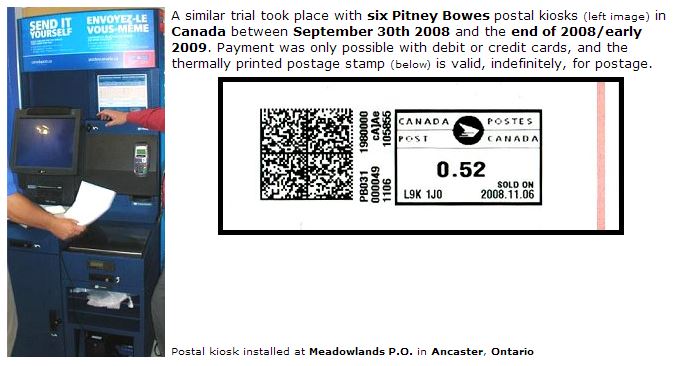
So, the current Wincor stamps and the previous Pitney Bowes stamps sold by vending machines in Canada are example of variable denomination stamps.
As for stamps with 2D-code, at least in the US, they also receive a cancellation. Not by a postmark though, but they get electronically cancelled during mail sorting.
Finally, at least in the US, the 2D-code containing the credit card transaction number allows USPS to track down the buyer, if he was involved/suspected in some sort of crime/plot or postage forgery.
Cheers,
atm_hunter
|
|
Send note to Staff
|
|
|
Valued Member
392 Posts |
|
|
atm_hunter Quote:
As for stamps with 2D-code, at least in the US, they also receive a cancellation. Not by a postmark though, but they get electronically cancelled during mail sorting. What do you mean by electronically cancelled during mail sorting? NomenclatureI have used the term ATM in my writings when referring to the Canadian Wincor labels because this a term used by many collectors to describe them. However, I prefer calling them Self-Service Kiosk stamps. The UPU defines "Self-Sevice Kiosk" as a set of automatic devices installed in a public place which customers use without the assistance of postal staff (postage stamp vending machines, letter boxes, post office boxes, telephones, etc.). Catalogue RecognitionThe inclusion of these stamps in catalogues is of little importance to me. I do not rely on catalogues to determine what I collect. |
|
Send note to Staff
|
|
|
Valued Member
15 Posts |
|
|
@lorddenning Quote:
What do you mean by electronically cancelled during mail sorting? I only can speak for USPS. The 2D-code of postage labels (from self-service kiosk postage stamps/ATM, personalized postage, Internet postage or meter postage) is being scanned during mail processing and compared with a database of valid 2D-codes (i.e. the 2D-codes that were created when the the various types of postage stamps were printed) or "electronically cancelled" (used) 2D-codes (i.e. codes on stamps on mail items that went through mail processing before). If it turns out that the 2D-code is valid, it will get electronically cancelled, which means that the 2D-code is saved in the database under "used 2D-codes". If the 2D-code is invalid (i.e. 2D-code previously used on a stamp or forged), the mail item is getting automatically removed from mail processing and the sender may be in trouble. Similar scenarios exist in Germany and France. In France, for example, Internet postage stamps (MontimbrenLigne) stay only valid for about 6 months since La Poste does not want to get its 2D-code database too big (which inevitably happens, if one saves all the printed 2D-codes). Quote:
I have used the term ATM in my writings when referring to the Canadian Wincor labels because this a term used by many collectors to describe them. However, I prefer calling them Self-Service Kiosk stamps. I agree. That's a much better term than ATM since it contains the word stamps, although many collectors of traditional postage stamps don't regard them as stamps. Quote:
The inclusion of these stamps in catalogues is of little importance to me. I do not rely on catalogues to determine what I collect. You are absolutely right. We collectors should not be slaves of catalog listings. I am definitely not. The truth though is that the majority of collectors blindly follow catalogs and their listings. Look at the various Self-Service Kiosk stamps here in the US. Except the early issues, all issues since 2002 are not listed by the Michel ATM world catalog. So, 99% of ATM collectors in Europe don't care about these issues, which is reflected by very low market prices for such issues. |
|
Send note to Staff
|
|
|
Pillar Of The Community
Canada
1401 Posts |
|
|
Today I was informed directly by Mr. Jim Phillips, Director, Stamp Services, Canada Post, that the pilot project for the kiosk stamps and labels has apparently ended. |
|
Send note to Staff
|
|
|
Valued Member
Canada
125 Posts |
|
|
I think it will make those stamps more valuable. Especially the 2012 ones. |
|
Send note to Staff
|
|
|
Rest in Peace
Canada
5701 Posts |
|
|
I think more were sold to stamp collectors (at least the 63c era) than to the public! |
|
Send note to Staff
|
|
|
|
Valued Member
15 Posts |
|
|
So that means that the trial with the Wincor-Nixdorf self-service kiosks lasted just 8 months (12/12/12-8/13), which is still twice as long as the trial with the Pitney Bowes self-service kiosks a couple of years ago (09/30/08-01/09/09). However, I have never seen any Pitney Bowes ATM seen on sale on ebay. Has anyone seen the being offered? |
|
Send note to Staff
|
|
|
Pillar Of The Community
923 Posts |
|
|
Valued Member
United States
146 Posts |
|
|
with the PO losing some much money, I wonder how much they have spent over the years having these machines developed,built,maintained, and then disposed off. I guess the public doesn't pay attention because you would think there would be some kind of inquiry about wasted public money. |
|
Send note to Staff
|
|
|
Pillar Of The Community
Guatemala
1501 Posts |
|
|
I would image that it is possible that the machines were bought from the USPS for a low price seeing that they were in use a few short years and then removed from service.
|
|
Send note to Staff
|
|
|
Valued Member
15 Posts |
|
|
@sak Yes, that's a very nice link - due to the fact I have written that article  But collectors interested in Canadian self-service kiosk postage should really get a copy of Earle Covert's excellent and very detailed article on PB kiosk postage published a couple of years ago: Covert, E. (2009). Pitney Bowes self-service kiosk. BNA Topics, Volume 66, Number 2, April-June 2009. @quigngt Actually, the Wincor-Nixdorf IBM machines used by USPS and installed back in 2004 are a different model (ProCash 1500 ATM) than the Canadian WN machines (ProPostal 2000). So, they are actually brand new machines. @xyyz 100% Agreed. Besides, those kiosks have been/are used by a number of other postal administrations (e.g. UK, NL, AT, IE, IT). Perhaps some inquiries by Canadian postal officials in advance could have prevented some issues encountered during the test. Royal Mail, for example, have a couple of hundred ProPostal 2000 kiosks successfully running for more than 4 years...It's not really necessary to reinvent the wheel each time  |
|
Send note to Staff
|
|
|
Valued Member
392 Posts |
|
|
Pilot Project is Over
This is to confirm an earlier posting. The Kiosk machine was removed from the Toronto Station B post office Friday August 9, 2013.
It would be interesting to find out how the nine month trial went.
Perhaps a member of the forum could let us know when the kiosks were taken out in other post offices.
|
|
Send note to Staff
|
|
|
Valued Member
Canada
170 Posts |
|
|
Assuming that all the Kiosks across the country are removed and the pilot project has been ended what happens to the remaining stamps (is stamps the right descriptor) that were printed? Are they still considered postage and has their value just increased dramatically with collectors? Interesting what will happen when the dust settles. |
|
Send note to Staff
|
|
|
Pillar Of The Community
United States
4183 Posts |
|
|
atm-hunter "Look at the various Self-Service Kiosk stamps here in the US. Except the early issues, all issues since 2002 are not listed by the Michel ATM world catalog"
Do you know why? |
|
Send note to Staff
|
|
|
Replies: 292 / Views: 50,697 |
|



 Posted 08/03/2013 11:26 am