| Author |
 Replies: 15 / Views: 1,713 Replies: 15 / Views: 1,713 |
|
|
Valued Member
Hong Kong
77 Posts |
|
|
Hello again! I was wondering if a stamp that has an extra flap (stamp itself plus the edges of a stamp sheet) make any difference in value? This picture may explain what I mean. 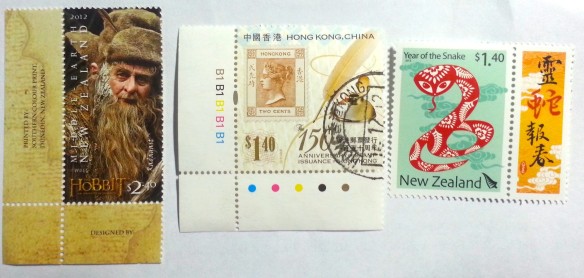 Each stamp has that extra bit/flap (I don't know what the philatelic term is). Example: the middle photo has the black, gray, magenta, cyan and yellow circles along with the B1 in those colors. Will that make any difference of the value or its just something extra that has no effect on the value. Just curious since the post office I go to always give me that extra bit. I kept it since it look kind of unique. Thanks!  |
|
Send note to Staff
|
|
|
|
|
Pillar Of The Community
United States
1614 Posts |
|
|
Pillar Of The Community
Germany
1714 Posts |
|
|
As already explained, this "flap" can be called selvage (selvedge in the UK) and is the part around the stamps in a sheet. It is collectable as it has information regarding cylinder numbers (the B1, B2 etc ) and also can contain the colors used in the printing. It can also tell which printer did the stamps as there can be several...
Normally collected in blocks of four but singles with selvedge attached are nice too. |
Send note to Staff 
|
|
|
Valued Member
United States
200 Posts |
|
|
Absolutely keep the selvage, especially if it contains information such as shown in your examples. It helps confirm the provenance of the stamp in addition to providing printing information.
Scotzm: I'm glad to see you refer to "cylinder numbers", because there seems to be a predilection in the field to refer to them as plate numbers and I have always recognized them as cylinder numbers as the correct terminology.
I am surprised at the print sequence in the center HK stamp where the first cylinder is gray, not black. Black is usually the first-down color because it is used to print the registration marks that are used to keep all the subsequent colors in registration. The marks are not shown here, having been trimmed off before finishing.
Donald |
|
Send note to Staff
|
|
|
Valued Member
Hong Kong
77 Posts |
|
|
Yes I noticed that as well with Hong Kong, they have grey cylinder compared to my other stamps that contain the selvage.
Thanks for everyone for helping me out! |
|
Send note to Staff
|
|
|
Pillar Of The Community
Germany
1714 Posts |
|
|
" Black is usually the first-down color " Probably that is true in most cases but perhaps the sequence is not reflected in the information printed on the selvedge? As an example, I show this GB block where the first color is the gold (2A) which is normally done last I think. 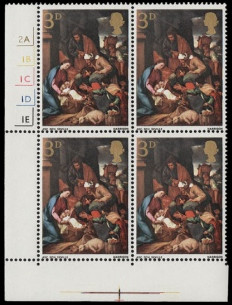 |
|
Send note to Staff
|
|
|
Valued Member
United States
200 Posts |
|
|
I think the cylinder sequence is shown in the selvage, but I read this example as 1E-1D-1C-1B-1A with the BLK cylinder first. The A-B-C-D-E sequence direction is not always the print sequence.
Even more interesting, your example shows one of the registration marks in the bottom selvage. This is most unusual in that they are usually slit off. By the shape of this mark, I would say the press direction was from left-to-right of the example, i.e., in the direction of the longer line. This kind of mark is usually used by the printer to make fine adjustments to bring all cylinders into registration.
It's difficult to tell for sure from the scan, but the registration mark seems to confirm that the gold was the last-down, which, as you pointed out, is general practice.
Donald |
|
Send note to Staff
|
|
|
Pillar Of The Community
Canada
1416 Posts |
|
|
in some cases, whis is quite imprtant and add significant value to a stamp Here is an exampla 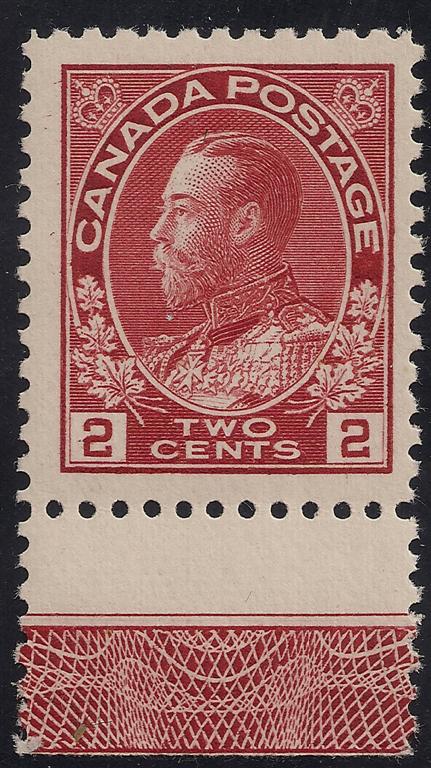 |
|
Send note to Staff
|
|
|
Valued Member
United States
252 Posts |
|
|
I am an old timer, being a stamp collector for 65 years, and you guess how old I may be.  I call these selvages "margins", as described in the catalogs "marginal inscriptions", "marginal plate numbers", etc. Margins are very important, it gives important information on the stamps whether it has any inscriptions or not. Please read my answer to the other similar topic on SCF. https://goscf.com/t/18122&whichpage=5 |
|
Send note to Staff
|
|
|
Valued Member
United States
200 Posts |
|
|
While this discussion was taking place, I stumbled across a 7-color print job (non-stamp) that displays both the cylinder colors and sequence plus an arrow indicator that shows the web direction. I have oriented the image to show how it would be seen by the press operator. 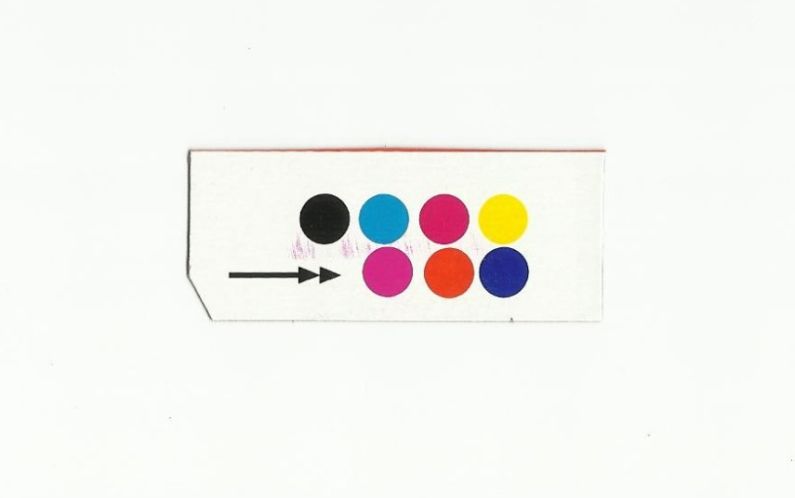 It shows that the display of the cylinder sequence and the indicator of the web direction are at a right angle to each other, same as can be inferred from the GB stamp shown earlier in this string. Donald |
|
Send note to Staff
|
|
|
Pillar Of The Community
Germany
1714 Posts |
|
|
" registration marks in the bottom selvage. This is most unusual in that they are usually slit off." I think in the UK the sheets are left with the registration marks intact. I have several with the "traffic lights" and registration marks from counter sheets. I had a very nice postmistress in our village who kept this sort of thing for me. I never paid much attention to the actual printing sequence. Is there a reference internet page that can explain? I'm having difficulty getting the actual sequence... perhaps it varies from printer to printer and there is no set sequence (just as there is no set name for selvedge, selvage, margin ) 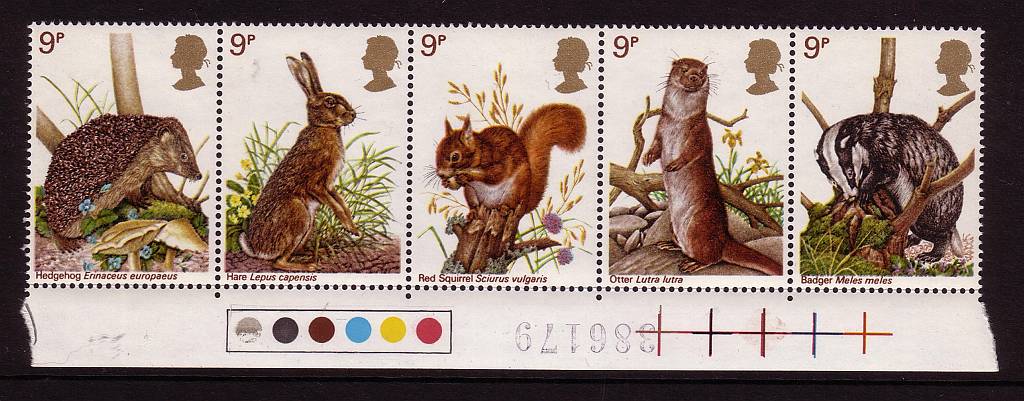 Incidently, I'm trying to collect all the printer's logo that appear on GB stamp "margins"... before they all disappear into De La Rue! |
|
Send note to Staff
|
| Edited by scotzm - 02/03/2013 2:25 pm |
|
|
Valued Member
United States
200 Posts |
|
|
A great example and very interesting that the registration marks are not slit off in the UK. I note that your example shows six "traffic lights", i.e., six colors, and only five cylinders (five registration marks), from which I infer that one cylinder has two colors (two separate images). It's difficult to see from the scan, but it appears that the silver and the dark brown were printed from the same cylinder. The dark brown could be used to print the registration marks that would control the electric eyes on the press that maintain registration. These marks are not shown in your example and are usually squares about 1/4 inch per side. The registration marks shown are too narrow for the photoelectric eyes to see and respond at press speeds. The marks shown are for the operator to fine tune the registration adjustment of each cylinder.
I suspect the "386179" is the work order number for the engraving of the cylinders. It's difficult to identify press direction with assurance; either the dark brown (2nd traffic light from the left) or the dark rose (magenta?) (last traffic light on the right) could have been used as the first-down color. Both appear dark enough.
I don't know of any Internet article on press sequencing; it may be different for each printer, but would be standarized for that printer for all jobs.
Donald |
|
Send note to Staff
|
|
|
Pillar Of The Community
Germany
1714 Posts |
|
|
A closer scan of the registration marks... 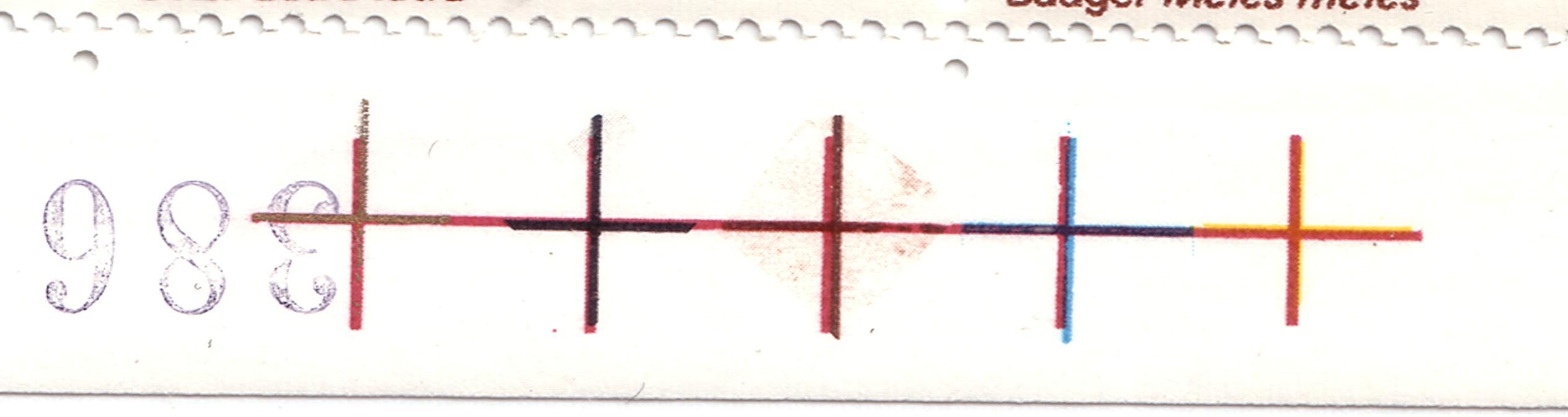 This seems to suggest that the Magenta was used first as all other colors are superimposed on it. Five "crosses" in magenta and then reading from right to left... lemon, blue, brown, black, gold all on top of the magenta. Thanks 168Bagua for asking the original question. Fascinating stuff |
|
Send note to Staff
|
|
|
Valued Member
United States
200 Posts |
|
|
I agree; cylinder and print sequence is from right to left. I still have not puzzled out why six traffic lights and five cylinders. Perhaps the silver was not printed but was stamped or embossed?
Donald |
|
Send note to Staff
|
|
|
Pillar Of The Community
Germany
1714 Posts |
|
|
Definitely six cylinders were used so the process must have been to first print the magenta five crosses and then use them as register points using one magenta cross for each of the next five colors. The colors in S.G. are Reddish-brown, Bright magenta, Pale lemon, Bright turquoise-blue, Grey black, Gold. |
|
Send note to Staff
|
|
|
Valued Member
United States
200 Posts |
|
|
Thanks so much. I don't have an SG to consult and am impressed that the colors are listed. Makes me want to buy one.
Donald |
|
Send note to Staff
|
|
| |
Replies: 15 / Views: 1,713 |
|




 Posted 02/02/2013 05:05 am


