| Author |
 Replies: 33 / Views: 4,441 Replies: 33 / Views: 4,441 |
|
Pillar Of The Community
Canada
6525 Posts |
|
|
Hello all. Just thought I'd share this somewhat tattered and stained cover mailed from Ottawa to Lévis Quebec in 1884. It is back canceled in Lévis. 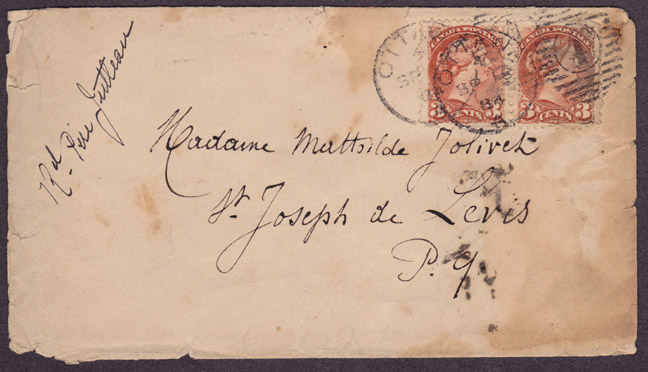 One thing I like about it are the conjoined pair of #37e. They do have the dot on the lower corner, but interestingly (to me anyway) the perfs are 12 X 12, whereas Unitrade says that the 37e should be 11.5 X 12. It is too early to be a 37 Ottawa print (1886). 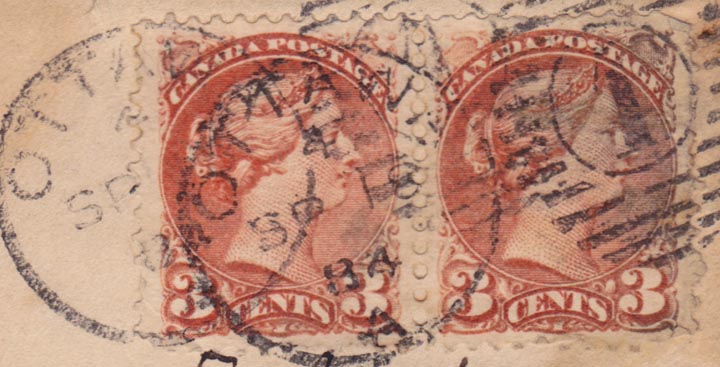 Perhaps it is a late usage 37b, they are 12 X 12. Who knows? |
|
Send note to Staff
|
|
|
|
|
Rest in Peace
Canada
5701 Posts |
|
|
That is and interesting cover Jamesw. Yours DOES look like a 37b. I also have a similar dated oddity. This stamp has a dot, is perf 12 x 12 and has the soft, smooth high quality wove paper, indicating a first Ottawa printing. The date of the cancel, however, is Nov 1, 1885. 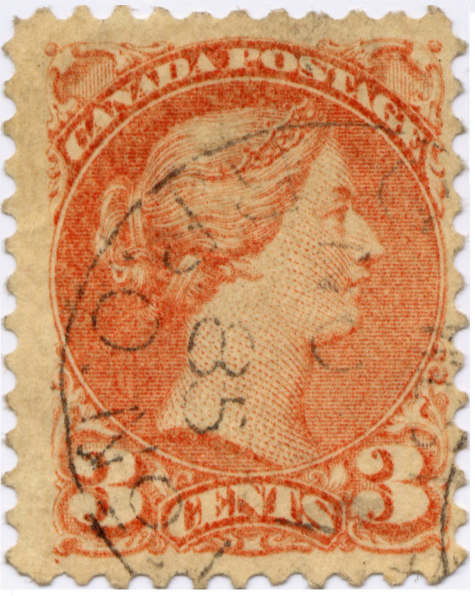 It does look more orange red than yours. |
Send note to Staff 
|
|
|
|
Pillar Of The Community
United States
6664 Posts |
|
|
Rest in Peace
Canada
5701 Posts |
|
|
Pillar Of The Community
United States
6664 Posts |
|
|
*Shakes fist @ BeeSee* Now look what you've done to me. Now I have to go home tonight and dig through all my Small Queens again.  On a side note, I think I just figured out your handle. Is it BeeSee as in B.C. for British Colombia ? My Wife is a graduate of UBC. |
|
Send note to Staff
|
|
|
Pillar Of The Community
Canada
2277 Posts |
|
|
Stallzer- tred slowly on your small queens as there is a landmine exception to almost every rule . No guide dot is a great rule- exceptions with many perfs being so off they cut lower section away, oh and left hand vertical row from sheet doesn't have dots , then go to color- but there bad for changing from oxidation, fading, then go to perfs - but wait look above at more exceptions for that. After all that have glass of yohooo or beverage of choice go back and start all over again. |
|
Send note to Staff
|
|
|
Pillar Of The Community
United States
6664 Posts |
|
|
Slowly it is. One thing I've realized in this hobby is that everything takes time and I'm in no hurry to find all the answers.This sounds like another fun way to try and find more information on the small Queens I have. |
|
Send note to Staff
|
|
|
Rest in Peace
Canada
5701 Posts |
|
|
Stallzer, BC is also my initials. WARNING: Also, if you do a search on this site for "small queens" in the subject, will will notice that the stamps are slowly driving Nitrolures, myself and others crazy  |
|
Send note to Staff
|
|
|
|
Pillar Of The Community
United States
6664 Posts |
|
|
Quote:
Stallzer, BC is also my initials. Doh ! Just when I thought I had it figured out. As far as the banging of the head goes, isn't that what we in this hobby live for ? Stamp and Postal history collectors must have a hidden masochistic side :) |
|
Send note to Staff
|
|
|
Pillar Of The Community
Canada
2277 Posts |
|
|
Small queens are Canadas answer to washington franklins - The printers and powers that be were probably sadist as much as were masochist for trying to figure them out.
I was born in BC so it could be the water! |
|
Send note to Staff
|
|
|
Rest in Peace
Canada
5701 Posts |
|
|
Here is what Hillson says about perforation on the RPSC site: "The basic perforation measurements of Small Queens are 12, 11.75, 11.5x12, 11.75x12, and 12x12.25.
First Ottawas are given in the catalogues as being Perf 12. Very few are apart from first printings, and accurately these will read on an original 'Instanta,' approximately 11.9 all round. The standard gauge for First Ottawas is 11.75 all round (accurately approximately 11.85 – I say approximately because one of the endearing features of early line perforators is that the pins were not mathematically equally spaced). Any Small Queen gauging just under 12 or about 11.75 all round is almost certainly First Ottawa.
The early Montreal printings gauged 11.5 x 11.75, then 11.5 x 12, later 11.75 x 12, then 12 all round, and finally 12 x 12.25. A Small Queen with any of the first three measurements is a Montreal printing.
Second Ottawas are usually 12 all round. Very occasionally, they can be 12 x 12.25, which is why paper must also be considered in one's determination."He also says: "...most plates which showed a lower left position dot were out of use by the early 1880's so its presence generally indicates either a First Ottawa or an early Montreal printing."
That would seem to confirm that our stamps are late usage of early First Ottawa printings. Then again "...most plates which showed a lower left position dot were out of use by the early 1880's...". Were some 3c plates with dots used later?  |
|
Send note to Staff
|
|
| Edited by BeeSee - 03/02/2013 10:14 am |
|
|
Pillar Of The Community
Canada
644 Posts |
|
|
Don't forget that the rule at the printer was "first in, last out", which meant that the earlier printings were at the bottom of any given pile and would often be the last to get sent out for use, depending on the print run, and the surplus at any given time. Just adds to the challenge of identifying any given stamp...  |
|
Send note to Staff
|
|
|
Pillar Of The Community
United States
6664 Posts |
|
|
I am absolutely laughing at myself at the moment. Wwhen I went through the small Queens in the collection I just bought I looked in my Scott catalog and thought to myself "These will be a snap to identify" :) |
|
Send note to Staff
|
|
|
Rest in Peace
Canada
5701 Posts |
|
|
Rest in Peace
Canada
5701 Posts |
|
|
Here is how the 3c is listed in Unitrade (2013):
37 3c orange red (Montreal) ERD: Mar 1, 1873
a. rose (Ottawa), 1870
b. copper or Indian red [Ottawa]
c. dull red [Ottawa or early Montreal ??] (1872)
d. copper or Indian red, perf. 12-1/2 [Ottawa] (Jan 17, 1870) ERD: Jan 13, 1870
e. red, perf. 11-1/2 x 12 [Montreal]
i. dark rose on thick paper [Ottawa]
ii. dull red, perf. 11-1/2 x 12 [Montreal]
iii. orange red, perf 11-1/2 x 12 [Montreal] ERD: Mar 1, 1873 ??
iv. rose, kiss print [Ottawa]
v. as 37b vertical stitch watermark
XX. as 37ii, precancelled
I am not sure how the basic number 37 would have the ERD (earliest recorded date) in 1873. I think that ERD should be for 37iii (as I added in red). In Unitrade, 37 a to c are implied to be perf 12, that number is listed at the top of the heading. I added the printing city in red and square brackets, these are omitted for some reason in Unitrade. I think I got the cities right.
Unitrade uses Scott numbers (except the i, ii, etc which are their own). Scott has had it wrong forever; in reality 37a, 37b or 37d should be 37, they were the first issued.
Having said all that, I would say the James cover has 37b, and my single is a shade variance of 37c. It is more of an orange red than a dull red. It cannot be the basic 37 as it has the guide dot.
**I edited 3c, not sure if it is Ottawa or early Montreal**
|
|
Send note to Staff
|
|
| Edited by BeeSee - 03/02/2013 10:09 am |
|
|
Pillar Of The Community
Canada
2277 Posts |
|
|
Oh and take all the colors with a grain or large dash of salt. As in previous discussions I took what looked to be 37b copper Indian and with a mild dip in peroxide found it to be a 41 vermillion just badly oxidized. These are horrible for changlings. |
|
Send note to Staff
|
|
|
Replies: 33 / Views: 4,441 |
|




 Posted 02/26/2013 11:25 pm


