| Author |
 Replies: 15 / Views: 3,273 Replies: 15 / Views: 3,273 |
|
|
Pillar Of The Community
3860 Posts |
|
|
|
I was wondering if anyone on here was interested in any aspect of Canadian stamp perforations. My interest is mostly on the old rotary perforating machines that had wheels that line perforated Canadian postage stamps and the Canadian postage stamps that were perforated by them. The first Canadian stamp that was perforated was issued in late 1858 (December?)(Scott/Unitrade # 11, Kiusalas 67-11.75?) and I wish that I had a copy of that stamp. The last line perforated 12 stamps were issued on March 22, 1974 (Scott/Unitrade # 629-632, Kiusalas 66.5-11.84?) and the last line perforated 11 stamp was issued on March 28, 1978 (Scott/Unitrade # 601, plate 2, Kiusalas 72.5-10.86?) which appears to be the last line perforated Canadian postage stamp. I became interested in perforations after reading Winthrop S. Boggs' booklet "Early American Perforating Machines and Perforations 1857-1867" many years ago. How about you?
|
|
Send note to Staff
|
| Edited by jogil - 07/10/2013 08:31 am |
|
|
|
|
Pillar Of The Community
Canada
528 Posts |
|
|
Hi jogil, I like perforated stamps, however I much prefer the imperforates. If they are in pairs then even better. Here is the Scott #11, the first perforated Canadian stamp you mentioned.  and here it is imperforated: 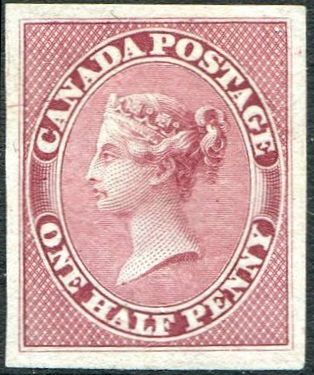 |
Send note to Staff 
|
| Edited by stamporator - 07/10/2013 11:50 am |
|
|
Pillar Of The Community
United States
5894 Posts |
|
|
Just a friendly reminder that I believe the term is imperforate, not imperforated.  |
|
Send note to Staff
|
|
|
Pillar Of The Community
Canada
1401 Posts |
|
|
Stamporator - any idea why does Unitrade not list Scott 11 as being imperforate? |
|
Send note to Staff
|
|
|
Pillar Of The Community
Canada
528 Posts |
|
|
Hi BlackJag,
An imperforate Scott #11 is Scott #8.
I believe that the plates used to print Canada Scott #11 were previously used to print Scott #8, which was imperforate (thanks Smauggie). Similar to Scott #12 (perforated) used plates for Scott #4 (imperforate), and Scott #13 (perforated) used plates for Scott #5 (imperforate).
If you look compare some errors on Scott #4 (beaver, imperforate), like 4vi - major re-entry (pos.34, pane A), you see a similar error listed as Scott #12ii (beaver, perforated) major re-entry (pos.34, pane A). Likewise for 8ii and 11ii (see notes in Unitrade).
- stamporator - |
|
Send note to Staff
|
| Edited by stamporator - 07/10/2013 8:35 pm |
|
|
Pillar Of The Community
United States
1125 Posts |
|
|
stamporator has it right. The first issue was imperforate. They then perforated the stamps. Then they made new plates (when they shifted from pence to cents. Here's a sample progression for the beaver: Scott/Unitrade 1 - 1851 - 3 pence printed on handmade laid paper, imperforate Scott/Unitrade 4 - 1852 - Same plates - printed on machine made, wove paper, imperforate Scott/Unitrade 12 - 1859 - Same plates - perforated Scott/Unitrade 15 - 1859 - New plates (5 cents) - only issued perforated Note that there are also variations in the gauge of the perforations across the early Canada issues. here's a nice one of the first perforated 3 pence: 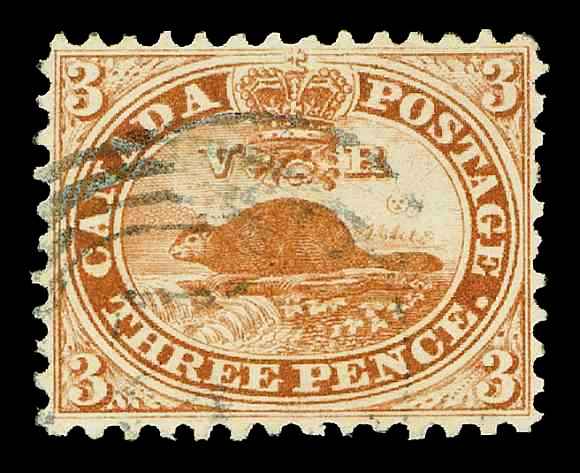 When looking at perforations, the Large Queens are kinda interesting. Because of the different papers, the perforation punches were more or less successful at making clean holes. There is a wide quality variety of the perforations on this issue. |
|
Send note to Staff
|
|
|
Pillar Of The Community
Canada
1401 Posts |
|
|
Excellent, easy to understand explanations and example. Thanks to you both. |
|
Send note to Staff
|
|
|
Pillar Of The Community
Canada
1416 Posts |
|
|
Rest in Peace
Canada
5701 Posts |
|
|
I think jogil (and myself) would like to know the EXACT perforation of that #12 beaver stamp. |
|
Send note to Staff
|
|
|
|
Valued Member
Canada
94 Posts |
|
|
I check for perf. varieties on almost all of my older stamps. The early perforated issues as well as the large and small queen stamps are available in a number of different perfs. With the small queens especially I find that identifying the perforation gauge is easily measurable and much less subjective than trying to identify a shade variety. Sometimes the perforation gauge used can help narrow down a printing period or even point to narrower range of possible shades to help identify a particular stamp. |
|
Send note to Staff
|
|
|
Pillar Of The Community
3860 Posts |
|
|
Do you know if for the early Canadian stamps from 1858 to 1859 Canada Scott # 11, 12 and 13 if it's Kiusalas 67-11.75 mostly or if it is also Kiusalas 68-11.58? Also, for those from 1859 to 1864 Canada Scott # 14, 15, 16, 17, 18, 19 and 20 if it's Kiusalas 67-11.75. Kiusalas 66-11.93, Kiusalas 65-12.11? |
|
Send note to Staff
|
| Edited by jogil - 07/21/2013 10:00 am |
|
|
Pillar Of The Community
United States
1125 Posts |
|
|
BeeSee Posted - 07/11/2013 : 09:05 am Quote:
I think jogil (and myself) would like to know the EXACT perforation of that #12 beaver stamp. Took me a while to find my perf gauge and figure out how to capture it, but since you asked: Didn't really line up well with the 12-67 or 12-66 templates: 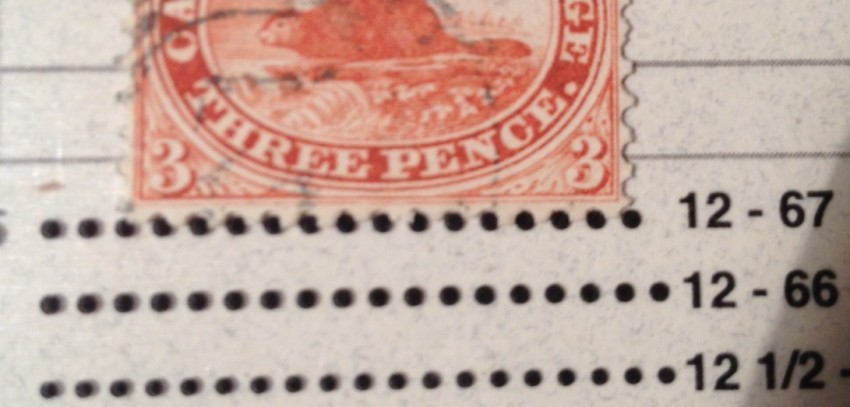 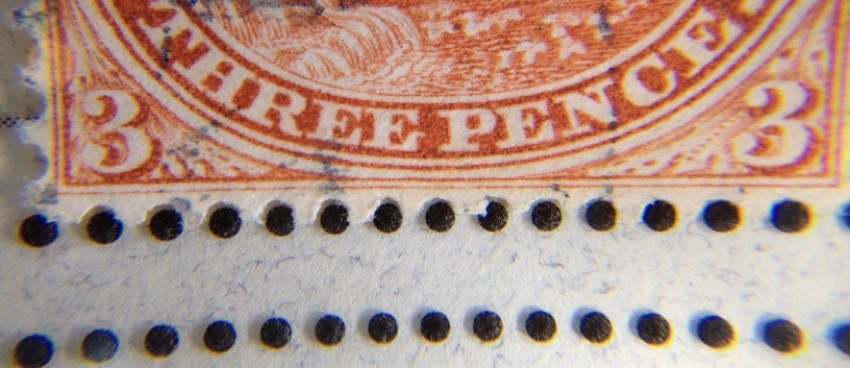 It looks like it is perf 11.85: 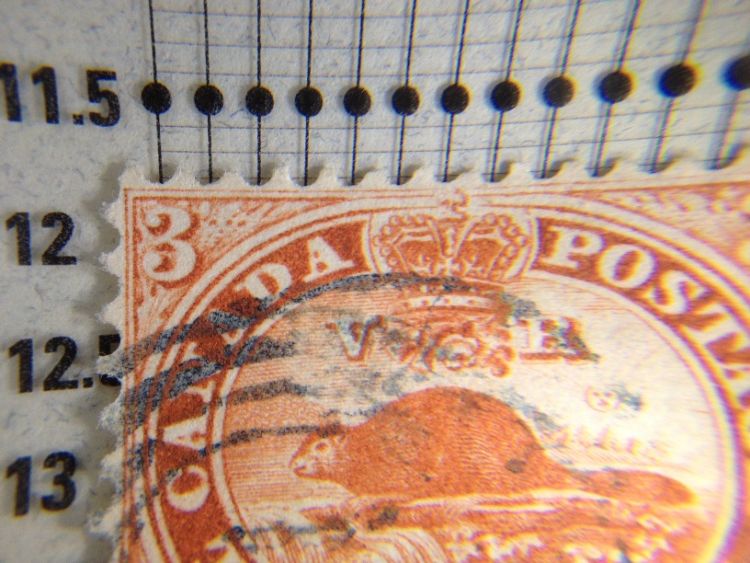 anything else you want? C. |
|
Send note to Staff
|
|
|
Rest in Peace
Canada
5701 Posts |
|
|
Thanks Chipg. That is what I expected it to be, about 11.9, which is the same measurement I get for the first Ottawa printings of the small queens. I did not use a perforation gauge for my measurements, I used a steel 1/64th of an inch engineering ruler and did the math to convert. |
|
Send note to Staff
|
|
|
|
Pillar Of The Community
3860 Posts |
|
|
What measurements have you found groupings around? Is that a Scott/Linns perforation gauge? |
|
Send note to Staff
|
| Edited by jogil - 07/25/2013 7:58 pm |
|
|
Pillar Of The Community
United States
1125 Posts |
|
|
Pillar Of The Community
3860 Posts |
|
|
If they can have a 72.5 on the Sonic Multi Gauge, they can also have a 66.5 too which appears to be what is needed for the above stamp. |
|
Send note to Staff
|
|
| |
Replies: 15 / Views: 3,273 |
|




 Posted 07/10/2013 08:25 am


