Thankyou for the link TRW.
I'll copy here what they say about paper on the small queens.
The Small Queens
PaperAs a rule of thumb, the earlier the printing, the better quality the paper used.
First Ottawa printings:
Paper a) A high quality medium thickness wove showing a clear grain on the back and smooth to the touch.
Paper b) Thick soft white paper, sometimes erroneously described as blotting paper, wrong because this paper has a very fine horizontal grain,. It was so soft that perforation pins were inclined to tear rather than punch the holes, so they look 'hairy' and there is often a lot of 'confetti' still adhering to the holes. To be found only on the One and Three Cents, as well as the Large Queens still printed at the time (Half, Two & Six Cents) it was in use around the end of 1871 and is scarce.
Paper c) Thin soft very white paper with a vertical grain, used in 1872 for some printings.
None of these papers were used in Montreal.
Montreal printings:
Paper d) Wove paper where the thickness can vary from thin to stout, creamy or yellowish in colour with a grain that is more marked and the backs therefore feel rougher. Depending on how the sheet to be printed was offered to the press, the grain can be either horizontal, the norm, or vertical. Because printing throughout the period, and in fact right up to 1922 with subsequent issues, was done on dampened paper, stamps with a vertical grain tend to be taller and narrower than those with one horizontal; the paper if breathed on will tend to curl side to side rather than top to bottom.
Paper e) Pelure paper – sometimes called 'onionskin' paper because it is so thin and transparent, very rare on the issue and if one comes across a copy, one is extremely lucky.
Paper f) Similar to Paper (d) but thin and clearly of poorer quality.
Second Ottawa printings:
Paper g) Poor thin quality paper with an indeterminate grain, it resembles rag stock, and stamps often show an embossing effect on the back.
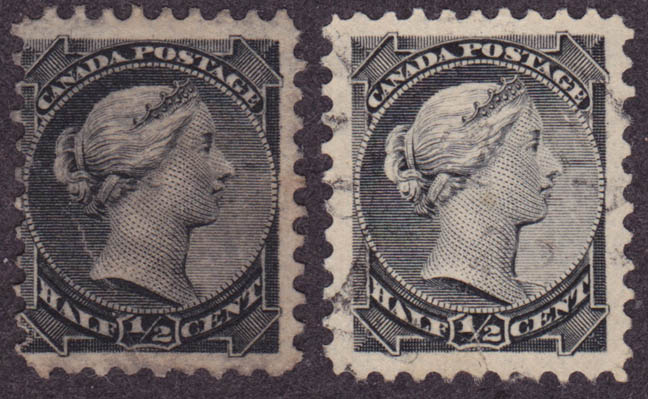
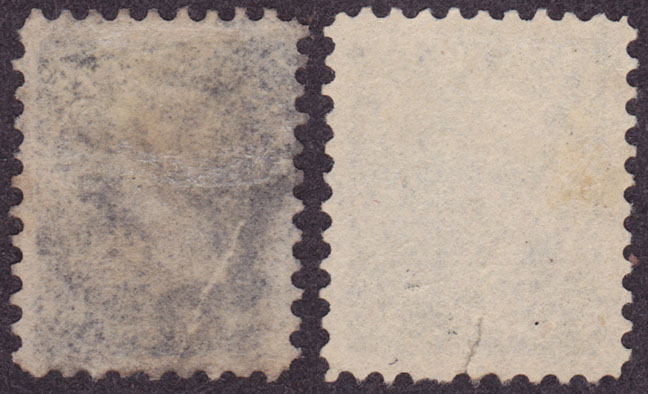
Looking at the used stamp first, it has a definite vertical grain, but isn't too course. The paper is thin and soft. That leads me to believe a Monteal printing on D or F paper. I'd need another varified copy to compare whether it is poorer or better quality. It's all relative.
The unused stamp intrigues me more. The paper, as I've mention is very thin and stiff and translucent, meaning you can almost see through it. It reminds me somewhat of the high quality paper used on Confederate States stamps printed in England. That paper is stiff with a waxy feel and is also translucent.
Here's a scan of the Queen on a page of the Unitrade catalogue. Observe how you can see the rules and some text through the paper.
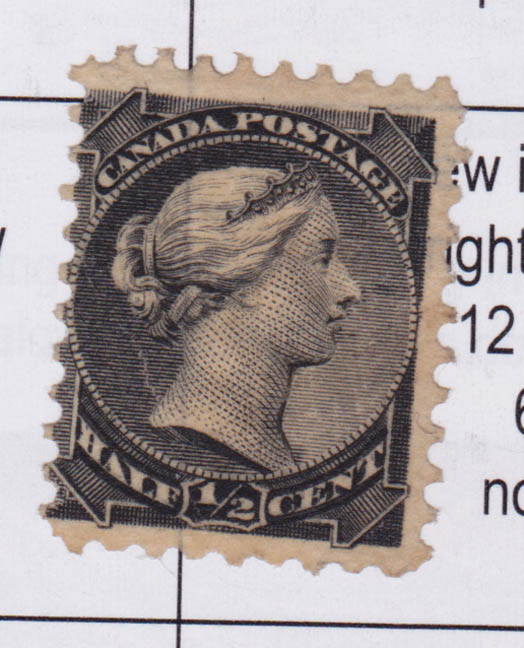
Is this the Pelure 'onion skin' paper mentioned as f in the Montreal printing? I wonder. Would have to get it varifyed I suppose. Unitrade does not mention this paper type or give a value based on paper.





 Posted 07/13/2013 7:53 pm