Many - far too many -
ebay users get over-excited when they find the stamps of Bussahir. The genuine stamps aren't common: the cheapest is catalogued at £5.50 in the 2014 Gibbons.
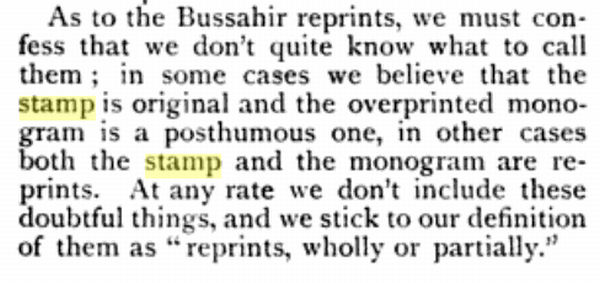
The catch is that there are far more remainders, reprints and imitations in circulation than there are legitimate stamps. Going purely on my own accumulation, perhaps five illegitimates for each one legitimate.
So how to tell the difference? With mint stamps, it's quite easy. They should match the catalogue-listed types and have the RS monogram

Some examples escaped without it, but unless you have a clear certificate from a competent authority such as the BPA, forget about it.
You'll find numerous remainders, reprints and imitations with other monograms. The commonest is probably the PS

for Padam Singh, who took over the running of the State Post Office
after it was officially closed down.
You'll also see this RNS monogram

In this case, the monogram is on an imitation, not a remainder. There never was a 1 Rupee stamp in this design, although the Bussahir State was quite happy to sell them to collectors at face value (around $US0.30 in 1900, so a nice little earner

)
The other important thing to keep an eye out for is the date 19 MA 1900 in cancellations:

Never mind that the stamp is on piece, as this is. Someone was kept busy at the back of the Rampur Post Office, sticking stamps to sheets of paper, cancelling them, and then cutting them up neatly like this. Many were done during the lifetime of the Bussahir Post Office, but the 19 MA 1900 was applied to
remainders. They're basically worthless.
And a footnote: for lovers of Rudyard Kipling's
Kim, the penultimate scene with the lama in the mountains was clearly placed in Bussahir. All the place names and scenery match. (If you haven't read
Kim, do! A wonderful yarn about the Great Game.)





 Posted 01/20/2014 10:57 pm