| Author |
 Replies: 53 / Views: 14,967 Replies: 53 / Views: 14,967 |
|
|
|
Rest in Peace
Netherlands
963 Posts |
|
|
Enough instructions and examples for now I suppose!
Have a nice week-end!
groetjes, Rein |
Send note to Staff 
|
|
|
Pillar Of The Community
Canada
5821 Posts |
|
|
This is fantastic stuff Rein, especially in the beginning
of the thread where you explain the basics of paper
making.
It's going to take me awhile to go through all this and
I'm not sure if I will ever understand it all but
I know I'm going to learn something new about
stamp production.
Thanks for moving this thread here.
|
|
Send note to Staff
|
|
|
Pillar Of The Community
United States
797 Posts |
|
|
Valued Member
United States
200 Posts |
|
|
An excellent dissertation and would add only that the type of pulp, type of wood, is also a consideration in the composition of the sheet. I once visited a mill that had 3000 kinds of pulp wood in its library! Obviously a specialty paper mill.
I must admit I cannot see what your blue lines are connecting and will have to study this.
Donald |
|
Send note to Staff
|
|
|
Rest in Peace
United States
7097 Posts |
|
|
I used to make paper for invitations, calligraphy and such so I can totally relate to this thread. I messed around with watermarks once and it was fun! It consisted of tying tiny pieces of wire to the screen to form a design. The mesh size has a lot to do with how well the detail shows up. Fun stuff. |
|
Send note to Staff
|
|
|
Valued Member
United Kingdom
314 Posts |
|
|
Valued Member
United Kingdom
314 Posts |
|
|
A piece of wove dandy roll cover with 24 wires to the inch. 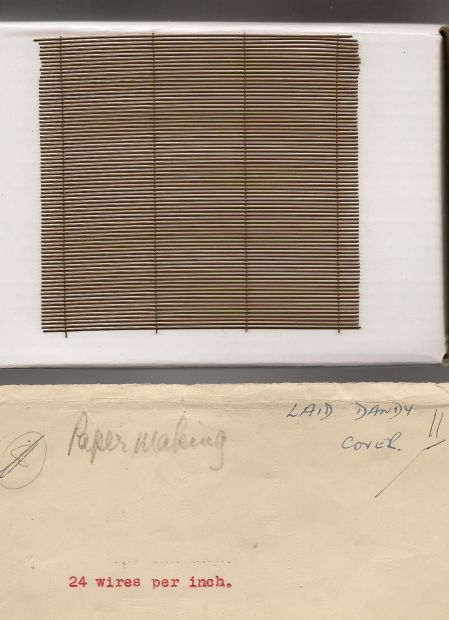 A piece of wove dandy roll cover with 40 wires to the inch. 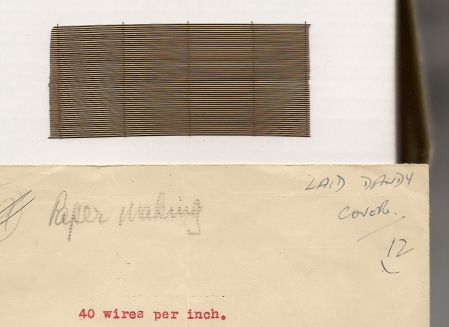 |
|
Send note to Staff
|
|
|
Valued Member
United Kingdom
314 Posts |
|
|
To see photographs of the Fourdrinier paper-making machine and shots taken around the Frogmore Paper Mill, please go to my site "www.stampprinters.info/Frogmore Paper Mill.pdf" (including a space after Frogmore and Paper) where a 27 page record of my visit will be found.
GLENN |
|
Send note to Staff
|
| Edited by 65170 - 02/10/2014 04:50 am |
|
|
Rest in Peace
Netherlands
963 Posts |
|
|
Glenn,
the dandy-roll is a separate cylinder for applying the watermark from the top side of the paper [the felt side], the wire is at the bottom [the wire side]!
groetjes, Rein |
|
Send note to Staff
|
|
|
Valued Member
United Kingdom
314 Posts |
|
|
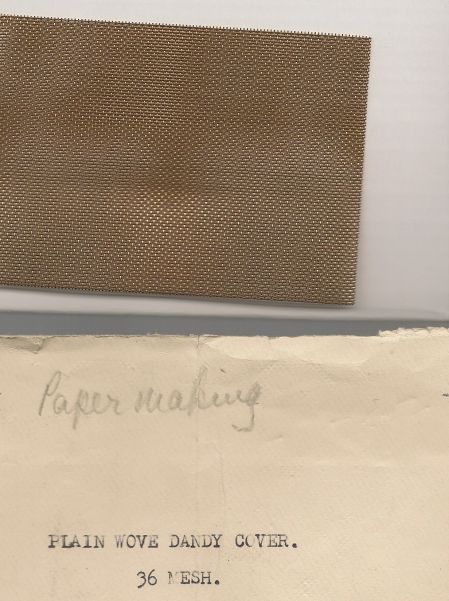
Hi Rein, The images of wove and laid mesh have the envelopes in which they came included in my scans. These were supplied by the paper manufacturer in said envelopes (to a deceased friend) and do state that they are covers for use on the dandy rolls. A schematic can be seen at website www.surrencystudios.com/Pape...facturing.htm which shows them in use above the paper, so maybe above and below methods (with and without dandy roll use) were employed? GLENN |
|
Send note to Staff
|
| Edited by 65170 - 02/12/2014 02:12 am |
|
|
Rest in Peace
Netherlands
963 Posts |
|
|
Glenn,
in the pictures that go with the article, the dandy roll is at the top and the (long) forming wire is below the paper web.
The piece of dandy roll you show does not have the watermark elements yet!?
What is important I think is to make a clear distinction to the parts of the machine that are responsible for the wire structure and that what makes the watermark.
Unless we have a reasonable doubt and we'd better assume that the watermark comes from the same wire as the wire structure.. Of which I do NOT know any examples really...
groetjes, Rein
|
|
Send note to Staff
|
|
|
Pillar Of The Community
Australia
3547 Posts |
|
|
Just a modest correction to an early remark: The direction of the paper mesh is an important determining factor for specialists in distinguishing printings of some of the Indian States, Alwar, Bundi and Wadhwan in particular. |
|
Send note to Staff
|
|
|
Rest in Peace
Netherlands
963 Posts |
|
|
Pillar Of The Community
Australia
3547 Posts |
|
|
Pillar Of The Community
United States
797 Posts |
|
|
Replies: 53 / Views: 14,967 |
|



 Posted 02/08/2014 06:32 am