| Author |
 Replies: 56 / Views: 13,793 Replies: 56 / Views: 13,793 |
|
Valued Member
103 Posts |
|
|
|
|
Pillar Of The Community
Canada
5821 Posts |
|
|
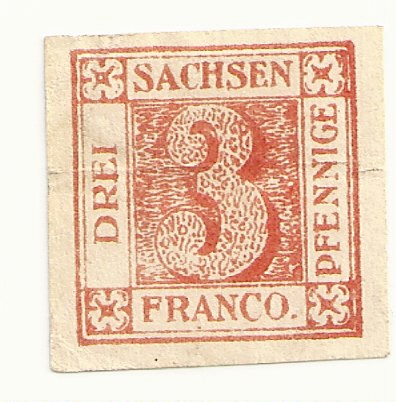
Are you saying it's a genuine Saxony 1 ?
In Michel the colours are stated as from zinnobberrot (ziegelrot)=
brick red to mittelkarminrot (kirschrot) = cherry red.
Yours looks like brown red. |
Send note to Staff 
|
|
|
Valued Member
103 Posts |
|
|
Valued Member
103 Posts |
|
|
Pillar Of The Community
Canada
5821 Posts |
|
|
Quote:
Are you saying is a fake? I'm not even into classic stamps really but I'm not colourblind. If Michel only mentions these shades for genuine stamps then what do you think? Another thing. The original stamps were printed via typography/ letterpress. Your copy, although it's hard to tell on the scan appears to be lithography. |
|
Send note to Staff
|
|
|
Pillar Of The Community
United States
7108 Posts |
|
|
I would say that it is a forgery. There are a lot of spotting features. Beyond the overall appearance, a specific characteristic is found in the corner rosettes. Each "petal" of the rosettes has a shading line in yours, and in the originals, that is not the case. Only the top left rosette should have a shading line in each petal.
If someone sees this differently, please speak up. |
|
Send note to Staff
|
|
|
Valued Member
103 Posts |
|
|
Pillar Of The Community
United States
7108 Posts |
|
|
Here is a marked-up image showing just one of the most obvious spotting features. The three areas marked in green should be empty, rather than having the short shading line at the outer edge of the "petal." This is what I was saying above, but a picture is worth a thousand words. 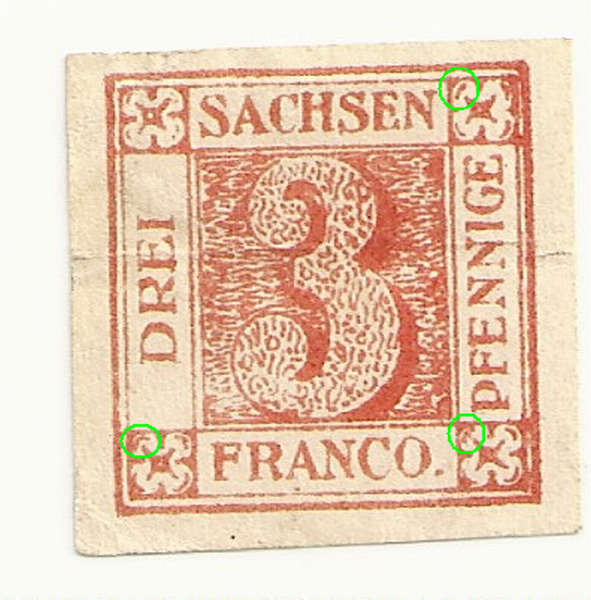 |
|
Send note to Staff
|
|
|
Pillar Of The Community
1515 Posts |
|
|
Here's one that fetched over $2,200 in a Cherrystone auction in 2009. Note how the "R" and "E" in Drei are connected: 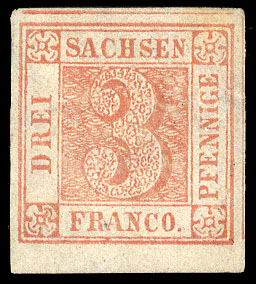 These letters are not connected in forgeries. Look at all the other differences in the letters as well as the petal details mentioned by Cjd. This stamp is one of the most commonly forged European stamps (probably by Fournier). Without a certificate, your stamp should be considered a forgery. |
|
Send note to Staff
|
| Edited by Jenny2U - 03/25/2014 3:46 pm |
|
|
Valued Member
103 Posts |
|
|
Valued Member
103 Posts |
|
|
...have anybody heard about the brown red? This question is for experts, of course. But any comments will be great to recibe. |
|
Send note to Staff
|
|
|
Pillar Of The Community
United States
7108 Posts |
|
|
Interestingly, with Saxony #1, Fournier copied a forgery instead of a genuine stamp.
Every forger worth his salt forged this stamp. (Along with quite a few forgers who weren't worth their salt.) Some forgeries are better than others. This one is not one of the convincing ones.
I have a few very old forgery manuals, along with the German Philatelic Society Reference Manual, and I wouldn't want to hazard a guess at how many different forgeries exist. Dozens? |
|
Send note to Staff
|
|
|
Valued Member
103 Posts |
|
|
Again.../...have anybody heard about the brown red? This question is for experts, of course. But any comments will be great to recibe. Is in Scott Catalog. |
|
Send note to Staff
|
|
|
Pillar Of The Community
United States
7108 Posts |
|
|
Yvert lists red and red-brown.
Scott lists varieties 1a. cherry red and 1b. brown-red.
So at least two or three colors are known. One of them might well be brown red. |
|
Send note to Staff
|
|
|
Valued Member
103 Posts |
|
|
Have anybody ever seen a brown red? It wasn´t available on SC until few last edition. It wasn´t in the 70´ & 80´s. So a Fourier copy is out of question, he would not imitate a color not listed. |
|
Send note to Staff
|
|
|
Valued Member
Denmark
445 Posts |
|
|
Here is a genuine example of a "bräunlichrot" (Michel 1 c) (Plate 3, type 7) Certified by Rismondo, BPP  |
|
Send note to Staff
|
|
|
|
Replies: 56 / Views: 13,793 |
|




 Posted 03/25/2014 2:57 pm