Quote:Robert:
Die cut singles are produced by
Canada Post, I believe, primarily for collectors. It is an opportunity to pick up a single of a self-adhesive stamp instead of having to purchase full booklet panes or larger coil multiples.
Sometimes the die cut single is also needed for
Canada Post's annual collection (although, more and more, souvenir sheets are being used for this purpose).
As the name suggests, single stamps are 'die cut' from the larger booklet pane (or coil roll) giving a single stamp that also includes the original backing paper. The die cutting provides a nice clean single of the stamp and backing paper together.
If a collector attempted to 'make' one these it would be nearly impossible and a tell-tale sign of the proper die cut single would most likely be missing...
Here is an image of two die cut singles from the 2014 Quarter 4 pack:
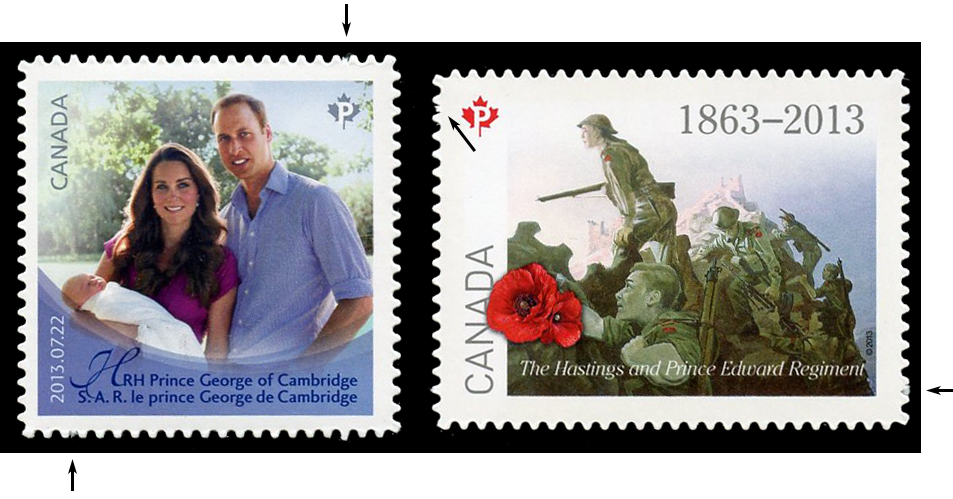
The arrows are pointing to where the die cutting has left a small remnant of the adjacent stamp within the 'valley'. If you look very closely at the exact opposite side of the stamp you will that the 'peak' is slightly larger or sometimes frayed.
In the two examples here, there is a single remnant on each side; some die cut singles have had two remnants per side.
In some cases, se-tenant multiples have been kept together (such as strips of 5 or blocks of 4).
These die cut singles are really new varieties, as individual could not produce these from a full booklet/roll. The Unitrade catalogue gives a small premium to these.
In a few cases, the singles provided in the quarterly pack have even more 'unique', including the Petro Canada stamp of 2000 (Scott 1867b) and Superman (from last year).
The Unitrade does not list die cut singles of some of the early self-adhesives where the four sides were fully straight-edged. Anyone could take a booklet of these and simply cut there own. But, try and do that with a "perforated-looking" self-adhesive. As noted earlier, that would be impossible.
By the way, have enjoyed attempting to find all of the different single combinations that would exist from a full booklet. It does require many quarterly packs, and many times you get 'duplicates'.
just a remark out of the blue since I have to explain this thing over and over again in other Forums!
What you call "die cut single" is just a "die cut" whereas the other stuff are "kiss die cuts"! In German speaking Forums I do have to tell the difference between "gestantzt" und "geschlitzt" or in Dutch "gestanst" (die cut) vs "geslit" ( kiss die cut)....





 Posted 05/01/2014 5:04 pm


