| Author |
 Replies: 17 / Views: 6,164 Replies: 17 / Views: 6,164 |
|
Valued Member
50 Posts |
|
|
Again, going through someone else's collection, found an old envelope stuffed with such letter cutouts from Japan. I feel intuitively that these need to be preserved without detaching stamps, that the cancellations are of great interest too. Am I right? 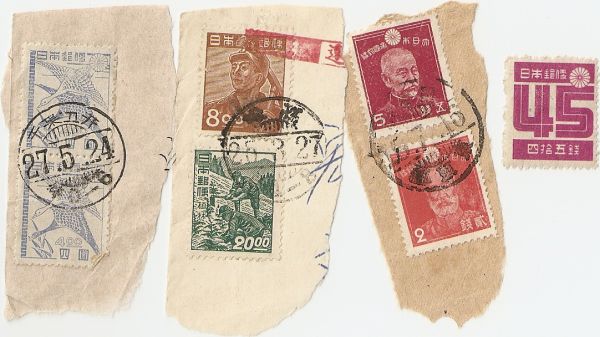 |
|
Send note to Staff
|
|
|
|
|
Pillar Of The Community
United States
6668 Posts |
|
|
Pillar Of The Community
United States
898 Posts |
|
|
I really agree with leaving them as they are. I wouldn't even trim them up. For example, on the second item from the left, there's a red rubber stamp. I don't know enough to know whether or not that's a commercial or postal marking, but it's worth leaving everything intact. These stamps are already widely available as used, but there are far fewer remaining on piece. (And that's a nice pair and strike on the far left item, too.) |
Send note to Staff 
|
|
|
|
Pillar Of The Community
United States
1047 Posts |
|
|
Does anyone know how to translate the dates on these cancels to the Western calendar?
Don |
|
Send note to Staff
|
|
|
Pillar Of The Community
Australia
3547 Posts |
|
|
The dates are shown in, reading from the left, Year Month Day format. To arrive at the CE year, add 1925. (The years are counted inclusively from the accession of the then current Emperor. The Showa Emperor ascended the throne in 1926.)
I can only make out a location on the left-hand pair: Goi, in Ichihara, Chiba Prefecture - now part of Greater Tokyo. |
|
Send note to Staff
|
| Edited by tonymacg - 06/20/2014 8:06 pm |
|
|
Pillar Of The Community
United States
1047 Posts |
|
|
So, the first cancel (25, 5, 24) would be May 24th, 1952?
Any printed references to determine who the "then current," but past emperors might have been and when he ascended the throne?
Are stamps issued during a previous emperor's reign demonetized upon his death and only the current emperor's stamps valid for payment of postage?
Just curious because it seems like the starting point for this method could move frequently.
Thanks for your info.
Don |
|
Send note to Staff
|
|
|
Pillar Of The Community
United States
898 Posts |
|
|
Hi, Don --
It would actually be May 24th, 1950. (1925+25).
Stamps are not demonetized upon the death of an emperor, so older ones can be used on current mail. (Maybe not way back, but at least for the last 60-70 years or so.)
I'm trying to find a chart I remember seeing on the web that showed how to do these conversions easily.
But there were only 4 reigns during the 20th century, and just 1 so far in the 21st, so the changes don't happen that often.
I'm no expert at all, but one clue in figuring out the year on a Japanese date stamp or postmark is, usually, at least, whether or not the Roman alphabet is used. If it is, then the year will be the standard year that most of us use. If all the writing is in Japanese, then there's a greater likelihood that the regnal year will be used. (Considered to be for domestic consumption vs international.) But I don't think the regnal year is used at all on postmarks anymore.
Either way, they will be almost always be in the form of YY-MM-DD, although I can think of some early datestamps where it was DD-MM in Roman numerals-YY.
It can be a confusing subject.
I'll see if I can find that chart somewhere online.
|
|
Send note to Staff
|
|
|
|
Pillar Of The Community
United States
898 Posts |
|
|
I don't see a chart that explains it easily, although I'm sure it's out there and someone else will find it.
There's only been one change in emperor since the example shown above. So, if you see anything particularly modern and you think it's subject to this regnal year count (again, I don't think you'll find that on postmarks anymore), you could take 1988 and add to it to get the current regnal year.
For instance, the 2014 is Heisei (pronounced like "hay-say") 26.
I don't know how much more I should go on about this, but the long-living emperor in the 20th century (pre-WW2) was the one we know as Hirohito, who died in 1989. His son, Akihito, is the current emperor.
However, the name of their reign is called something different. So, for Hirohito, his reign is known as "Showa" (pronounced like it looks, "show-wa"). In the datestamp above (25, or 1950) the year would be referred to as "Showa 25".
The current emperor Akihito's reign is known as "Heisei", so that's why 2014 can be referred to as "Heisei 26".
Aren't you glad you asked? :-) |
|
Send note to Staff
|
|
|
|
Pillar Of The Community
United States
898 Posts |
|
|
Pillar Of The Community
United States
898 Posts |
|
|
And note that the year in which an emperor dies can have 2 year references, one for the emperor who died and one for the emperor who succeeded him.
So, 1989 is both "Showa 64" and "Heisei 1".
Or, 1926 is both "Taisho 15" and "Showa 1".
[edited to fix typo] |
|
Send note to Staff
|
|
| Edited by Philatarium - 06/21/2014 8:15 pm |
|
|
Pillar Of The Community
United States
1047 Posts |
|
|
Philatarium:
Many thanks for taking the time to explain this process. All I can say is "holy cats," how much more complicated could it get?
It still seems to me that one does not know the starting point unless the mail received is contemporary. For example, if I were to find a 19th century Japanese stamp on cover (assuming stamps are not demonetized) today, with the date 2, 5, 24 on it, how would I know under which emperor it was posted? Postage rates of a given period would be a help, I'm sure, but rates may extend from one emperor to another.
The chart looks good. I'm bookmarking it for future study and application.
Don |
|
Send note to Staff
|
| Edited by DonSellos - 06/21/2014 7:15 pm |
|
|
Pillar Of The Community
Australia
3547 Posts |
|
|
Don, I don't collect Japan, but I can assure you that only a certifiable lunatic would use stamps from the Meiji or Taisho eras now. One Yen in those days was really worth something; these days, it costs Yen 110 just to send an airmail letter to Australia. |
|
Send note to Staff
|
|
|
Pillar Of The Community
United States
898 Posts |
|
|
Don, I think it's usually possible to reason through to the right emperor and thus to the right year fairly easily, using the context of the datestamp and the stamp.
For instance, with the examples you cited:
"2" would be either 1869, 1913, 1927 (or 1990, but let's omit these really recent years). I think the actual stamp used would help narrow this down to the right choice, although it's always possible that a late usage could throw you off the track. (And, in this particular case, regular postage stamps weren't issued until 1871, so, again, context would likely help you get to the right answer.)
"5" would be either 1872, 1916, or 1927. It's possible that, with a long-running definitive and a late usage, it might be hard to be sure right off the top about 1916 vs 1927.
"24" would be either 1891 or 1949.
So, in general, I think context (and the stamp(s)!) would get you to the right answer, most of the time, anyway.
You can always ask on here, or ask me directly (I can reached through this site), and I'll try to help figure it out. (But again, I am not really an expert in this area.)
-- Dave
|
|
Send note to Staff
|
|
| Edited by Philatarium - 06/21/2014 8:44 pm |
|
|
Pillar Of The Community
United States
898 Posts |
|
|
And you asked, "how much more complicated could it get?". Well, the good news is that Japan switched to celebrating the new year on January 1st beginning in 1873 (as part of its modernization/Westernization efforts), so it doesn't use the lunar new year as the change of the year. At least we have that!
Tony, as I reading your post, and you said:
"I can assure you that only a certifiable lunatic would ...", I was sure your sentence was going to end with "collect the stamps of this era"! :-)
-- Dave |
|
Send note to Staff
|
|
|
|
Pillar Of The Community
Australia
3547 Posts |
|
|
Dave, you tempt me ... As a collector of the Indian States only, I do wonder at collectors who find any other issues interesting, though. |
|
Send note to Staff
|
|
|
Pillar Of The Community
United States
1047 Posts |
|
|
Replies: 17 / Views: 6,164 |
|




 Posted 06/19/2014 9:53 pm


