| Author |
 Replies: 15 / Views: 3,225 Replies: 15 / Views: 3,225 |
|
|
Rest in Peace
7742 Posts |
|
|
Hi guys..Here I am again not understanding the types of papers and how to tell them apart..Take for example my Scott # 411, nice stamp, but as it shows in Unitrade (and this catalogue always blows me away with the depth of information in it)..Anyways, my stamp NH-VF is listed for $15.00...NOW, if it is LF paper the price increases to $50.00..A big difference..My question is how do I tell what paper is what..??? 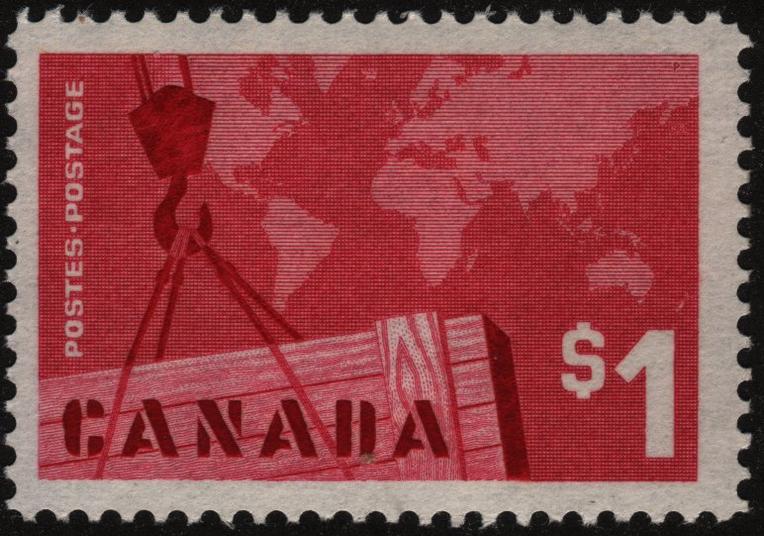 This scan below is borrowed from Unitrade, it is their paper definition chart This scan below is borrowed from Unitrade, it is their paper definition chart. 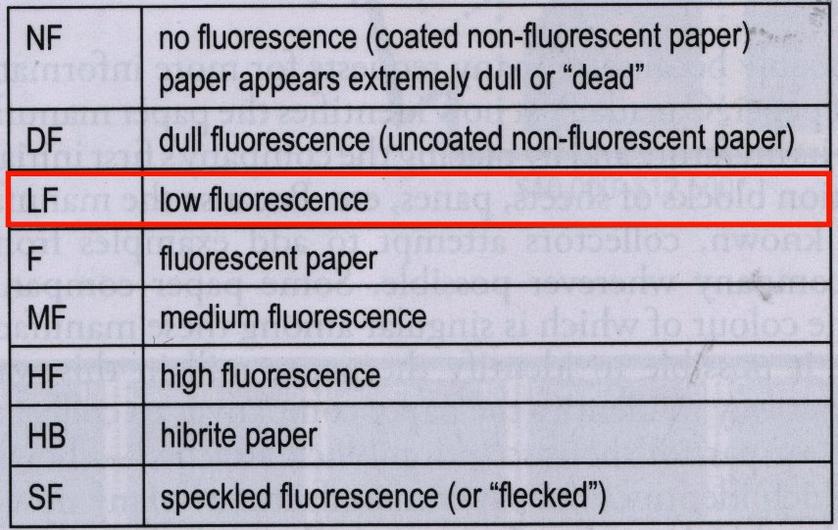 |
|
Send note to Staff
|
|
|
|
|
Pillar Of The Community
United States
728 Posts |
|
|
Wert a black light is needed as a tool for identifying fluorescence. Here is a link on black lights and wave length needed: http://www.michaelkay.co.uk/ultra-v...o-i-need.htm This an advertisement but it does explain wave length needed. The next step is to get copies of known fluorescent values as a comparative guide. Ounce you have a set of papers you can compare you put your guide sample under the light with the stamp you are examining to compare them. Under no circumstances should you look directly at the black light bulb when it is lit. This is very bad for your eyes. I started doing this a long time ago but decided that it just was not worth the bother. I did keep the copies I sorted organized. Again on value of stamps in catalogs they are a guide. Most of the stamps in my collection cost me a tenth or less of catalog. The true value of a stamp is determined by what a buyer and seller agree to and is for the most part a completely different value than what is in a catalog. |
Send note to Staff 
|
|
|
Rest in Peace
7742 Posts |
|
|
Thanks for the link watermark...I do have a light already, but only used it to identify tagging..didn't realize it could be put to that use...I will use your idea of looking at KNOWN paper type within my stamp collection...Thanks, more work for me now...haha And I am not worried about the price, cause I dont sell stamps..I collect them...  |
|
Send note to Staff
|
| Edited by wert - 07/14/2014 8:34 pm |
|
|
Pillar Of The Community
United States
8956 Posts |
|
|
Wert, a word of caution here. You state you already own a UV light. I do not know how it works in Canada, but here in the US you need a different wavelength for tagging and for papertypes. Tagging here reacts to long wave UV (LWUV), and Hibrite paper reacts to short wave UV (SWUV). This is not the same for all countries!
Peter |
|
Send note to Staff
|
|
|
Valued Member
452 Posts |
|
|
Pillar Of The Community
United States
728 Posts |
|
|
Peter, You are correct on paper fluorescence. If I recall correctly some of the early Canadian tagging needed short wave UV. Later tagging requires Long wave UV. My light did both wave lengths. It had a selector switch to use for changing wave lengths. If one uses the wrong wave length for what they wish to see they will not find what they wish to see. It is explained in the link I posted earlier. Mike |
|
Send note to Staff
|
|
|
Rest in Peace
Canada
6750 Posts |
|
|
Quote:Here is a link to the BMAPS's - Elizabethan II Study Group's - Glossary of stamping terms, to look under Fluorescence. There you will find a table of stamps that are known to show ONLY ONE fluorescence. http://www.adminware.ca/esg/esg-glossary-f.htm Quote:
Paper fluorescence
Flrsc . Unitrade / Scott #
Dead . .515, 482. (this one puzzles me, not sure, have to look.)
NF . . .441 . . . No fluorescence
LF . . .558 . . . Low fluorescence
MF . . .658-659 . Medium fluorescence
HF . . .625 . . . High fluorescence
HB . . .486B. . . Hi-Brite . . and . . [quote]Fluorescence - the reaction of the stamp paper when exposed by an ultraviolet (UV) light. Levels of fluorescence (flrsc) include: Dead, Dull (NF), Low (LF), Medium (MF), High (HF), and Hi-brite (HB). The 'brighter' the fluorescence, the whiter the stamp (under the UV light); the duller varieties are darker (grey to black) under the UV light. Determining the fluorescence of a stamp is generally subjective in nature. It would be neat sometime to make up a visual reference for this table, as the question has been asked before on SCF and most likely, elsewhere. Hmmm, fun to do stuff . . . note. |
|
Send note to Staff
|
| Edited by Puzzler - 07/14/2014 10:49 pm |
|
|
Rest in Peace
7742 Posts |
|
|
Quote:
It would be neat sometime to make up a visual reference for this table BINGO Puzzler...Now your catching on..Three ways to help other stamp collectors to interpret the different paper varieties... 1 - Ask unitrade to place sample papers in their catalogue. (Not likely). 2 - Make a website with all known paper samples. 3 - (the most important one)..Ask paper companies if they would send out requested samples to collectors. Sound Good...??? watermark..Here is the one I use..see picture below. 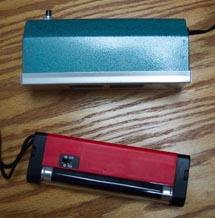 |
|
Send note to Staff
|
| Edited by wert - 07/14/2014 10:48 pm |
|
|
Rest in Peace
Canada
6750 Posts |
|
|
Neat.
I was thinking though of just getting copies of the stamps listed above and photgraphing them all, neatly arranged of course, under a UV lamp and regular lamp light.
Then posting them on an appropriately named and phrased topic on Stamp Community. |
|
Send note to Staff
|
|
|
Pillar Of The Community
United States
728 Posts |
|
|
It would be nice to post these as visual examples. The problem lies in computer settings and lighting. If you want to get a good comparison of the stamps it needs to be done by the individual using actual stamps and their black light. The same goes for true color comparison you need actual stamps and a full spectrum light source doing it on a computer screen just doesn't work there are to many variables in screen adjustments and lighting. Making your own comparison chart isn't difficult. Use a matt black card and mount each reference stamp upside down on the card. Place the card under the black light a you have your scale. Now take the stamp you want to check and compare it with your known examples. Do note that some chemicals in envelope paper can transfer fluorescence as well as drinking water if stamps have been soaked in it. |
|
Send note to Staff
|
|
|
Pillar Of The Community
United States
728 Posts |
|
|
Hi Wert, The blue UV looks like it might have both Hi and Low UV bulbs (depends on brand check your instructions). I don't know about the red one. |
|
Send note to Staff
|
|
|
Valued Member
Canada
228 Posts |
|
|
The brightness scale with stamp references as mentioned by Puzzler was developed by David Gronbeck-Jones and published in his handbook on the Caricature & Landscape definitives.
Watermark mentions how a fluorescence scale can be made from these stamps by mounting them "upside down" on a black card. I believe what you are suggesting is that the stamps should be mounted with the gum side showing. This opens up the problems I have always had in trying to put together a scale based on these stamps.
(1) It is common knowledge that soaked used stamps can have changed fluorescence (due to the envelopes they were stuck to and the soaking process itself) so using used stamps is not a good idea. Gronbeck-Jones mentions that his chosen stamps were selected since they would be common mint stamps for collectors to acquire. So he is suggesting mint stamps which makes sense.
(2) The problem with mint stamps is that you cannot really use the gum side of the stamps since the type of gum and its application would have an effect on the fluorescence of the stamps as well. Some Canadian stamps are known to have substantially different fluorescence from front to back. Unless Gronbeck-Jones has built his scale using the backs of these stamps while taking into account the type(s) of gum, I fear that using the backside of the stamps will not be accurate. On the other hand, the front of the stamps introduces all sorts of problems because of the design and/or tagging on the newer stamps getting in the way of the background paper.
Since the Gronbeck-Jones scale is mentioned in the Unitrade catalogue, it seems to have some validity and I would like to put a sample scale together. Has anybody here used this scale and do you feel it is accurate? Can it be used with the gum side of mint stamps or do we need to work with the face of the stamps? Does anybody know of a better reference that is available? |
|
Send note to Staff
|
|
|
Valued Member
Canada
228 Posts |
|
|
One more note: I just realised that the scale presented by Puzzler and referenced from www.adminware.ca is actually not quite accurate. The final stamp sample for HB paper should be #468B and not #486B. |
|
Send note to Staff
|
|
|
Rest in Peace
Canada
6750 Posts |
|
|
Quote:
The final stamp sample for HB paper should be #468B and not #486B. Indeed, my mistake in typing. 468B it should be. I hadn't noticed that in all this time. Thank you for the correction. |
|
Send note to Staff
|
|
|
Pillar Of The Community
Canada
644 Posts |
|
|
I have worked a lot with the various papers of Canadian stamps and in reference to mint or used/front or back, I prefer the fronts.
As stated, the back can be different and gum can make a difference in mint stamps. I use both mint and used.
One good way to avoid the image, is to use stamps from the edge of a sheet and with a large margin.
If possible then, I would use the paper margins on the front of mint or used stamps. The used stamps should be ones that do not show obvious signs of transfer from an envelope - that is, the fluorescence should be uniform across the stamps.
If comparing stamps from the same issue (eg. Centennials), use all mint or all used - place margins side-by-side under the UV light. |
|
Send note to Staff
|
|
|
Rest in Peace
7742 Posts |
|
|
3dadeo that is what I have been doing...looking at the edge of the stamps....I was thinking of going into my collection and scanning the edges of known paper type of stamps and building a database with my findings cause there are (and me included) lots of collectors that are not familiar say with the difference between HB and say LF paper. |
|
Send note to Staff
|
|
| |
Replies: 15 / Views: 3,225 |
|




 Posted 07/14/2014 7:54 pm


