Stamp Community Family of Web Sites
Thousands of stamps, consistently graded, competitively priced and hundreds of in-depth blog posts to read


Stamp Community Forum
 
Username:
Password:
Save Password
Forgot your Password?

This page may contain links that result in small commissions to keep this free site up and running.

Welcome Guest! Registering and/or logging in will remove the anchor (bottom) ads. It's Free!

Removing Gummed Address Labels?

 
To participate in the forum you must log in or register.
Author Previous TopicReplies: 7 / Views: 2,072Next Topic  
Moderator
1589 Posts
Posted 07/16/2014   5:05 pm  Show Profile Bookmark this topic Add blcjr to your friends list Get a Link to this Message
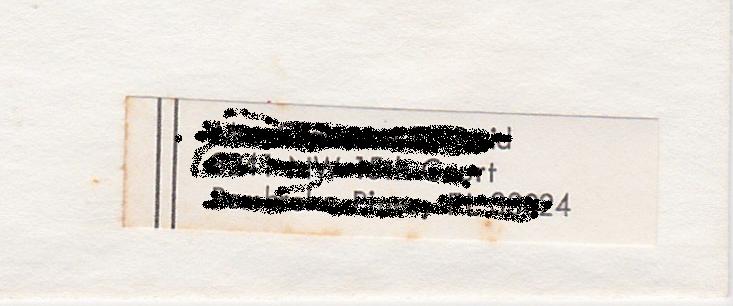
Is there a "safe" way to remove gummed address labels (like the one shown in the image below) without otherwise damaging the cover?


Basil
Send note to Staff

Bedrock Of The Community
United States
10632 Posts
Posted 07/16/2014   5:25 pm  Show Profile Bookmark this reply Add revcollector to your friends list  Get a Link to this Reply
Careful application of lighter fluid should do it.
Send note to Staff  Go to Top of Page
Moderator
1589 Posts
Posted 07/16/2014   6:13 pm  Show Profile Bookmark this reply Add blcjr to your friends list  Get a Link to this Reply

Quote:
Careful application of lighter fluid should do it.


What about other solvents? On hand, I have: acetone, VM&P naptha, methyl ethyl ketone, and "Oops"--which is a mixture of solvents.

I don't have any "lighter fluid" on hand, but if there is a reason to prefer it, it shouldn't be difficult to get. But what "kind" of "lighter fluid." Seems that there are three different kinds: "charcoal" lighter fluid, butane, and naptha.

I have some covers I can "experiment" with that I won't fret over if I damage them.

So how would you "carefully" do this? My inclination would be to use something like a q-tip to apply it to the edges of the label, and gradually try to saturate the label.

Obviously, I've never done this before.

Basil
Send note to Staff  Go to Top of Page
Pillar Of The Community
Learn More...
United States
880 Posts
Posted 07/16/2014   8:35 pm  Show Profile Check johnsim03's eBay Listings Bookmark this reply Add johnsim03 to your friends list  Get a Link to this Reply
I am aware of no method to do this without leaving obvious traces. You have the chemical reaction of the gum to the cover paper. In the case of older covers, you have all sorts of chemical reactions going on over a long period of time. Take a look at most FDCs 40 years or older, and you will see the reaction most often on the reverse of the envelope, along the gum seal of the envelope flaps. I think you will find when you do remove the label, there will be a chemical stain beneath it that cannot be gotten rid of... Please let us know how your experiment turns out! John
Send note to Staff  Go to Top of Page
Moderator
1589 Posts
Posted 07/16/2014   11:21 pm  Show Profile Bookmark this reply Add blcjr to your friends list  Get a Link to this Reply

Quote:
I am aware of no method to do this without leaving obvious traces. ... Please let us know how your experiment turns out! John
I'm not expecting to fool anyone. I would describe a cover to which this was done as "with address label (removed)."


Quote:
I think you will find when you do remove the label, there will be a chemical stain beneath it that cannot be gotten rid of


Here are a couple of covers demonstrating that:
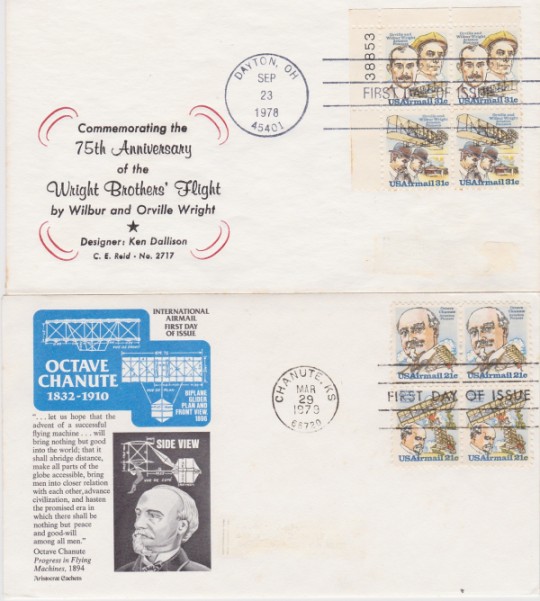


The staining is definitely noticeable ... in the image. But less so to the naked eye. In the top one, it is not noticeable "at a glance;" you have to look closely (and the naked eye will notice that a thin layer of a portion of the label still adheres to the cover--see postscript below).

It is what it is. I don't think there is any difference in "value" between a cover with an address label, and one in which the address label has been removed. Both lack the value attached to an unaddressed cover. Aesthetically, I find the labels distracting, and thus the cover is more appealing to me with the label removed.

Whenever I have an addressed cover in my collection, I'm always on the look out for an unaddressed version. But until then, the "address label (removed)" will do.

Basil

Postscript:

I'm not sure how much of what you see in the image is evidence of actual "chemical staining," and how much has to do with image characteristics. In the top cover, the "staining" appears darker at the right end of where the label was. But it is darker because there is a layer of label still stuck to the cover. So the "staining" may in part be related to traces of the label left behind, and where the traces are thicker, in the image it appears darker.
Send note to Staff  Go to Top of Page
Pillar Of The Community
Learn More...
United States
880 Posts
Posted 07/17/2014   06:43 am  Show Profile Check johnsim03's eBay Listings Bookmark this reply Add johnsim03 to your friends list  Get a Link to this Reply
Hi Basil, I did not mean to imply any sinister intent on your part with your wanting to remove the labels...
I'm looking at it entirely from an eye appeal/chemistry point of view. It is purely a matter of personal choice. I would keep the label on, rather than have any kind of stain present after the removal of the label. Most labels which were older would probably already show staining around the edges before removal of the label. Which is more pleasing - an address label on the cover, or a stain left behind from a removed label? John
Send note to Staff  Go to Top of Page
Pillar Of The Community
United States
1947 Posts
Posted 07/17/2014   07:18 am  Show Profile Bookmark this reply Add rohumpy to your friends list  Get a Link to this Reply
The lighter fluid being discussed is, I think, cigarette lighter fluid such as Ronsonol.
Send note to Staff  Go to Top of Page
Moderator
1589 Posts
Posted 07/17/2014   08:07 am  Show Profile Bookmark this reply Add blcjr to your friends list  Get a Link to this Reply

Quote:
Which is more pleasing - an address label on the cover, or a stain left behind from a removed label?
I would say it all depends...on the degree of staining. If you have to look twice to see it, then I'm okay with it. But then it is all "in the eye of the beholder," right? If the results are not eye pleasing to me, then I will not continue.

In any case, we're not talking about the effect upon articles that are rare or highly sought. The few covers where I would have a gummed label that I want to remove are modern. Older covers, where value is more significant, predate the use of gummed address labels. And in the case of older covers, the handwritten address is often part of what makes the cover interesting. (I collect airmail FDC's, and I have early covers with addressed to Ioor and Roessler --in their handwriting, I believe-- that are obviously worth more because of the address on them.) The era of typewritten addresses is somewhere between the two, and whether the address is interesting or not, there is not much I can do about it (except look for an unaddressed copy).

But thanks for the replies. I do appreciate the dialog.

Basil
Send note to Staff  Go to Top of Page
  Previous TopicReplies: 7 / Views: 2,072Next Topic  
 
To participate in the forum you must log in or register.

Go to Top of Page

Disclaimer: While a tremendous amount of effort goes into ensuring the accuracy of the information contained in this site, Stamp Community assumes no liability for errors. Copyright 2005 - 2026 Stamp Community Family - All rights reserved worldwide. Use of any images or content on this website without prior written permission of Stamp Community or the original lender is strictly prohibited.
Privacy Policy / Terms of Use    Advertise Here
Stamp Community Forum © 2007 - 2026 Stamp Community Forums
It took 0.19 seconds to lick this stamp. Powered By: Snitz Forums 2000 Version 3.4.05