Regarding BeeSee's question:
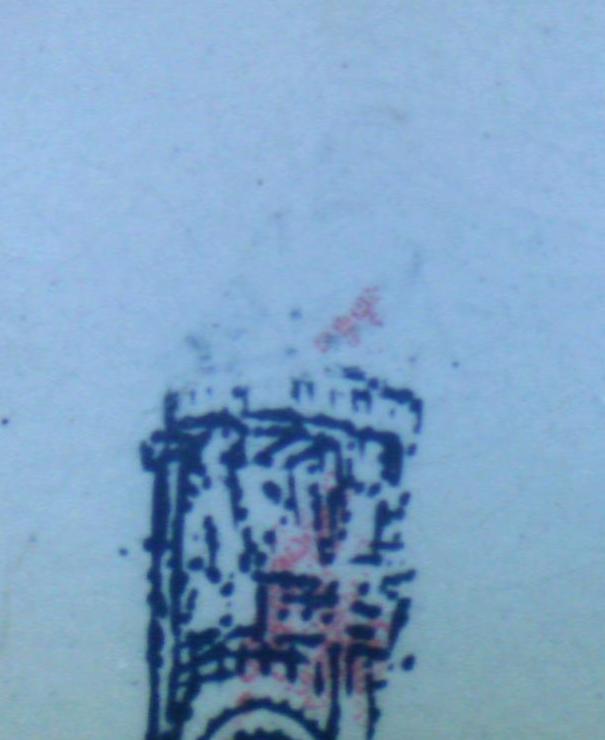
As noted in my original response, the missing bird was printed using engraving. In this printing method, the lines of the design consist of grooves in the cylinder that hold the ink. A characteristic of the engraving process is that the lines of the stamp design are raised above the surface of the paper. The deeper the grooves, the more pronounced the raised effect.
The paper is pressed against the cylinder under great pressure so that it picks up the ink in the grooves. If the ink is missing, the pressure will still push the paper into the grooves. The paper will still be raised where the lines of the stamp design occur, but because there is no ink, what you will see is the design embossed in the paper.
A well known example of the same variety occurs on the 1967 Centennial definitives $1.00 booklet containing the 8c Library stamp.
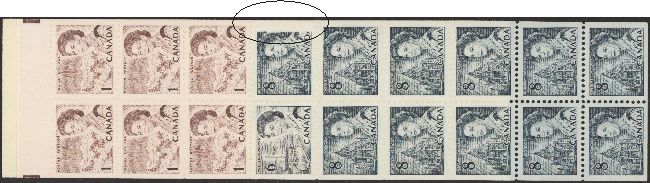
Like the stamp with the missing bird, this booklet was printed by BABN on its Goebel press. On the 8c Library stamp with the variety, the missing part of the design can be seen embossed in the paper. The cause is the same for both varieties - the inking roller did not deposit ink into the grooves of the cylinder. The reason is explained in greater detail in the Robin Harris Centennial Definitives catalogue.
Another example of the same sort of variety is shown below on the 1937 4c Mufti definitive. A vertical strip is missing on the stamps in the rightmost column.
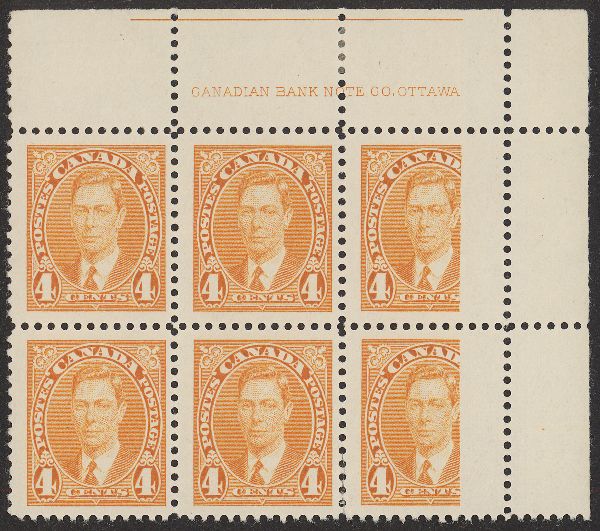
This stamp was printed by Canadian Bank Note Co. using a sheet-fed rotary press. The missing part of the design is embossed on the paper. The effect is quite striking where the deeper grooves occur (the value tablet, the lines of the oval, and the frame lines), although unfortunately the embossing doesn't show up in the image. The reason for the missing part of the design is quite different in this case. Here, there was a strip of foreign paper covering the vertical strip. The edges of this paper also show up as embossing.
Incidentally, why the term "cylinder" and not "plate" for the BABN stamps? The Goebel press is a web-fed press, and the design for the photogravure and engraved colours are impressed onto a solid cylinder, not a flat plate that is subsequently bent to fit around the printing cylinder of a sheet-fed rotary press.
Regarding Partime's question:
According to the new issue information released by
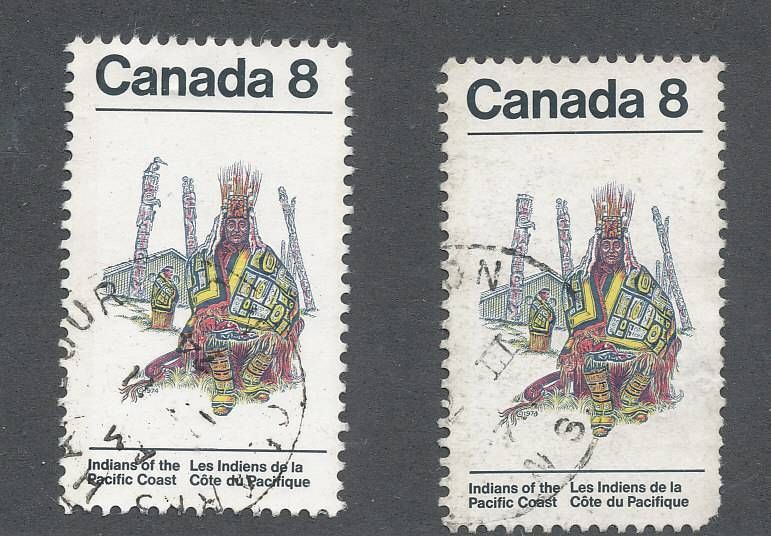
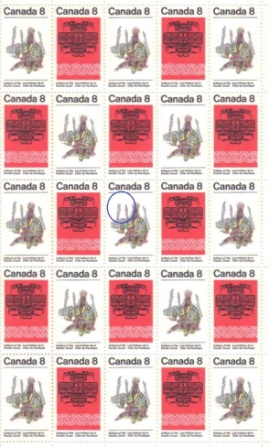
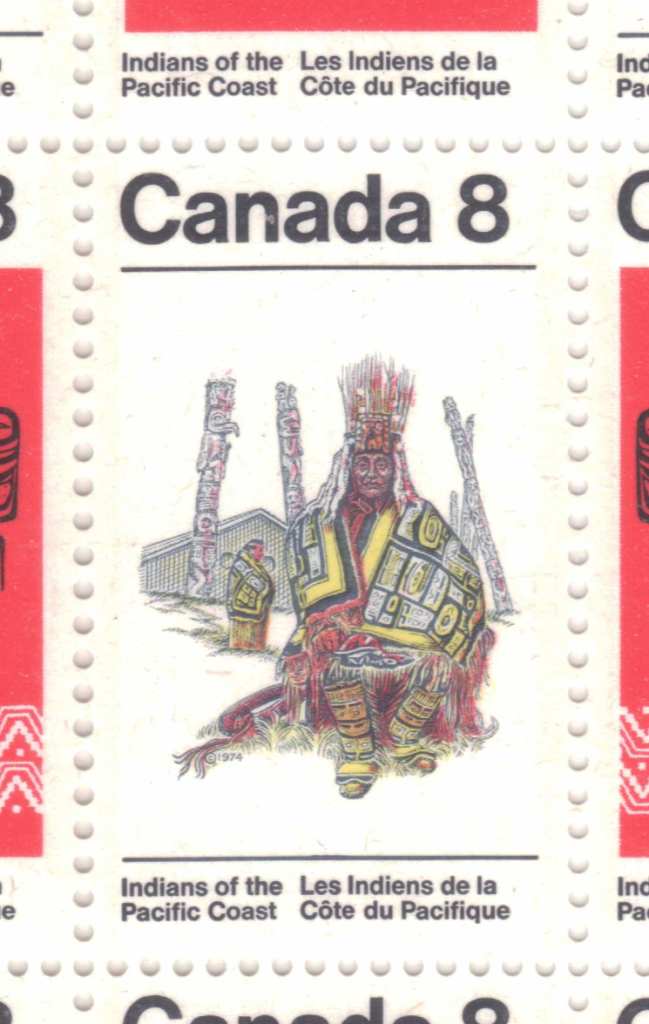
Canada Post, the Pacific Indians costume and thunderbird pair were printed using two-colour photogravure and two-colour engraving. You can see what portion of the Indian costume stamp is printed by engraving from the image of the die proof posted by Library and Archives Canada:
http://data4.collectionscanada.ca/n...G&SECT3=ITLVThe two photogravure colours are red and yellow (but just red on the thunderbird stamp). I'm not sure what the two engraved colours are because the engraving looks to be all the same colour to me. In any event, there could be a colour shift between the photogravure and engraved colours. In fact, this is not uncommon on stamps printed on the Goebel press. However, even if there were two engraved colours, there could be no shift of one relative to the other because both colours would be printed by the same cylinder. So in this case because the bird and the totem pole are both printed by engraving, the bird (or its embossed image) will always be at the same place on top of the totem pole.





 Posted 08/13/2014 3:57 pm