| Author |
 Replies: 16 / Views: 3,941 Replies: 16 / Views: 3,941 |
|
Valued Member
Czech Republic
41 Posts |
|
|
Hi, I have two covers: Do you know how is it possible that there is no stamp (back side is blank)? Does someone have more "free" covers from the same time? 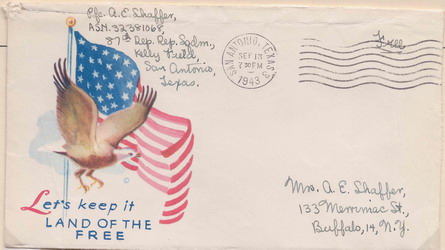 This item is a piece of paper with pair #O17 but it is not a cover. Can someone tell me more about this piece of paper. I don't know what is it and how can it be cancelled. 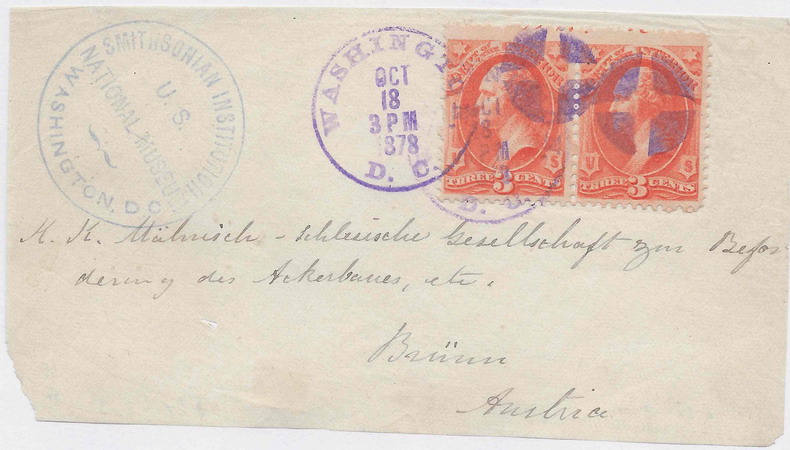 If you can help me approximately estimate a value I will be very happy  . |
|
Send note to Staff
|
|
|
|
|
Pillar Of The Community
United States
2782 Posts |
|
|
1. During World War II, U.S. military personal had free franking privileges. This was common for many other countries and other wars. Nice patriotic cachet. "Free" covers are very, very common, but still an be very interesting especially if the letters are still enclosed or there's an APO address. This one appears to have come from a military base in San Antonio, Texas.
2. This item probably was once a full cover, but someone cut the back off of it. Commonly called a "cover front". |
Send note to Staff 
|
|
|
Pillar Of The Community
United States
6668 Posts |
|
|
Certain officials have "Free franking" privileges. The first appears to be military and the 2nd is an official cover sent from D.C (Department of Agriculture) to Austria in 1878 but not too sure about the later added Smithsonian museum handstamp. The museum did not open until 1910.
Certain government departments had their own stamps so the postal system could recognize the sender. A few of these Departments were the Navy, Agriculture, Treasury, Justice, State, War, Executive, etc.
These departmentalized issues ended around 1881 I believe. In 1983 a general "Official mail" stamp was issued.
|
|
Send note to Staff
|
| Edited by stallzer - 08/30/2014 2:03 pm |
|
|
Bedrock Of The Community
United States
12128 Posts |
|
|
The first cover is one of many patriotic cachet attributed to Jacques Minkus. It is documented here: http://arago.si.edu/index.asp?con=2...4&img=1&pg=8As to your specific cover, the return address reads PFC A.E. Shaffer, 87th Depot Repair Squadron, Kelly Field, San Antonio, Texas. By 1945, A.E. Shaffer had been promoted to Sergeant as shown by this cover currently for sale on ebay: 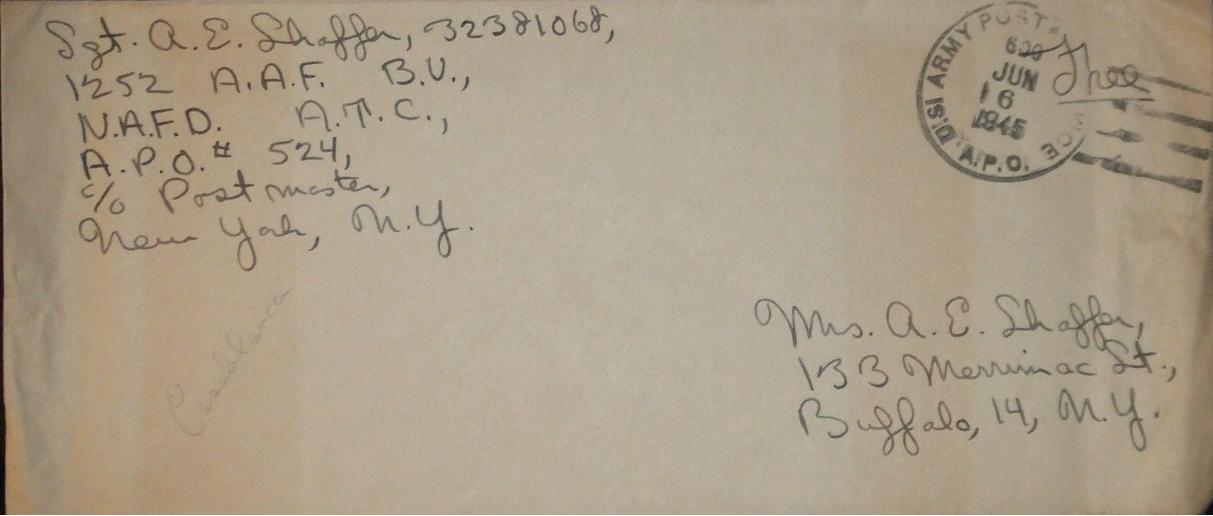 Based on APO 524, I believe he would have been stationed at the time in Casablanca, Morocco. |
|
Send note to Staff
|
|
|
Pillar Of The Community
United States
2782 Posts |
|
|
The National Museum was open to the public in 1881. The Museum of Natural History opened in 1910.
The postmark on wt1's example - APO 600 is also for Morocco or even possibly Algeria. |
|
Send note to Staff
|
| Edited by Battlestamps - 08/30/2014 2:35 pm |
|
|
Pillar Of The Community
United States
3305 Posts |
|
|
Quote:
These departmentalized issues ended around 1881 I believe. Use of the departmental stamps ended in 1884 officially. Sorry, couldn't resist the play on words.  |
|
Send note to Staff
|
|
|
Pillar Of The Community
United States
6668 Posts |
|
|
Ok, it is still 4 years prior to the museum opening. Did the postal history museum do favor / philatelic cancels? |
|
Send note to Staff
|
|
|
Pillar Of The Community
United States
2782 Posts |
|
|
The museum was probably already established some years as an organization prior to public opening. In 1878, the Smithsonian acquired some 60 boxcars loads of materials from the 1876 Centennial and was well on it's way to becoming a full fledged museum. If the name of the receiver can be established on the cover front, a connection might be established. The receiver might have been someone who provided information or specimens for the museum. |
|
Send note to Staff
|
|
|
Valued Member
United States
9 Posts |
|
|
The Smithsonian Institution was founded by the Organic Act of 1846, under the Department of the Interior. The stamps used on this cover front are "Dept of the Interior", the ones the museum was authorized to use. The use of these stamps was abolished in 1884. |
|
Send note to Staff
|
| Edited by CDavid - 08/31/2014 2:11 pm |
|
|
Pillar Of The Community
United States
6668 Posts |
|
|
Thanks for the info CDavid, I've never see that Smithsonian hand stamp before. |
|
Send note to Staff
|
|
|
Valued Member
United States
9 Posts |
|
|
stallzer - I haven't seen the hand-stamp either. Dan Piazza, Curator of Philately at the National Postal Museum, collects Smithsonian postal history. He might have information about it. |
|
Send note to Staff
|
|
|
Valued Member
United States
202 Posts |
|
|
Jingi, we had the same privilege in Vietnam. Sooooo, I made my own stamp with FREE occupying the vignette. This may be the only canceled "stamp", so to speak, that was sent home by a military person from Vietnam! 1967
Who knows?
The only official thing about this stamp is the cancellation and maybe the word "FREE"
|
|
Send note to Staff
|
|
|
Valued Member
Czech Republic
41 Posts |
|
|
Thanks for information.
Does anyone have a contact for Dan Piazza or is he active here on the forum? I would like to hear/read his opinion. It is really interesting to get know something about history of Smithsonian. |
|
Send note to Staff
|
|
|
Pillar Of The Community
1213 Posts |
|
|
To answer the question about value on the first one, free franked military covers from WW 2 tend to sell for about $1 unless they are from a famous person or famous unit. This one is neither. One thought about the Smithsonian marking on the second one, the Smithsonian was established in 1846 "for the increase and diffusion of knowledge," as a group of museums and research centers administered by the United States government. It was originally organized as the "United States National Museum" which is in the cachet. Yes, this is only a cover front which dramatically reduces its value as postal history - it puts it more in the realm of cut square or "stamps on piece". I do not have a current US catalog for Officials, but perhaps someone here has a current one and can look up the value of the three cent Department of Interior official stamps. They seem to sell on ebay for about $1 to $2 each in used condition like these. Of course like most all stamps on ebay there are hopeful sellers who try to catch uninformed buyers by starting auctions for these at $10 to $25 each, but when you look at the auctions where someone actually bought one these are where you see the market value which is about $1 to $2 per stamp. |
|
Send note to Staff
|
| Edited by Kimo - 09/01/2014 10:37 pm |
|
|
Valued Member
United States
9 Posts |
|
|
Jingi - I believe Dan's email is *** Edited by Staff - Please Review the rules that you agreed to when you registered. *** That is the normal format for emails at the Smithsonian. |
|
Send note to Staff
|
| Edited by CDavid - 09/02/2014 10:12 am |
|
|
Moderator

United States
4788 Posts |
|
|
Replies: 16 / Views: 3,941 |
|




 Posted 08/30/2014 1:40 pm


