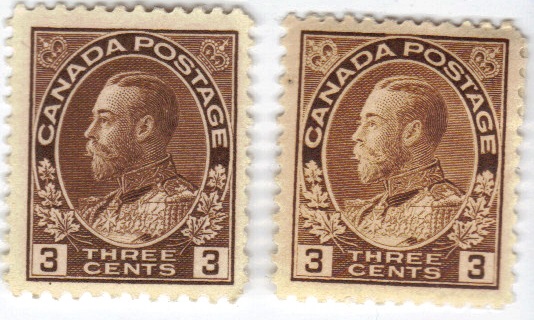
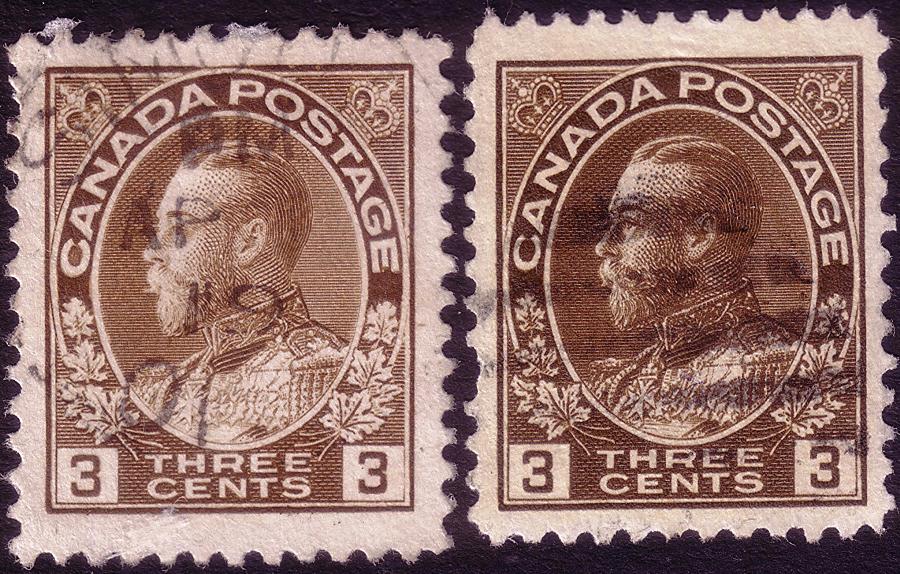
Good job on the research, mudhut.
Another difference between these two stamps is that the stamp on left was produced by the dry print method, while the one on the right is a wet print.
The names of these two printing methods suggest exactly what they are. The Admirals were initially produced with the wet print method. With that, the paper is first moistened, printed, and then gummed. With the dry print method, the paper is dry and pre gummed for printing.
The results are, with wet print there is some shrinkage across the grain of the paper, which leads to the image area of the stamp shrinking either on the horizontal or vertical, depending on which way the fibres in the paper lay.
Your right hand stamp is notably shorter than its friend on the left.
I've taken the liberty of lining them up to show you. The red line at the bottom shows the difference in size.
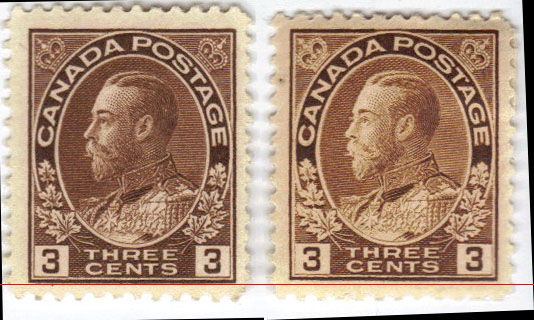
The other indicator is the dry print method achieves better sharpness or clarity of the image. This is probably a consequence of the greater pressure needed in the press rollers needed during the printing process.
So, using Unitrade for ID, that would make the stamp on the right a 108 while the stamp on the left is a 108a. The 108 was issued on August 6, 1918, while the dry print 108a came out in 1923. Of course the ID number can be broken down even further, getting into the colour variations.
The brown 3¢ admiral was replace at the end of 1923 with a carmine (red) version, to conform with new UPU colour regulations set out at Madrid Conference of the UPU in 1920.





 Posted 09/20/2014 02:34 am