Stamp Community Family of Web Sites
Thousands of stamps, consistently graded, competitively priced and hundreds of in-depth blog posts to read


Stamp Community Forum
 
Username:
Password:
Save Password
Forgot your Password?

This page may contain links that result in small commissions to keep this free site up and running.

Welcome Guest! Registering and/or logging in will remove the anchor (bottom) ads. It's Free!

Canada Scott B4 - Possible Constant..?

 
To participate in the forum you must log in or register.
Author Previous TopicReplies: 12 / Views: 2,775Next Topic  
Rest in Peace
7742 Posts
Posted 10/12/2014   09:29 am  Show Profile Bookmark this topic Add wert to your friends list Get a Link to this Message
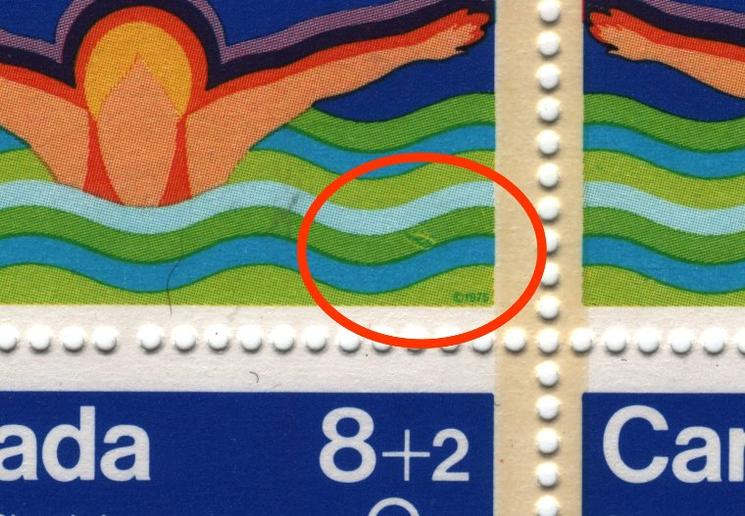
Hi guys...Take a look at these stamps..I have a block of Scott B4 and a sheet of Scott B4...This is a donut shaped flaw in position 4 on a sheet of 50 stamps and on this block.

Would it be classified as a constant..?


Send note to Staff

Pillar Of The Community
Canada
4648 Posts
Posted 10/12/2014   11:03 am  Show Profile Bookmark this reply Add Bujutsu to your friends list  Get a Link to this Reply
I strongly think that this is just a 'fly-speck' variety that was
caused by dirt on the plate as it was being printed (?)

Keep trying Wert, I like your posts <G>

Chimo

Bujutsu
Send note to Staff  Go to Top of Page
Rest in Peace
7742 Posts
Posted 10/12/2014   11:23 am  Show Profile Bookmark this reply Add wert to your friends list  Get a Link to this Reply
I would like to know how a stamp is classified as a constant/non constant...?

Does it have a minimum limit...?
Does it have to appear on a sheet/block/stamp 10 times...1000 times...10,000 times...?

What makes a stamp a constant for Unitrade to recognize it as such...??
Send note to Staff  Go to Top of Page
Pillar Of The Community
United States
725 Posts
Posted 10/12/2014   11:52 am  Show Profile Bookmark this reply Add watermark to your friends list  Get a Link to this Reply
Hi Wert, You are trying to apply a term used in describing errors in engraved stamp printing to a lithographed stamp. The term constant plate variety deals with stamps printed from an engraved plate and could be caused by rerocking an image into the plate (re-entry/double transfer), engravers slips or retouches, tool damage to the plate, or cracking of the plate to name a few. In modern printing for the most part plates are not used so we now have errors, freaks, and oddities. Some of these last through several print runs or very few and how dramatic they are may influence the collectability but very few if any would be considered as a constant variety.
Send note to Staff  Go to Top of Page
Pillar Of The Community
Canada
1415 Posts
Posted 10/12/2014   12:45 pm  Show Profile Bookmark this reply Add Gilles le timbre to your friends list  Get a Link to this Reply
Like the Paul Kane mark on teepee and the door frame on Kriegoff 8c. There are considered constant since they appear on all stamps on a specific position of a specific pane. The Corgi times latest edition describes the 8c Kriegoff constant flaws, and most are listed in Unitrade
Send note to Staff  Go to Top of Page
Rest in Peace
7742 Posts
Posted 10/12/2014   2:17 pm  Show Profile Bookmark this reply Add wert to your friends list  Get a Link to this Reply
Watermark/Gilles le timbre...just for argument sake, lets say a plate gets cracked half way through a run...So, they call it a variety and it ends up in the Unitrade catalogue..On the other hand as you say a piece of dirt stuck to a plate stays on for half the run...Same as the other 50% good, 50% bad, but it cant be called a constant..??
Send note to Staff  Go to Top of Page
Valued Member
Canada
382 Posts
Posted 10/12/2014   5:50 pm  Show Profile Bookmark this reply Add gportch to your friends list  Get a Link to this Reply
Wert, the stuff we see happening on stamps printed by lithography is simply the way things happen in lithography. There are lots of things that can get stuck on the paper or the blanket or the plate - but they don't remain there long. These create the irregular stamps that the hobby calls freaks and oddities. On the other hand, things that damage an intaglio plate tend to be permanent which means that every subsequent impression will recreate that same flaw in the same position. In that sense, the flaw is constant from that point forward.

GJP
Send note to Staff  Go to Top of Page
Rest in Peace
7742 Posts
Posted 10/12/2014   10:23 pm  Show Profile Bookmark this reply Add wert to your friends list  Get a Link to this Reply
Thanks gportch...understood,
Send note to Staff  Go to Top of Page
Valued Member
36 Posts
Posted 10/12/2014   10:23 pm  Show Profile Bookmark this reply Add AdmCol to your friends list  Get a Link to this Reply
I would like to take exception with watermarks's statements:


Quote:
The term constant plate variety deals with stamps printed from an engraved plate


and


Quote:
In modern printing for the most part plates are not used


Lithographic stamps are also printed using plates, one plate for each colour. The plates are made from thin aluminum sheets. Ink is transferred to the plate by an inking roller. The plate deposits the ink on a cylindrical rubber blanket which then deposits it on the paper (hence the term "offset lithography"). The following Wikipedia article on offset printing provides more information about the printing process:

http://en.wikipedia.org/wiki/Offset_printing

Perhaps watermark meant that modern plates are produced differently than engraved plates. This is certainly true of litho and photogravure plates, and it is also true of engraved plates produced after the mid 1960s.

A litho plate (one for each stamp colour) typically has two to six panes of stamps on it. Until the mid 1990's, stamp designs were reproduced on a litho plate using a "step-and-repeat" camera. This gave rise to plate flaws that were constant on:

a) Every stamp in each row or column of every pane. These flaws are called "primary" flaws. Examples include the "stroke on teepee" on the 1971 7c Paul Kane stamp and the "stroke in A" on the 1968 5c McCrae stamp.

b) One stamp on every pane on the plate. These are "secondary" flaws. Examples include the "burning bush" on the 1970 6c Group of Seven and the "chinstrap" and "flagstaff" flaws on the 1976 8c Royal Military College - Wing Parade stamp.

c) Just one stamp on the plate. These are "tertiary" flaws. Examples include the "red thumb" on the 1975 8c Marguerite Bourgeoys stamp and the "light in window" on the 1975 8c Marie Chapdelaine stamp.

The frequency of the flaws on the plate depends on when the flaw occurred during the "step-and-repeat" process. The frequency of some flaws is harder to explain. Two examples: the "missing medallion" on the 1976 8c Indian stamp and the "beacon on mountain" on the 1982 $1.50 Waterton Lakes definitive.

Some litho stamps were printed from more than one set of plates. Flaws might occur on just one set. Examples include the "dot on moustache" on one of the 1980 17c O Canada stamps (a "primordial" flaw - it occurs on EVERY Composers stamp, but only on one set of plates), the "nick in ring" on the 1997 45c Law Society of Upper Canada stamp (secondary flaw on one set of plates), and the "blue, blue sea" on the 1984 32c Lighthouse - Louisbourg stamp (tertiary flaw on one set of plates).

Around 1995, the step-and-repeat camera gave way to the computer. Computers were used to reproduce the design multiple times on the plate. This produced flaws such as the delightful "no space after Canada" flaw on the 2007 3c Beneficial Insects definitive.

Flaws on engraved stamps such as re-entries, retouches, plate scratches and other damage to the plate occur on just one stamp on the plate. Can a flaw on an engraved plate occur on more than one stamp? Yes, indeed. On engraved stamps up until relatively modern times, the stamp design was transferred to the plate using a relief on a transfer roll. More than one relief might be used especially for definitives where multiple plates were produced. Different reliefs might have small but noticeable differences. Also, a relief might suffer wear or damage while in use (a "relief break"). Stamps transferred to the plate after a relief break occurred would be distinguishable from stamps transferred before the break. In the mid 1960s, Canadian Bank Note Co. began using a "plastic mould" process to manufacture plates. Most of the plates for the 1967 Centennial definitives were produced using plastic moulds. And so was the 1978 14c red Parliament Environment definitive, which has several well known plate flaws that repeat on one stamp of every pane on multiple plates.

Referring to wert's question that began this thread, his variety is almost certainly a "hickie" or "doughnut" variety which was common to the lithographic printing process. Such varieties are caused by grit on the plate preventing the ink from being transferred to the plate. These varieties are transient. They may vary in size over time and typically occur on no more than a few hundred sheets. They are non-constant, but can have a certain amount of eye appeal depending on their size and how they affect the stamp design. Constant flaws refer to flaws on the plate. They are called constant because they occur on the plate, and occur over a significant part of the print run, although not necessarily the entire run if multiple plates were used. Admittedly, some flaws occur on the plate part way through the print run and develop as more and more stamps are printed. Notable examples are the large plate cracks, well known on the 1942 War Issue definitives although they occurred on stamps before and after the War Issue.
Send note to Staff  Go to Top of Page
Rest in Peace
7742 Posts
Posted 10/13/2014   06:49 am  Show Profile Bookmark this reply Add wert to your friends list  Get a Link to this Reply
WOW AdmCol...Thanks for all that info...Back in high school I took the "printing course" for 4 years...Did it all, and when we ran a certain colour and say ran the same colour next day we would wipe the plate down for the night to begin the next day.."IF" in the process of wiping the plate we damaged it, we would burn another one..NOW follow me on this...If we came the next morning and we found that wiping the plate damaged it we would burn a new one and if there was a "FLAW" in the old plate then I guess we would call it a "constant"...???
Thats what I said originally that maybe 50% GOOD AND 50% A CONSTANT...??
Send note to Staff  Go to Top of Page
Valued Member
36 Posts
Posted 10/13/2014   09:39 am  Show Profile Bookmark this reply Add AdmCol to your friends list  Get a Link to this Reply
wert,

As noted in my post, a "constant" flaw is a flaw on the plate. A constant flaw may not occur on every sheet of stamps printed for at least two reasons:

1. Referring to your scenario, more than one plate (or one set of plates for stamps printed by multi-colour litho) is used during the print run. Only one of the plates might have the flaw. On engraved stamps, plates are typically numbered so it is easy to determine whether more than one plate was used. It is also easy to associate a flaw with a particular plate if the stamp with the flaw is in a block that has a marginal inscription showing the plate number. Litho and photogravure plates are typically not numbered, so it is much harder to determine whether more than one plate (or set of plates) was used during the print run.

2. A flaw on a plate occurs part way through a print run, and possibly grows as more and more sheets are printed. Good examples are the plate cracks on the 1942 War Issue definitives. Such a flaw may also shrink at some point if the printer notices the flaw and decides to repair it rather than discard the plate in favour of a new one.
Send note to Staff  Go to Top of Page
Pillar Of The Community
United States
725 Posts
Posted 10/13/2014   11:24 am  Show Profile Bookmark this reply Add watermark to your friends list  Get a Link to this Reply
Another scenario of printing with engraved printing plates is the possibility of repair. As plates may have been used for producing large quantities of stamps the plates became worn. Sometimes these engraved plates were repaired and placed back in use. A good example of this is Unitrade #15, 5 cent Beaver. The engraved plates, according to most experts, were repaired 10 times resulting in 11 states of the engraved plates. There are a lot of re-entries and plate flaws that occurred on this issue. Some only lasted through one or two states of the plate but a few lasted for a number of states. All are considered constant because they occurred consistently in the same plate position through the entire run of the states they were present in. A good example is the major re-entry Unitrade #15v this occurred in the tenth state of the plate and is present in the eleventh and final state of the plate. There are volumes written on this one issue and its many constant plate varieties.
Send note to Staff  Go to Top of Page
Rest in Peace
7742 Posts
Posted 10/13/2014   12:44 pm  Show Profile Bookmark this reply Add wert to your friends list  Get a Link to this Reply
So...Bottom line...No one here considers this stamp as a constant..??

just another stamp like this post..?
https://goscf.com/t/36881
Send note to Staff  Go to Top of Page
  Previous TopicReplies: 12 / Views: 2,775Next Topic  
 
To participate in the forum you must log in or register.

Go to Top of Page

Disclaimer: While a tremendous amount of effort goes into ensuring the accuracy of the information contained in this site, Stamp Community assumes no liability for errors. Copyright 2005 - 2026 Stamp Community Family - All rights reserved worldwide. Use of any images or content on this website without prior written permission of Stamp Community or the original lender is strictly prohibited.
Privacy Policy / Terms of Use    Advertise Here
Stamp Community Forum © 2007 - 2026 Stamp Community Forums
It took 0.2 seconds to lick this stamp. Powered By: Snitz Forums 2000 Version 3.4.05