| Author |
 Replies: 18 / Views: 4,489 Replies: 18 / Views: 4,489 |
|
Pillar Of The Community
United States
728 Posts |
|
|
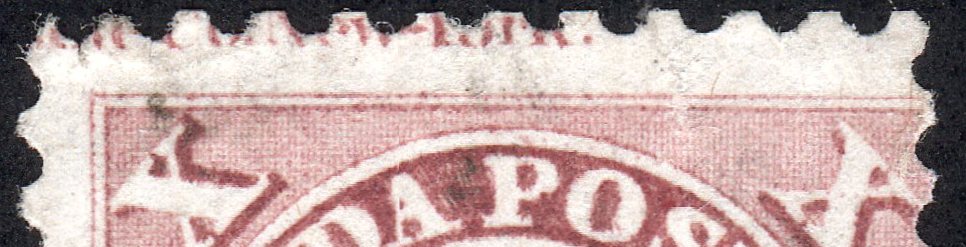
The "String of Pearls" constant plate flaw is from position three and is Unitrade Catalogue 17iv. I thought everyone might like to see the nice copy I just recently acquired. The string of pearls is a dotted line running through the top of the portrait oval into the upper right X. Enjoy the pictures.   |
|
Send note to Staff
|
|
|
|
|
Pillar Of The Community
Canada
1416 Posts |
|
|
Valued Member
Canada
228 Posts |
|
|
Very nice copy Watermark. I am always amazed that I can never see the variety in most auction images for this stamp. But I see now that it is quite subtle and not so easy to show in a scan or photo. I appreciate you providing a visual reference for this classic variety. Since I only have one copy of #17 it did not take long for me to ensure that I did not have the variety. |
Send note to Staff 
|
|
|
Valued Member
Canada
305 Posts |
|
|
Amazing stamp ! Thanks for sharing. Yes, the variety is incredibly subtle !
|
|
Send note to Staff
|
|
|
Rest in Peace
7742 Posts |
|
|
Very nice stamp indeed watermark..Well centered compared to mine and other examples I have seen...Only you would find this stamp...haha
Robert |
|
Send note to Staff
|
|
|
Pillar Of The Community
New Zealand
731 Posts |
|
|
I echo the comments, above. Nice and thank you for sharing.
I'm afraid to admit my ignorance, but I have never focused on plate flaws and have only a rudimentary understanding.
But could someone explain the whole position thing? I see it all the time in Unitrade, but have never understood the numbering.
Perhaps there is a previous post? Or a handy web reference on the positioning numbering?
Thanks |
|
Send note to Staff
|
|
|
Pillar Of The Community
United States
728 Posts |
|
|
Numbering begins with the plate number and or letter. Then starting in the upper left corner you have position 1. The stamps are numbered from left to right in each horizontal row. The next row down is numbered from left to right the sequence of numbers beginning from the last stamp in each row. For a simple example say you are looking at a sheet of 100 stamps laid out in in 10 stamps across by 10 stamps down.
Say the plate is labeled as A-5 (plate A-5) the first horizontal row of stamps are numbered 1 through 10. The next horizontal row is numbered 11 through 20. The next row 21 through 30 and so on until you get to the bottom row which would be numbered 91 through 100. Say there is a re-entry in a stamp in a upper left plate block of six stamps 2 across and 3 down and the second stamp down in the right column is re-entered. It would be numbered: Plate A-5, Position 12. Make a diagram 10 squares across and 10 squares down and number them and you will see you have 100 possible positions. Stamp sheets and panes come in different sizes but the sequence for numbering remains the same you would just have a different number of squares for the layout of the plate used. Hope this helps. |
|
Send note to Staff
|
| Edited by watermark - 11/11/2014 1:03 pm |
|
|
Pillar Of The Community
New Zealand
731 Posts |
|
|
Got it, thanks. I had always ignorantly thought that the position number referred to an imaginary grid above each individual stamp, so you knew generally where the imperfection resided (ie, by the "X" in the stamp above). Now I see that it refers the position each stamp that had a the sheet, so one knows.
So, then the stamp above (Position 3), was the 3rd stamp from the upper left, right?
And lastly, why is this sort of relevant to know the position--seems nice to know but the imperfection or the re-entry is the germane unique aspect, right? Could it be possible that a re-entry hit several positions in a sheet (like #3 and #14 and #25 etc)?
Thanks |
|
Send note to Staff
|
|
|
Valued Member
Canada
228 Posts |
|
|
Hi Tommy,
You are correct that the String of Pearls stamp, at position 3, would indeed be the 3rd stamp from the upper left of the pane.
Because of the way that re-entries occur, following the steel transfer roll being impressed more than once on the plate from which the stamps were printed, it is very unlikely for exactly the same re-entry to occur in different places on the same plate. However, it is quite common on older stamps for there to be very similar re-entries. The position number provides a way to identify similar re-entries (and also dissimilar re-entries) that might not be possible via a written description or image alone. The String of Pearls re-entry is not typical in that it has a very distinctive feature that can easily be applied to describe and name the re-entry.
Most early Canadian re-entries are recognised by similar doubling or marks seen in the reversed (white) text or frame lines of the stamp. It would be very hard to subjectively name and document these without providing the position number on the plate. Of course, having a piece with multiple copies of a stamp and/or some of the identifying selvedge can also be used to identify the plate position and to locate any potential re-entries that may be hard to identify by sight alone.
Sometimes a plate will have more than one major re-entry (considered to be the most or one of the most significant) plus a number of minor re-entries. Using the position number is the only way to identify these, price them, and trade/sell them.
Finally, you should note that position numbers are also relevant to other plate anomalies besides re-entries. Constant plate varieties are also usually noted by their plate position. Checking the position on multiple stamps/panes or examining the plate proofs is sometimes the only way to ensure that certain varieties are "constant". Many modern constant varieties (mostly on non-engraved stamps) occur multiple times on the plate. Identifying their positions and the number of times they occur helps to define a rarity factor and pricing for them.
Hope this is of some help. |
|
Send note to Staff
|
|
|
Pillar Of The Community
United States
1125 Posts |
|
|
The "String of Pearls" (who comes up with some of these names?) is a fairly subtle re-entry. If you didn't know you were looking for it, you probably wouldn't even notice it. Nice margins on that one. Another example:  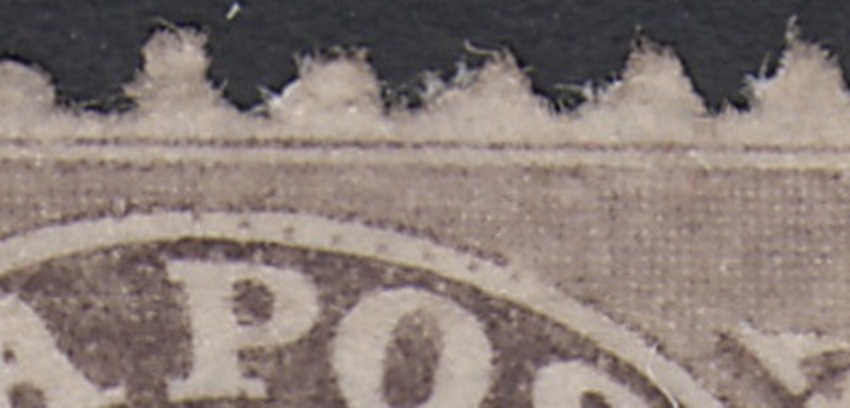 |
|
Send note to Staff
|
|
|
Pillar Of The Community
United States
728 Posts |
|
|
The "String of Pearls" is a constant plate flaw and not a re-entry.
According to Boggs THE POSTAGE STAMPS OF CANADA page 197: Flaws "String of pearls." This is known on the proofs and has been seen on nearly all printings.
As a plate flaw it will only be found on position #3 of the plate. |
|
Send note to Staff
|
|
|
Valued Member
Canada
228 Posts |
|
|
Yes, Watermark is quite correct in pointing out that the String of Pearls is not a re-entry. My mistake for referring to it as such.
However, the information I posted for Tommy is still accurate. The String of Pearls variety falls into the last paragraph of my post where I mention other plate anomalies such as constant plate varieties.
In case there is any confusion based on Watermark's last post, it should be noted that re-entries can also appear on plate proofs.
Cheers! |
|
Send note to Staff
|
|
|
Pillar Of The Community
United States
728 Posts |
|
|
Sorry Scottamer my post was not directed toward yours as you wrote a very good explanation. It was directed to the post by Chipg who shows a very nice example but referred to it as a "fairly subtle re-entry" which it is not. |
|
Send note to Staff
|
|
|
Pillar Of The Community
United States
1125 Posts |
|
|
sorry
you're right, of course.
probably caused by something hitting the plate during it's creation, as it is known on the proofs.
C. |
|
Send note to Staff
|
|
|
Rest in Peace
7742 Posts |
|
|
Pillar Of The Community
United States
728 Posts |
|
|
Replies: 18 / Views: 4,489 |
|




 Posted 11/10/2014 8:06 pm